de Cea Marc, Wollman Emma E, Atabaki Amir H, Gray Dodd J, Shaw Matthew D, Ram Rajeev J
Research Laboratory of Electronics, Massachusetts Institute of Technology, Cambridge, MA, 02139, USA.
Jet Propulsion Laboratory, California Institute of Technology, Pasadena, CA, 91109, USA.
Sci Rep. 2020 Jun 11;10(1):9470. doi: 10.1038/s41598-020-65971-5.
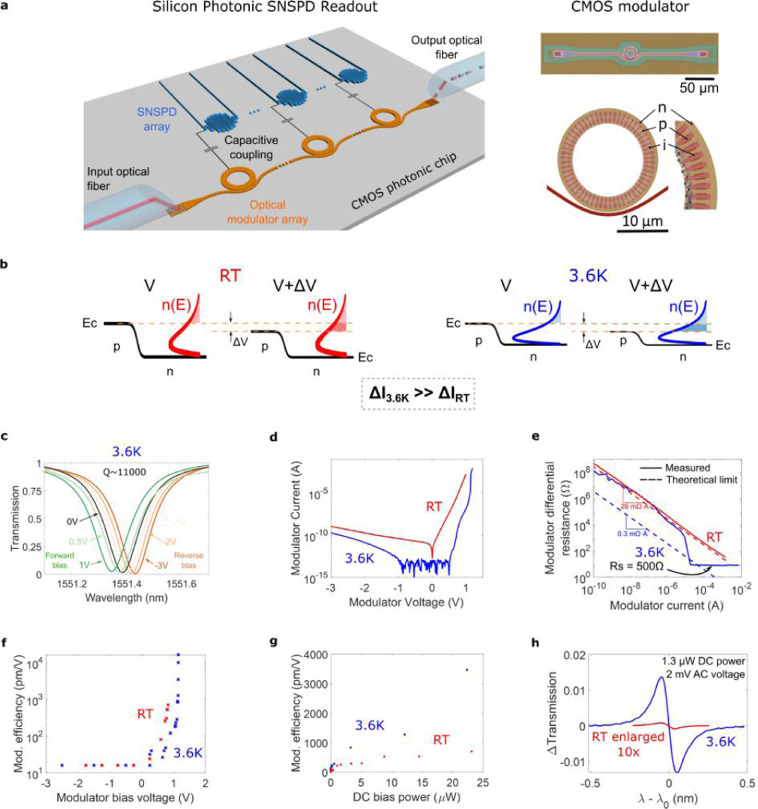
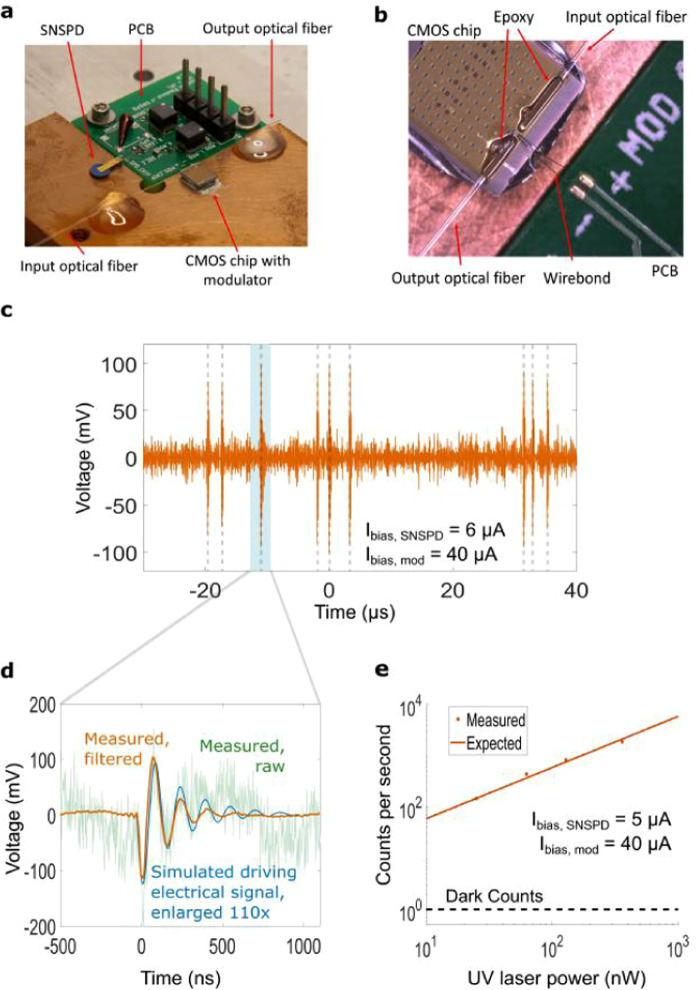
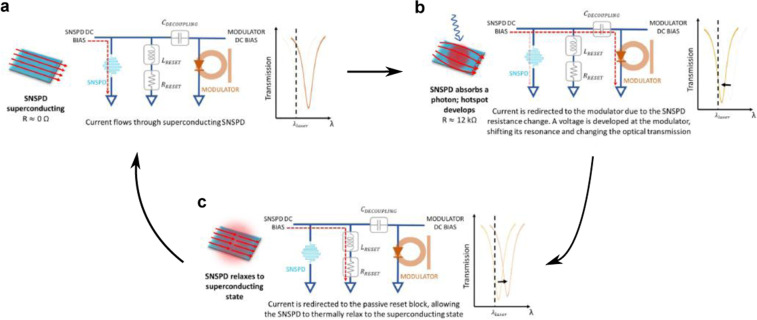
Scalable, low power, high speed data transfer between cryogenic (0.1-4 K) and room temperature environments is essential for the realization of practical, large-scale systems based on superconducting technologies. A promising approach to overcome the limitations of conventional wire-based readout is the use of optical fiber communication. Optical fiber presents a 100-1,000x lower heat load than conventional electrical wiring, relaxing the requirements for thermal anchoring, and is also immune to electromagnetic interference, which allows routing of sensitive signals with improved robustness to noise and crosstalk. Most importantly, optical fibers allow for very high bandwidth densities (in the Tbps/mm range) by carrying multiple signals through the same physical fiber (Wavelength Division Multiplexing, WDM). Here, we demonstrate for the first time optical readout of a superconducting nanowire single-photon detector (SNSPD) directly coupled to a CMOS photonic modulator, without the need for an interfacing device. By operating the modulator in the forward bias regime at a temperature of 3.6 K, we achieve very high modulation efficiency (1,000-10,000 pm/V) and a low input impedance of 500 Ω with a low power dissipation of 40 μW. This allows us to obtain optical modulation with the low, millivolt-level signal generated by the SNSPD.
在低温(0.1 - 4K)和室温环境之间实现可扩展、低功耗、高速的数据传输,对于基于超导技术的实用大规模系统的实现至关重要。克服传统基于电线读出方式局限性的一种有前景的方法是使用光纤通信。光纤的热负载比传统电线低100 - 1000倍,减轻了热锚定的要求,并且还不受电磁干扰,这使得敏感信号的路由对噪声和串扰具有更高的鲁棒性。最重要的是,光纤通过在同一物理光纤中传输多个信号(波分复用,WDM),可实现非常高的带宽密度(在Tbps/mm范围内)。在此,我们首次展示了直接耦合到CMOS光子调制器的超导纳米线单光子探测器(SNSPD)的光学读出,无需接口设备。通过在3.6K的温度下在前向偏置状态下操作调制器,我们实现了非常高的调制效率(1000 - 10000 pm/V)和500Ω的低输入阻抗,功耗为40μW。这使我们能够利用SNSPD产生的低至毫伏级的信号获得光调制。