Zhang Yantao, Sun Yong, Zhang Qiwen
Department of Two Gland Surgery, Jinan People's Hospital Affiliated to Shandong First Medical University, Jinan, Shandong 271100 China.
Cancer Cell Int. 2020 Jun 9;20:224. doi: 10.1186/s12935-020-01308-6. eCollection 2020.
Although previous studies have evaluated the prognostic role of the systemic immune-inflammation index (SII) in patients with breast cancer, the results were inconsistent. Therefore, in this context, we aimed to identify the prognostic and clinicopathological value of the SII in patients with breast cancer by performing a meta-analysis.
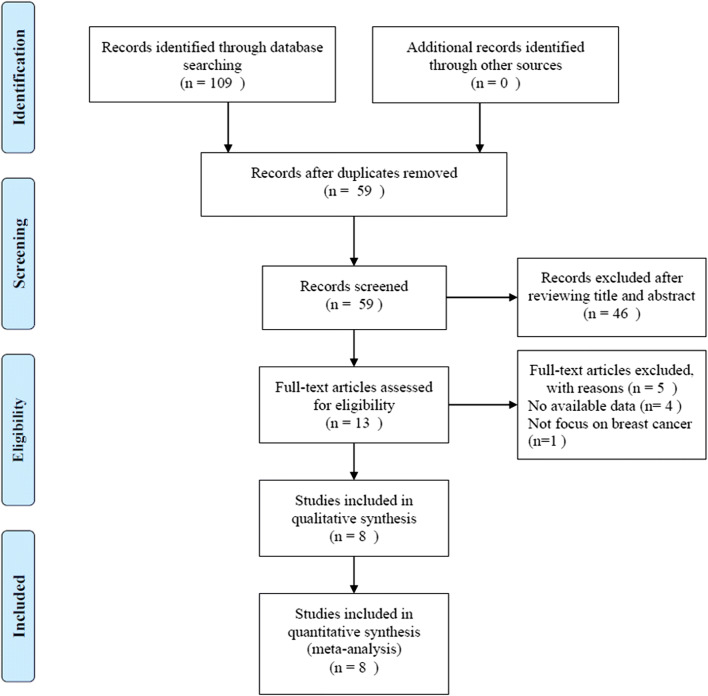
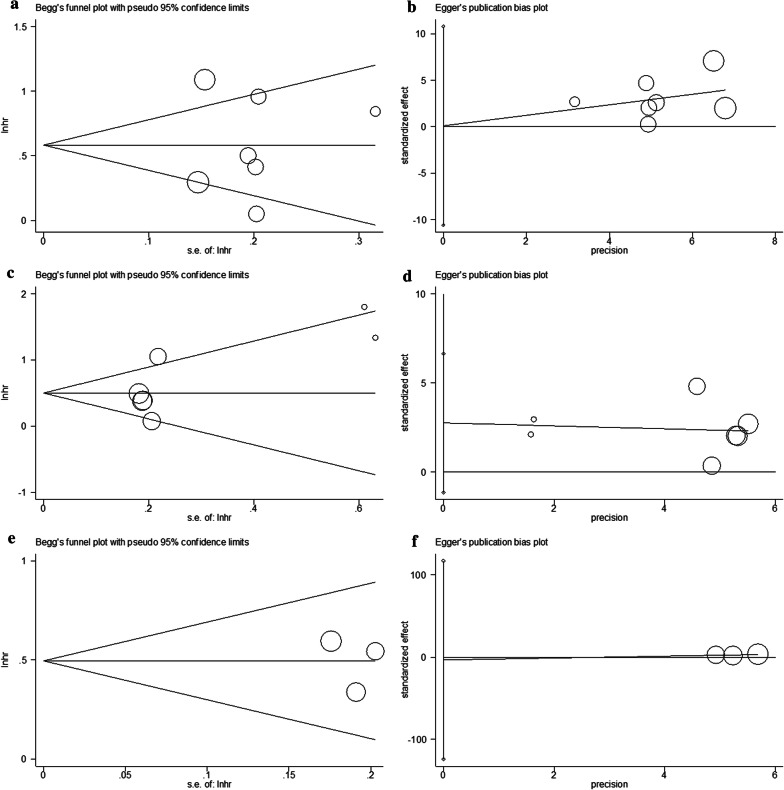
A literature search was using PubMed, Web of Science, EMBASE, and Cochrane Library databases for relevant articles, from their inception to May 12, 2020. The prognostic value of the SII in breast cancer was assessed by pooling the hazard ratios (HRs) with 95% confidence intervals (CIs). The clinical outcomes included the overall survival (OS), disease-free survival (DFS), recurrence-free survival (RFS), and distant metastasis-free survival (DMFS). The methodological quality of all the included studies was evaluated using the Newcastle-Ottawa quality assessment scale. The odds ratios (ORs) with 95% CIs were combined to evaluate the correlation between the SII and clinicopathological characteristics of patients with breast cancer. Publication bias was evaluated using the Begg funnel plot and the Egger linear regression test. All statistical analyses were performed using Stata software, version 12.0 (Stata Corporation, College Station, TX, USA). A value of < 0.05 was considered statistically significant.
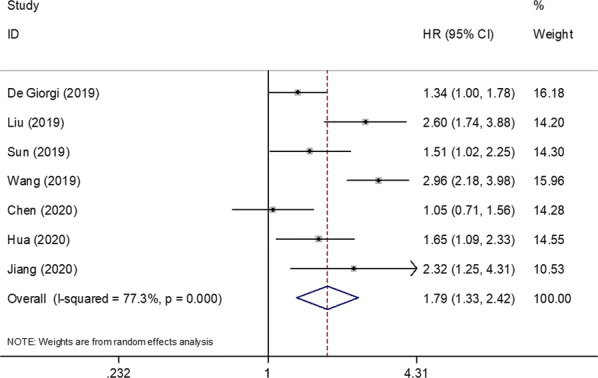
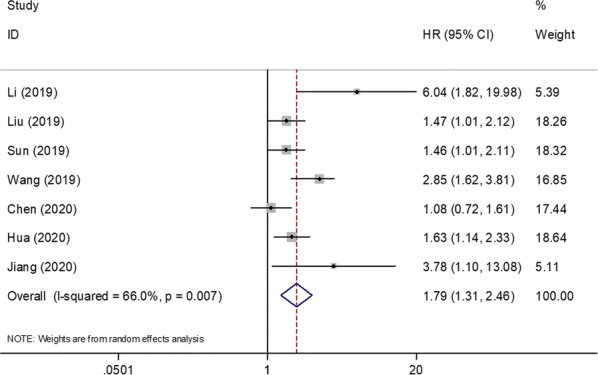
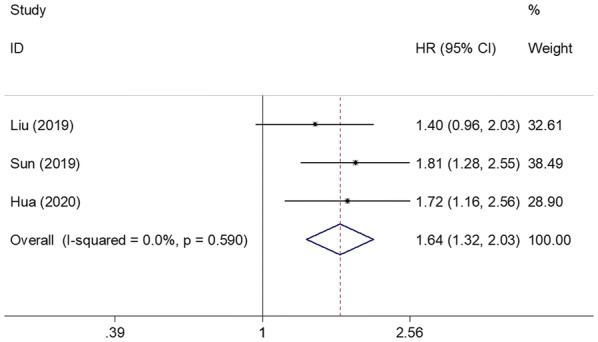
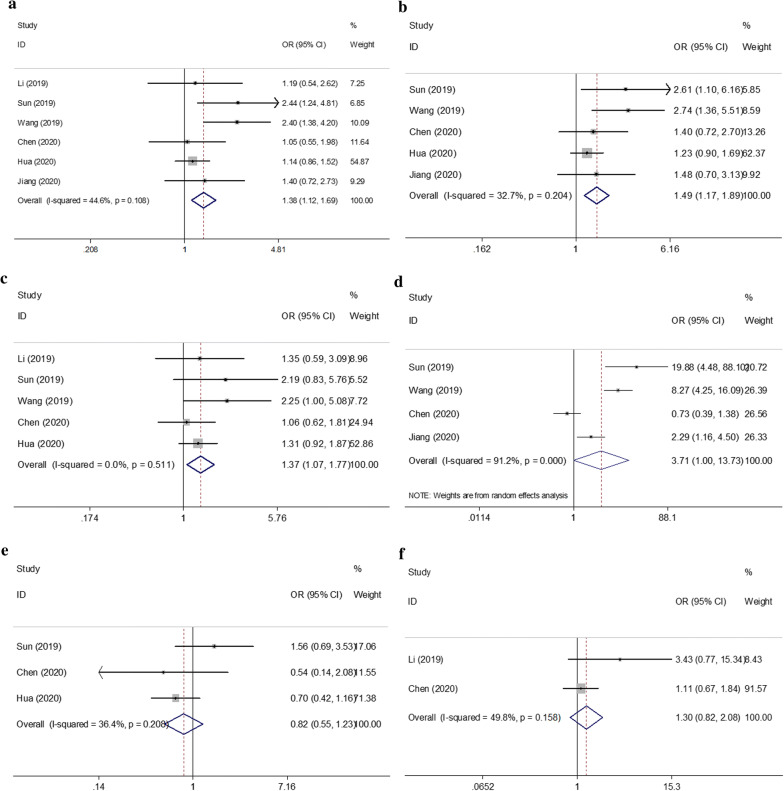
Eight studies involving 2642 patients were included in the current meta-analysis. The combined data showed that patients with a high SII had worse OS (HR = 1.79, 95% CI 1.33-2.42, p < 0.001), poorer DFS/RFS (HR = 1.79, 95% CI 1.31-2.46, p < 0.001), and inferior DMFS (HR = 1.64, 95% CI 1.32-2.03, p < 0.001) than patients with a low SII. In addition, a high SII was correlated with the presence of lymph node metastasis (OR = 1.38, 95% CI 1.12-1.69, p = 0.002), higher T stage (OR = 1.49, 95% CI 1.17-1.89, p < 0.001), advanced TNM stage (OR = 1.37, 95% CI 1.07-1.77, p = 0.014), and higher histological grade (OR = 3.71, 95% CI 1.00-13.73, p = 0.049). However, there was no significant association between the SII and the pathological type (OR = 0.82, 95% CI 0.55-1.23, p = 0.345) or lymphatic invasion (OR = 1.30, 95% CI 0.82-2.08, p = 0.266).
The results of our meta-analysis suggest that an elevated SII predicts poor survival outcomes and is associated with clinicopathological features that indicate tumor progression of breast cancer.
尽管先前的研究评估了全身免疫炎症指数(SII)在乳腺癌患者中的预后作用,但结果并不一致。因此,在此背景下,我们旨在通过进行荟萃分析来确定SII在乳腺癌患者中的预后及临床病理价值。
使用PubMed、Web of Science、EMBASE和Cochrane图书馆数据库进行文献检索,检索时间从数据库建立至2020年5月12日。通过汇总风险比(HR)及95%置信区间(CI)来评估SII在乳腺癌中的预后价值。临床结局包括总生存期(OS)、无病生存期(DFS)、无复发生存期(RFS)和无远处转移生存期(DMFS)。使用纽卡斯尔-渥太华质量评估量表评估所有纳入研究的方法学质量。合并95%CI的比值比(OR)来评估SII与乳腺癌患者临床病理特征之间的相关性。使用Begg漏斗图和Egger线性回归检验评估发表偏倚。所有统计分析均使用Stata软件12.0版(美国德克萨斯州大学站市Stata公司)进行。P值<0.05被认为具有统计学意义。
本荟萃分析纳入了8项研究,共2642例患者。合并数据显示,与SII低的患者相比,SII高的患者OS更差(HR=1.79,95%CI 1.33-2.42,P<0.001),DFS/RFS更差(HR=1.79,95%CI 1.31-2.46,P<0.001),DMFS更差(HR=1.64,95%CI 1.32-2.03,P<0.001)。此外,SII高与淋巴结转移(OR=1.38,95%CI 1.12-1.69,P=0.002)、更高的T分期(OR=1.49,95%CI 1.17-1.89,P<0.001)、晚期TNM分期(OR=1.37,95%CI 1.07-1.77,P=0.014)以及更高的组织学分级(OR=3.71,95%CI 1.00-13.73,P=0.049)相关。然而,SII与病理类型(OR=0.82,95%CI 0.55-1.23,P=0.345)或淋巴管侵犯(OR=1.30,95%CI 0.82-2.08,P=0.266)之间无显著关联。
我们的荟萃分析结果表明,SII升高预示着生存结局不良,且与提示乳腺癌肿瘤进展的临床病理特征相关。