Fowler Eileen G, Oppenheim William L, Greenberg Marcia B, Staudt Loretta A, Joshi Shantanu H, Silverman Daniel H S
Center for Cerebral Palsy, Department of Orthopaedic Surgery, University of California, Los Angeles, Los Angeles, CA, United States.
Tarjan Center at UCLA, Los Angeles, CA, United States.
Front Hum Neurosci. 2020 May 25;14:159. doi: 10.3389/fnhum.2020.00159. eCollection 2020.
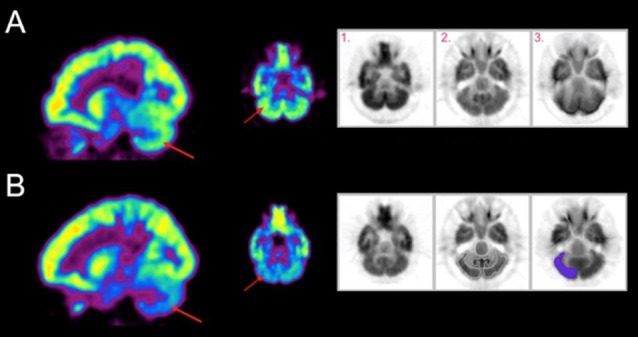
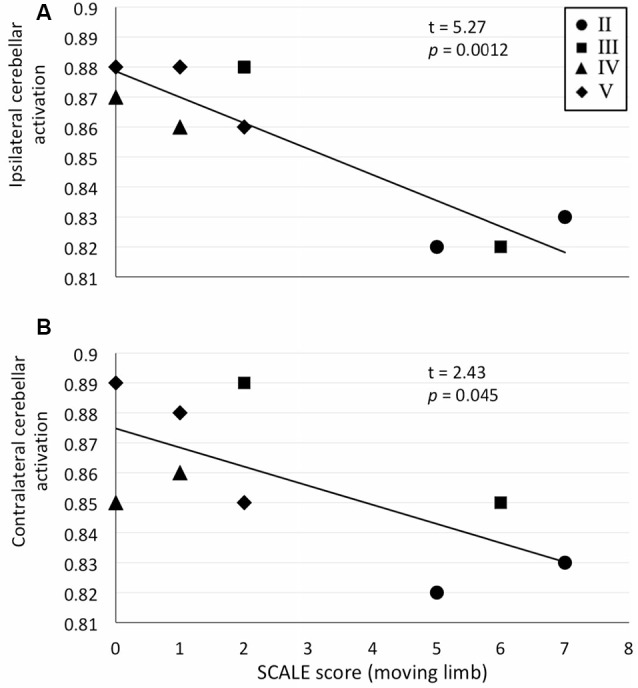
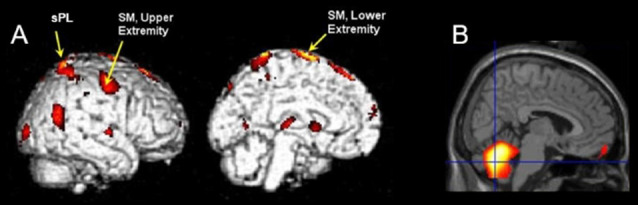
Reduced selective voluntary motor control (SVMC) is a primary impairment due to corticospinal tract (CST) injury in spastic cerebral palsy (CP). There are few studies of brain metabolism in CP and none have examined brain metabolism during a motor task. Nine children with bilateral spastic CP [Age: 6-11 years, Gross Motor Function Classification System (GMFCS) Levels II-V] completed this study. SVMC was evaluated using Selective Control Assessment of the Lower Extremity (SCALE) ranging from 0 (absent) to 10 (normal). Brain metabolism was measured using positron emission tomography (PET) scanning in association with a selective ankle motor task. Whole brain activation maps as well as ROI averaged metabolic activity were correlated with SCALE scores. The contralateral sensorimotor and superior parietal cortex were positively correlated with SCALE scores ( < 0.0005). In contrast, a negative correlation of metabolic activity with SCALE was found in the cerebellum ( < 0.0005). Subsequent ROI analysis showed that both ipsilateral and contralateral cerebellar metabolism correlated with SCALE but the relationship for the ipsilateral cerebellum was stronger ( = 0.80, < 0.001 vs. = 0.46, = 0.045). Decreased cortical and increased cerebellar activation in children with less SVMC may be related to task difficulty, activation of new motor learning paradigms in the cerebellum and potential engagement of alternative motor systems when CSTs are focally damaged. These results support SCALE as a clinical correlate of neurological impairment.
选择性随意运动控制(SVMC)降低是痉挛型脑瘫(CP)中皮质脊髓束(CST)损伤导致的主要损害。关于脑瘫脑代谢的研究较少,且尚无研究在运动任务期间检测脑代谢。九名双侧痉挛型脑瘫儿童[年龄:6 - 11岁,粗大运动功能分类系统(GMFCS)II - V级]完成了本研究。使用下肢选择性控制评估(SCALE)评估SVMC,范围从0(无)到10(正常)。结合选择性踝关节运动任务,使用正电子发射断层扫描(PET)测量脑代谢。全脑激活图以及感兴趣区域(ROI)平均代谢活性与SCALE评分相关。对侧感觉运动皮层和顶上叶皮层与SCALE评分呈正相关(<0.0005)。相比之下,小脑的代谢活性与SCALE呈负相关(<0.0005)。随后的ROI分析表明,同侧和对侧小脑代谢均与SCALE相关,但同侧小脑的关系更强(=0.80,<0.001,而=0.46,=0.045)。SVMC较低的儿童皮质激活减少和小脑激活增加可能与任务难度、小脑中新运动学习范式的激活以及CST局部受损时替代运动系统的潜在参与有关。这些结果支持SCALE作为神经损伤的临床相关指标。