Robitzsch Alexander, Lüdtke Oliver, Goldhammer Frank, Kroehne Ulf, Köller Olaf
IPN - Leibniz Institute for Science and Mathematics Education, Kiel, Germany.
Centre for International Student Assessment (ZIB), Kiel, Germany.
Front Psychol. 2020 May 26;11:884. doi: 10.3389/fpsyg.2020.00884. eCollection 2020.
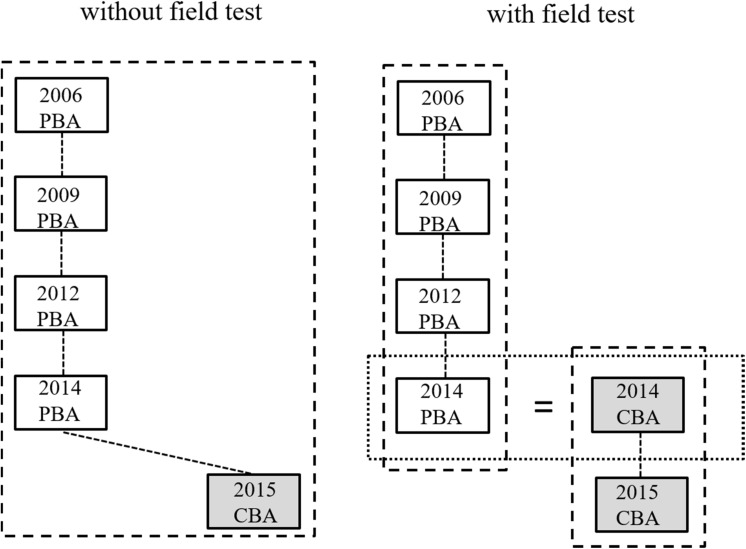
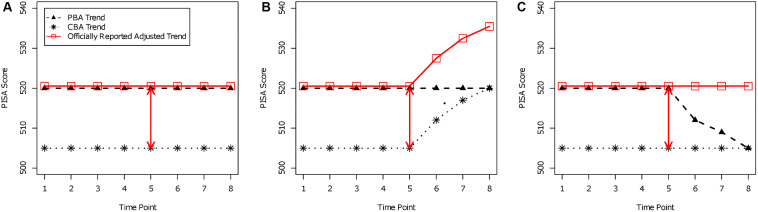
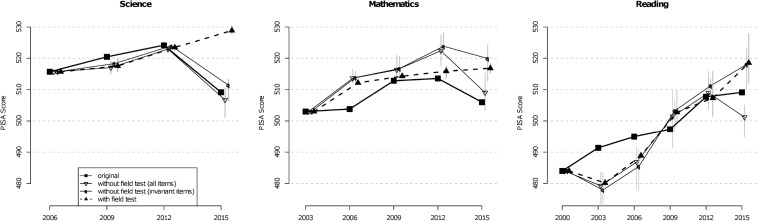
International large-scale assessments, such as the Program for International Student Assessment (PISA), are conducted to provide information on the effectiveness of education systems. In PISA, the target population of 15-year-old students is assessed every 3 years. Trends show whether competencies have changed in the countries between PISA cycles. In order to provide valid trend estimates, it is desirable to retain the same test conditions and statistical methods in all PISA cycles. In PISA 2015, however, the test mode changed from paper-based to computer-based tests, and the scaling method was changed. In this paper, we investigate the effects of these changes on trend estimation in PISA using German data from all PISA cycles (2000-2015). Our findings suggest that the change from paper-based to computer-based tests could have a severe impact on trend estimation but that the change of the scaling model did not substantially change the trend estimates.
开展国际大规模评估,如国际学生评估项目(PISA),旨在提供有关教育系统有效性的信息。在PISA中,每3年对15岁学生这一目标群体进行评估。趋势显示了各国在PISA各轮评估期间能力是否发生了变化。为了提供有效的趋势估计,最好在所有PISA轮次中保持相同的测试条件和统计方法。然而,在2015年的PISA中,测试模式从纸质测试改为计算机测试,并且评分方法也发生了变化。在本文中,我们使用PISA所有轮次(2000 - 2015年)的德国数据,研究这些变化对PISA趋势估计的影响。我们的研究结果表明,从纸质测试到计算机测试的转变可能对趋势估计产生严重影响,但评分模型的变化并未实质性改变趋势估计。