Conservation Ecology Group, Groningen Institute for Evolutionary Life Sciences (GELIFES), Univ. of Groningen, Groningen, The Netherlands.
Department of Animal Ecology, Netherlands Institute of Ecology (NIOO-KNAW), Wageningen, The Netherlands.
Oecologia. 2020 Jun;193(2):285-297. doi: 10.1007/s00442-020-04682-0. Epub 2020 Jun 11.
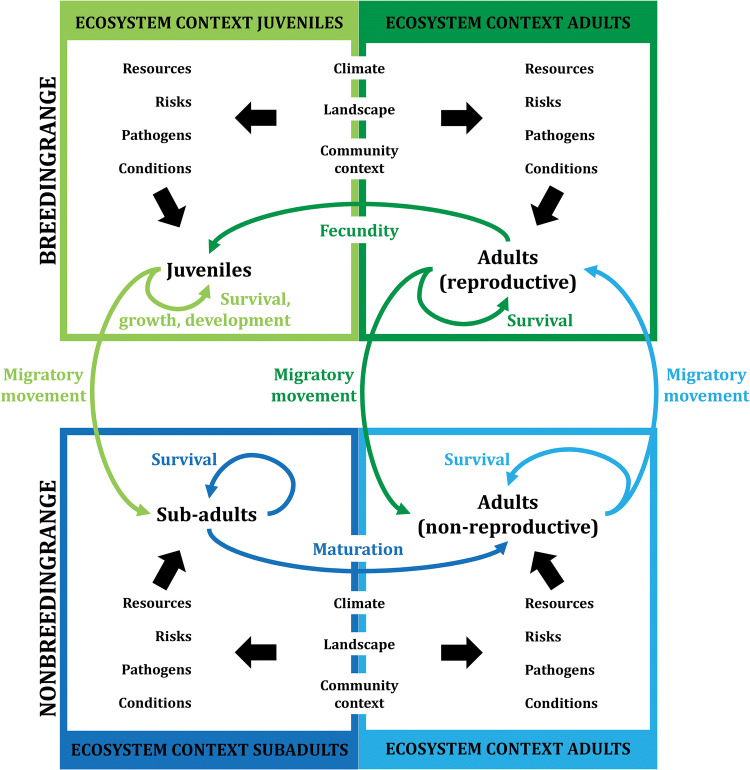
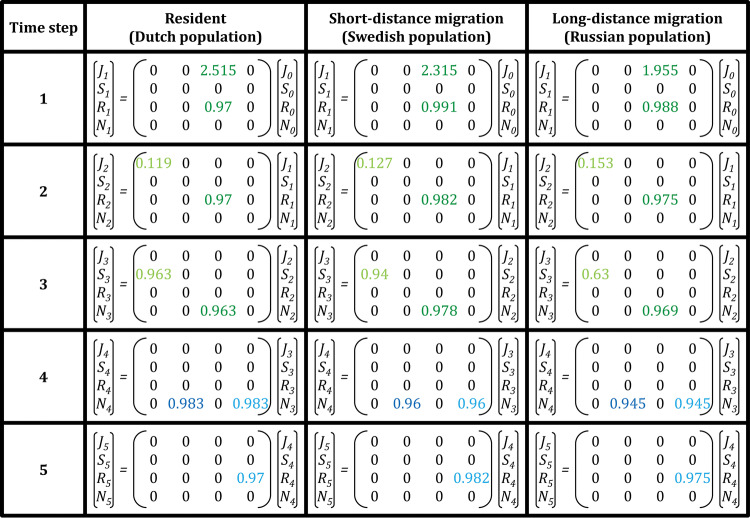
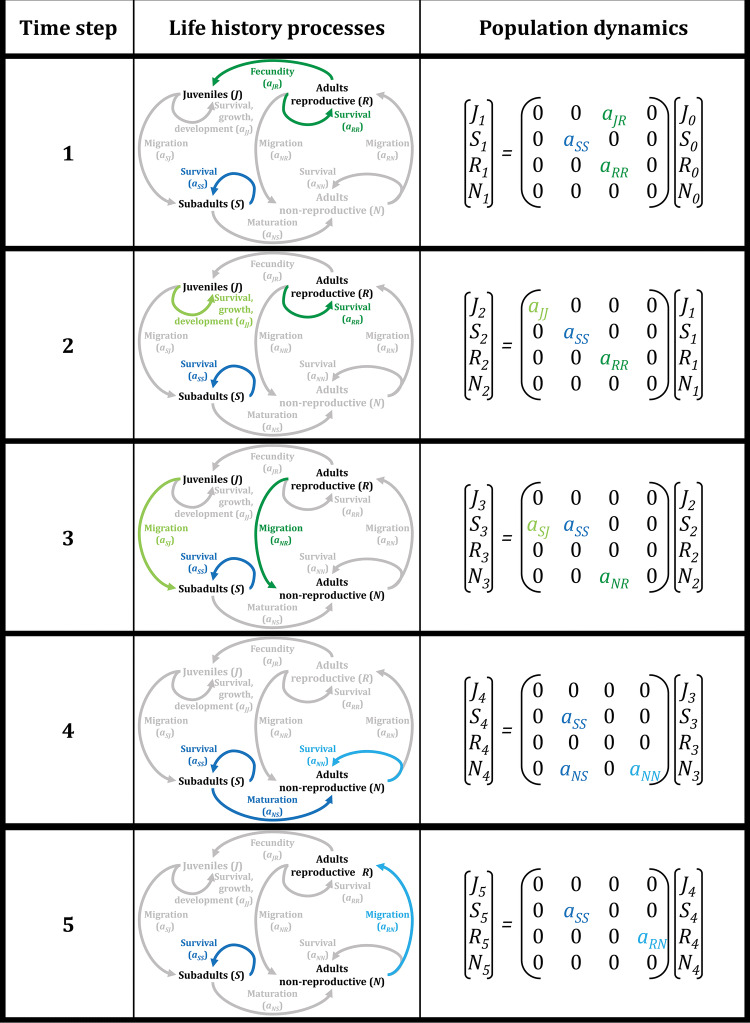
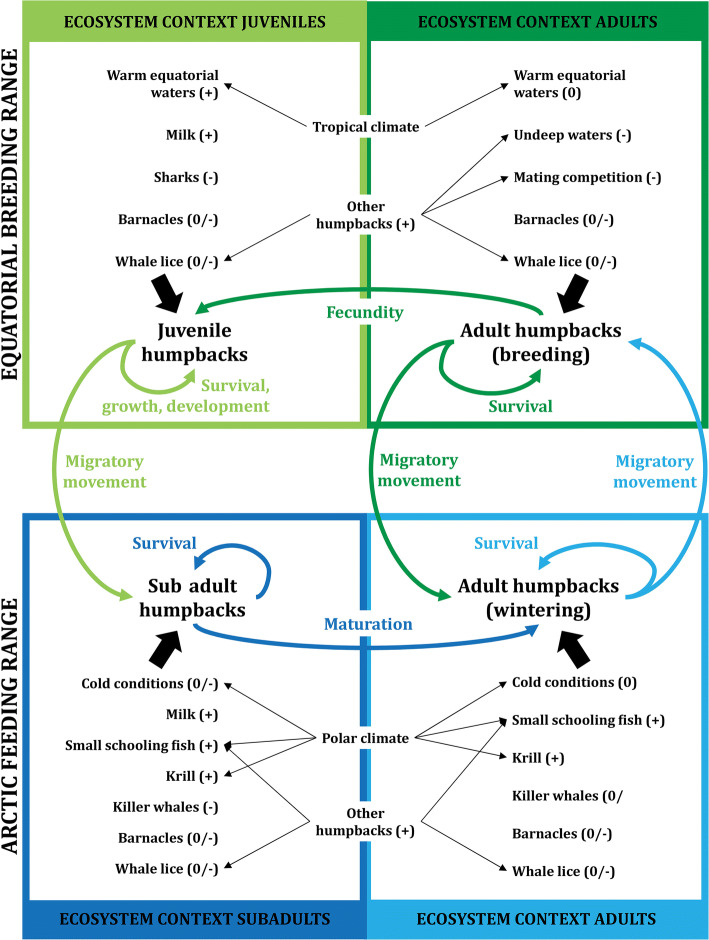
Ontogenetic niche shifts have helped to understand population dynamics. Here we show that ontogenetic niche shifts also offer an explanation, complementary to traditional concepts, as to why certain species show seasonal migration. We describe how demographic processes (survival, reproduction and migration) and associated ecological requirements of species may change with ontogenetic stage (juvenile, adult) and across the migratory range (breeding, non-breeding). We apply this concept to widely different species (dark-bellied brent geese (Branta b. bernicla), humpback whales (Megaptera novaeangliae) and migratory Pacific salmon (Oncorhynchus gorbuscha) to check the generality of this hypothesis. Consistent with the idea that ontogenetic niche shifts are an important driver of seasonal migration, we find that growth and survival of juvenile life stages profit most from ecological conditions that are specific to breeding areas. We suggest that matrix population modelling techniques are promising to detect the importance of the ontogenetic niche shifts in maintaining migratory strategies. As a proof of concept, we applied a first analysis to resident, partial migratory and fully migratory populations of barnacle geese (Branta leucopsis). We argue that recognition of the costs and benefits of migration, and how these vary with life stages, is important to understand and conserve migration under global environmental change.
个体发育生态位转移有助于理解种群动态。在这里,我们表明,个体发育生态位转移也提供了一个解释,补充了传统概念,说明为什么某些物种表现出季节性迁徙。我们描述了物种的人口过程(生存、繁殖和迁移)和相关的生态需求如何随着个体发育阶段(幼体、成体)和迁徙范围(繁殖、非繁殖)而变化。我们将这一概念应用于广泛不同的物种(暗腹滨鹬(Branta b. bernicla)、座头鲸(Megaptera novaeangliae)和洄游太平洋三文鱼(Oncorhynchus gorbuscha),以检验这一假设的普遍性。与个体发育生态位转移是季节性迁徙的重要驱动因素的观点一致,我们发现幼体生命阶段的生长和存活率最受益于特定于繁殖区的生态条件。我们建议,矩阵种群建模技术是检测维持迁徙策略的个体发育生态位转移的重要性的有前途的方法。作为一个概念验证,我们对滨鹬(Branta leucopsis)的留居、部分迁徙和完全迁徙种群进行了首次分析。我们认为,认识到迁徙的成本和收益,以及这些成本和收益如何随生命阶段而变化,对于在全球环境变化下理解和保护迁徙是很重要的。