Department of Experimental Diagnostic and Specialty Medicine (DIMES), Nephrology, Dialysis and Renal Transplant Unit, S. Orsola-Malpighi Hospital, University of Bologna, 40138 Bologna, Italy.
Department of General Surgery and Transplantation, S. Orsola-Malpighi Hospital, University of Bologna, 40138 Bologna, Italy.
Medicina (Kaunas). 2020 Jun 10;56(6):284. doi: 10.3390/medicina56060284.
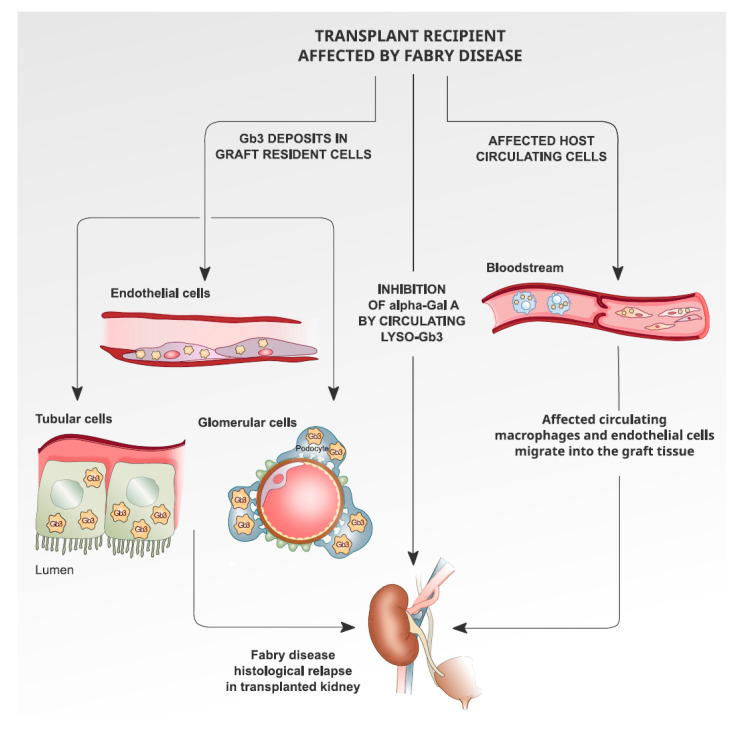
Fabry disease is classified as a rare X-linked disease caused by a complete or partial defect of enzyme alpha-galactosidase, due to gene mutations. This disorder leads to intracellular globotriaosylceramide (Gb3) deposition associated with increased Gb3 plasma levels. Most of the symptoms of the disease, involving kidneys, heart and nervous system, result from this progressive Gb3 deposition. The incidence is estimated in 1/50,000 to 1/117,000 in males. Fabry nephropathy begins with microalbuminuria and/or proteinuria, which, in the classic form, appear from childhood. Thus, a progressive decline of renal function can start at a young age, and evolve to kidney failure, requiring dialysis or renal transplantation. Enzyme replacement therapy (ERT), available since 2001 for Fabry disease, has been increasingly introduced into the clinical practice, with overall positive short-term and long-term effects in terms of ventricular hypertrophy and renal function. Kidney transplantation represents a relevant therapeutic option for Fabry nephropathy management, for patients reaching end-stage renal disease, but little is known about long-term outcomes, overall patient survival or the possible role of ERT after transplant. The purpose of this review is to analyze the literature on every aspect related to kidney transplantation in patients with Fabry nephropathy: from the analysis of transplant outcomes, to the likelihood of disease recurrence, up to the effects of ERT and its possible interference with immunosuppression.
法布瑞病被归类为一种罕见的 X 连锁疾病,由α-半乳糖苷酶的完全或部分缺陷引起,这是由于基因突变所致。这种疾病会导致细胞内神经酰胺三己糖苷(Gb3)沉积,并伴有 Gb3 血浆水平升高。该病的大多数症状涉及肾脏、心脏和神经系统,均由这种进行性 Gb3 沉积引起。该病的发病率估计为每 50000 至 117000 名男性中有 1 例。法布瑞肾病始于微量白蛋白尿和/或蛋白尿,在经典形式中,这种蛋白尿从儿童期开始出现。因此,肾功能的进行性下降可能在年轻时就开始,并发展为肾衰竭,需要透析或肾移植。酶替代疗法(ERT)自 2001 年以来可用于治疗法布瑞病,已越来越多地被引入临床实践,在心室肥厚和肾功能方面具有总体积极的短期和长期效果。对于终末期肾病患者,肾移植是法布瑞肾病管理的一个重要治疗选择,但对于长期结果、总体患者存活率或移植后 ERT 的可能作用知之甚少。本综述的目的是分析与法布瑞肾病患者肾移植相关的各个方面的文献:从移植结果分析,到疾病复发的可能性,再到 ERT 的效果及其对免疫抑制的可能干扰。