Zhang Lijie, Makamure Joyman, Zhao Dan, Liu Yiming, Guo Xiaopeng, Zheng Chuansheng, Liang Bin
Department of Radiology, Hubei Key Laboratory of Molecular Imaging, Union Hospital, Tongji Medical College, Huazhong University of Science and Technology, Wuhan, Hubei 430022, P.R. China.
Exp Ther Med. 2020 Jul;20(1):427-435. doi: 10.3892/etm.2020.8722. Epub 2020 May 6.
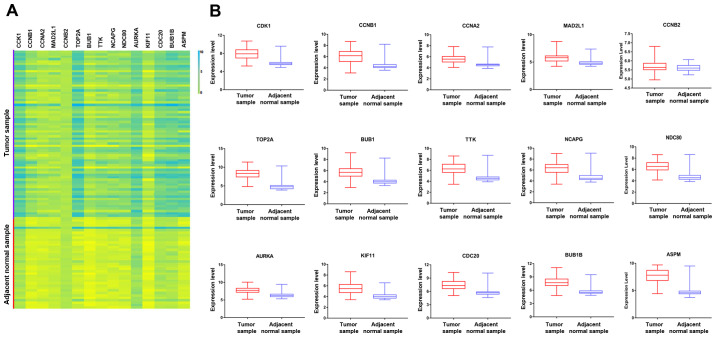
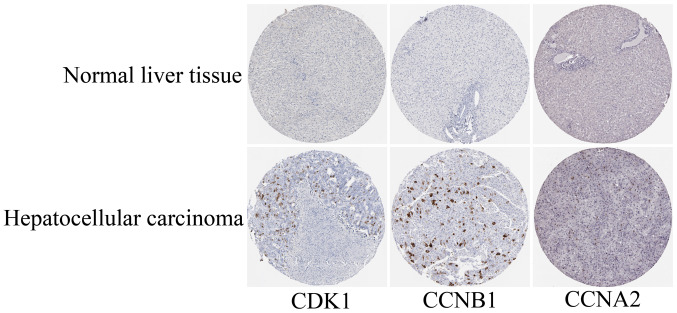
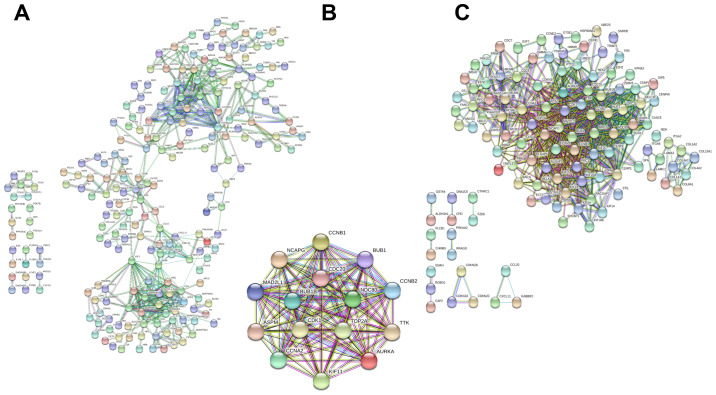
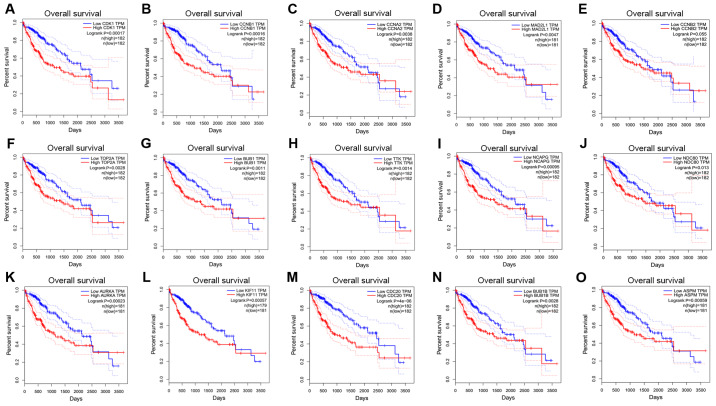
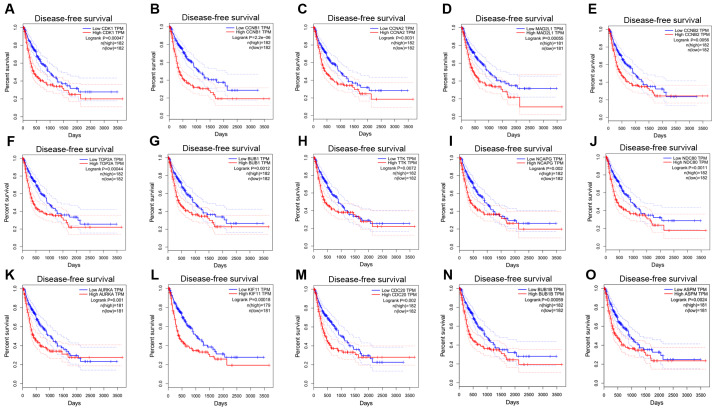
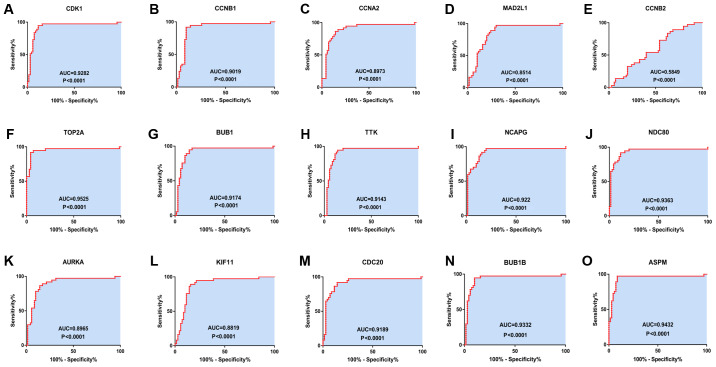
Hepatocellular carcinoma (HCC) is the most common type of malignant neoplasm of the liver with high morbidity and mortality. Extensive research into the pathology of HCC has been performed; however, the molecular mechanisms underlying the development of hepatitis B virus-associated HCC have remained elusive. Thus, the present study aimed to identify critical genes and pathways associated with the development and progression of HCC. The expression profiles of the GSE121248 dataset were downloaded from the Gene Expression Omnibus database and the differentially expressed genes (DEGs) were identified. Gene Ontology (GO) and Kyoto Encyclopedia of Gene and Genome (KEGG) analyses were performed by using the Database for Annotation, Visualization and Integrated Discovery. Subsequently, protein-protein interaction (PPI) networks were constructed for detecting hub genes. In the present study, 1,153 DEGs (777 upregulated and 376 downregulated genes) were identified and the PPI network yielded 15 hub genes. GO analysis revealed that the DEGs were primarily enriched in 'protein binding', 'cytoplasm' and 'extracellular exosome'. KEGG analysis indicated that DEGs were accumulated in 'metabolic pathways', 'chemical carcinogenesis' and 'fatty acid degradation'. After constructing the PPI network, cyclin-dependent kinase 1, cyclin B1, cyclin A2, mitotic arrest deficient 2 like 1, cyclin B2, DNA topoisomerase IIα, budding uninhibited by benzimidazoles (BUB)1, TTK protein kinase, non-SMC condensin I complex subunit G, NDC80 kinetochore complex component, aurora kinase A, kinesin family member 11, cell division cycle 20, BUB1B and abnormal spindle microtubule assembly were identified as hub genes based on the high degree of connectivity by using Cytoscape software. In addition, overall survival (OS) and disease-free survival (DFS) analyses were performed using the Gene Expression Profiling Interactive Analysis online database, which revealed that the increased expression of all hub genes were associated with poorer OS and DFS outcomes. Receiver operating characteristic curves were constructed using GraphPad prism 7.0 software. The results confirmed that 15 hub genes were able to distinguish HCC form normal tissues. Furthermore, the expression levels of three key genes were analyzed in tumor and normal samples of the Human Protein Atlas database. The present results may provide further insight into the underlying mechanisms of HCC and potential therapeutic targets for the treatment of this disease.
肝细胞癌(HCC)是肝脏最常见的恶性肿瘤类型,发病率和死亡率都很高。人们已经对HCC的病理学进行了广泛研究;然而,乙型肝炎病毒相关HCC发生发展的分子机制仍不清楚。因此,本研究旨在确定与HCC发生发展相关的关键基因和通路。从基因表达综合数据库下载GSE121248数据集的表达谱,并鉴定差异表达基因(DEG)。使用注释、可视化和综合发现数据库进行基因本体(GO)和京都基因与基因组百科全书(KEGG)分析。随后,构建蛋白质-蛋白质相互作用(PPI)网络以检测枢纽基因。在本研究中,鉴定出1153个DEG(777个上调基因和376个下调基因),PPI网络产生了15个枢纽基因。GO分析显示,DEG主要富集于“蛋白质结合”、“细胞质”和“细胞外囊泡”。KEGG分析表明,DEG在“代谢途径”、“化学致癌作用”和“脂肪酸降解”中积累。构建PPI网络后,使用Cytoscape软件基于高连接度将细胞周期蛋白依赖性激酶1、细胞周期蛋白B1、细胞周期蛋白A2、有丝分裂阻滞缺陷2样1、细胞周期蛋白B2、DNA拓扑异构酶IIα、苯并咪唑不抑制的出芽(BUB)1、TTK蛋白激酶、非SMC凝聚素I复合体亚基G、NDC80动粒复合体成分、极光激酶A、驱动蛋白家族成员11、细胞分裂周期20、BUB1B和异常纺锤体微管组装鉴定为枢纽基因。此外,使用在线基因表达谱交互式分析数据库进行总生存(OS)和无病生存(DFS)分析,结果显示所有枢纽基因表达增加均与较差的OS和DFS结果相关。使用GraphPad prism 7.0软件构建受试者工作特征曲线。结果证实,15个枢纽基因能够区分HCC和正常组织。此外,在人类蛋白质图谱数据库的肿瘤和正常样本中分析了三个关键基因的表达水平。本研究结果可能为深入了解HCC的潜在机制以及该病治疗的潜在靶点提供进一步的线索。