Zhao Ye, Zhang Tian-Ran, Li Qian, Feng Lin, Liu Yang, Jiang Wei-Dan, Wu Pei, Zhao Juan, Zhou Xiao-Qiu, Jiang Jun
College of Animal Science and Technology, Sichuan Agricultural University, Chengdu, 611130, China.
Animal Nutrition Institute, Sichuan Agricultural University, Chengdu, 611130, China.
Anim Nutr. 2020 Jun;6(2):198-209. doi: 10.1016/j.aninu.2020.02.003. Epub 2020 Mar 25.
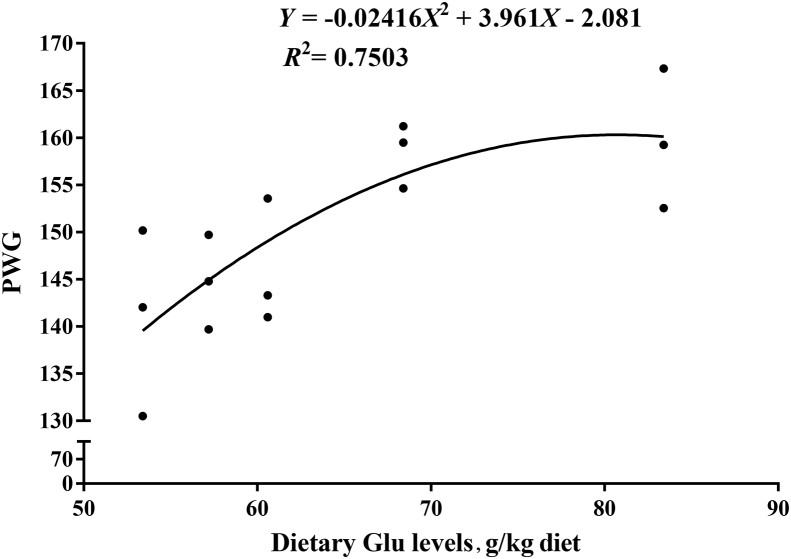
The present study explored effects of -glutamate (Glu) levels on growth, digestive and absorptive capability, and intestinal physical barrier functions of Jian carp (). A total of 600 Jian carp (126.40 ± 0.21 g) were randomly distributed into 5 groups with 3 replicates each, fed diets containing graded levels of Glu (53.4 [control], 57.2, 60.6, 68.4, and 83.4 g/kg) for 63 d. Results showed compared with control diet, feed intake and percent weight gain (PWG) in fish fed 83.4 g of Glu/kg diet were increased and feed conversion ratio in fish fed 68.4 g of Glu/kg diet was decreased ( < 0.05). Similarly, body crude protein and lipid contents in fish fed 68.4 g of Glu/kg diet were higher ( < 0.05). The activities of trypsin and chymotrypsin in the hepatopancreas and intestine, and amylase, alkaline phosphatase (AKP), Na, K-ATPase (NKA), and creatine kinase (CK) in intestine were higher in fish fed 68.4 g of Glu/kg diet ( < 0.05). Dietary Glu (57.2 to 83.4 g/kg diet) decreased malondialdehyde (MDA) and protein carbonyl (PCO) contents in the intestine ( < 0.05). The activities of catalase (CAT), glutathione peroxidase (GPx), and glutathione S-transferase (GST) in the hepatopancreas and intestine were higher in fish fed 60.6 and 68.4 g of Glu/kg diets ( < 0.05). Intestinal the glutathione reductase (GR) activity and glutathione (GSH) content in fish fed 60.6, 68.4, and 83.4 g of Glu/kg diet were increased ( < 0.05). The GPx1a, GST, and nuclear factor erythroid 2-related factor 2 (Nrf2) mRNA expressions in the intestine were up-regulated in fish fed 60.6 and 68.4 g of Glu/kg diet ( < 0.05). The zonula occludens protein-1 (ZO-1), occludin1, and claudin3 mRNA expressions were also up-regulated in fish fed 83.4 g of Glu/kg diet ( < 0.05). Fish fed 68.4 g of Glu/kg diet had higher levels of claudin 2, claudin7, and protein kinase C (PKC) mRNA ( < 0.05). These results indicated that Glu improved fish growth, digestive and absorptive ability, and intestinal physical barrier functions. Based on the quadratic regression analysis of PWG, and MDA of the hepatopancreas and intestine, the optimal dietary Glu levels were estimated to be 81.97, 71.06, and 71.36 g/kg diet, respectively.
本研究探讨了谷氨酸(Glu)水平对建鲤生长、消化吸收能力及肠道物理屏障功能的影响。选取600尾建鲤(体重126.40±0.21克),随机分为5组,每组3个重复,分别投喂含不同梯度Glu水平(53.4[对照组]、57.2、60.6、68.4和83.4克/千克)的饲料63天。结果显示,与对照饲料相比,投喂83.4克Glu/千克饲料的鱼的采食量和增重率(PWG)增加,投喂68.4克Glu/千克饲料的鱼的饲料转化率降低(P<0.05)。同样,投喂68.4克Glu/千克饲料的鱼的体粗蛋白和粗脂肪含量更高(P<0.05)。投喂68.4克Glu/千克饲料的鱼的肝胰脏和肠道中胰蛋白酶和糜蛋白酶活性,以及肠道中淀粉酶、碱性磷酸酶(AKP)、钠钾ATP酶(NKA)和肌酸激酶(CK)活性更高(P<0.05)。饲料中Glu(57.2至83.4克/千克饲料)降低了肠道中丙二醛(MDA)和蛋白质羰基(PCO)含量(P<0.05)。投喂60.6和68.4克Glu/千克饲料的鱼的肝胰脏和肠道中过氧化氢酶(CAT)、谷胱甘肽过氧化物酶(GPx)和谷胱甘肽S-转移酶(GST)活性更高(P<0.05)。投喂60.6、68.4和83.4克Glu/千克饲料的鱼的肠道谷胱甘肽还原酶(GR)活性和谷胱甘肽(GSH)含量增加(P<0.05)。投喂60.6和68.4克Glu/千克饲料的鱼的肠道中GPx1a、GST和核因子红细胞2相关因子2(Nrf2)mRNA表达上调(P<0.05)。投喂83.4克Glu/千克饲料的鱼的紧密连接蛋白-1(ZO-1)、闭合蛋白1和紧密连接蛋白3 mRNA表达也上调(P<0.05)。投喂68.4克Glu/千克饲料的鱼的紧密连接蛋白2、紧密连接蛋白7和蛋白激酶C(PKC)mRNA水平更高(P<0.05)。这些结果表明,Glu改善了鱼的生长、消化吸收能力及肠道物理屏障功能。基于PWG以及肝胰脏和肠道MDA的二次回归分析,估计饲料中Glu的最佳水平分别为81.97、71.06和71.36克/千克饲料。