University of California at Berkeley, University of California at San Francisco (UCSF), Graduate Program in Bioengineering, United States; UCSF Medical Scientist Training Program, San Francisco, CA, United States; Department of Neurology, UCSF, United States.
Department of Neurology, UCSF, United States; Department of Psychiatry, Indiana University School of Medicine, Indianapolis, IN, United States.
Behav Brain Res. 2020 Sep 1;393:112768. doi: 10.1016/j.bbr.2020.112768. Epub 2020 Jun 13.
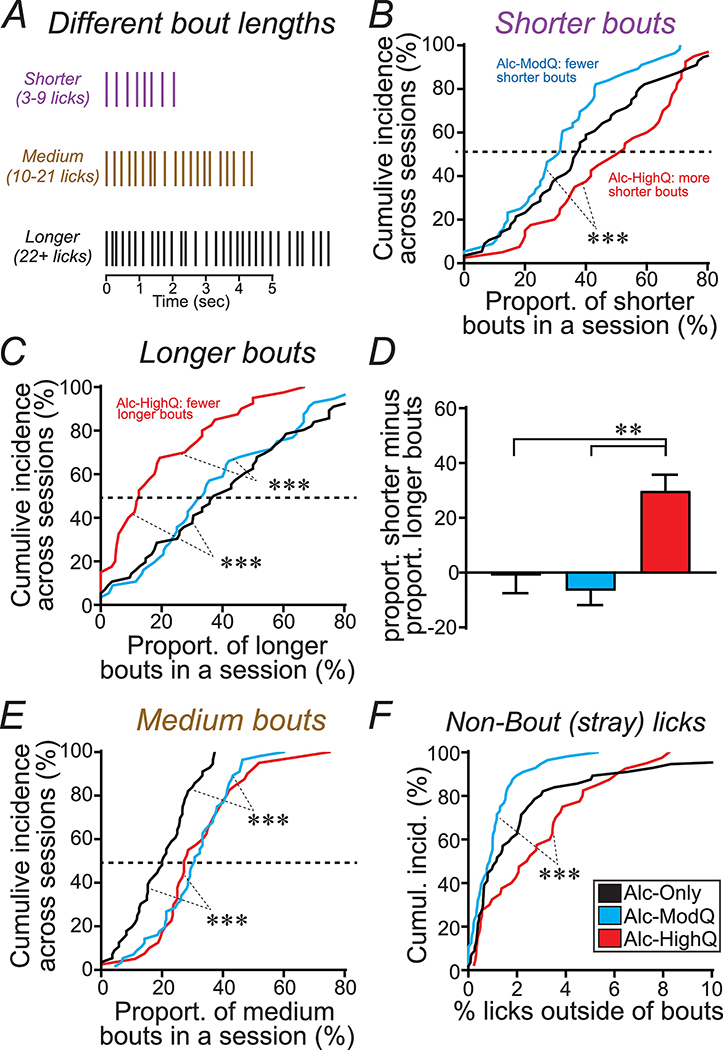
Intake despite negative consequences (compulsivity) contributes strongly to the harm of alcohol use disorder, making the underlying psychological and circuit mechanisms of great importance. To gain insight into possible underlying action strategies, we compared rat licking microstructure across compulsion-like and non-compulsive conditions. We previously showed that drinking under a moderate-challenge, quinine-alcohol model (Alc-ModQ) shows less variable responding in many measures, suggesting a more automatic strategy to overcome challenge. Here, we reanalyzed our original data, newly focusing on the behavioral profile of higher-challenge intake (100 mg/L quinine in alcohol, Alc-HighQ). Alc-HighQ greatly dropped consumption, yet retained aspects of greater automaticity and drive seen with Alc-ModQ, including earlier bout initiation and measures suggesting more stereotyped tongue control. In contrast, Alc-HighQ disordered bout generation and timing. Importantly, only fast-starting bouts persisted under Alc-HighQ, and while there were many fewer longer Alc-HighQ bouts, they still contributed >50 % of consumption. Also, longer bouts under Alc-HighQ had an early, several-second period with greater chance of stopping, but afterwards showed similar persistence and recovery from slow licking as other drinking conditions. Together, our findings elucidate novel behavioral indicators of successful and unsuccessful epochs of Alc-HighQ, compulsion-like intake. We also relate findings to congruent human and animal work implicating anterior insula and medial prefrontal cortices as critical for compulsion-like alcohol responding, and where ventral frontal cortex has been more associated with overall action plan and tongue control (retained under Alc-HighQ), with medial cortex more related to proximal action timing (disrupted under Alc-HighQ except after faster bout initiation).
尽管存在负面后果(强制性),摄入仍会极大地促成酒精使用障碍的伤害,这使得潜在的心理和电路机制变得非常重要。为了深入了解潜在的作用策略,我们比较了强迫性和非强迫性条件下大鼠舔舐的微观结构。我们之前曾表明,在适度挑战的奎宁酒精模型(Alc-ModQ)下饮酒时,许多措施的反应变化较小,这表明存在一种更自动的策略来克服挑战。在这里,我们重新分析了我们的原始数据,新的重点是更高挑战摄入的行为特征(100mg/L 奎宁在酒精中,Alc-HighQ)。Alc-HighQ 大大降低了摄入量,但保留了与 Alc-ModQ 相似的更大自动性和驱动力方面,包括更早的回合开始和更具刻板性的舌头控制措施。相比之下,Alc-HighQ 打乱了回合的产生和时间。重要的是,只有快速启动的回合在 Alc-HighQ 下持续,尽管 Alc-HighQ 的回合数量要少得多,但它们仍然贡献了超过 50%的摄入量。此外,Alc-HighQ 下的长回合在早期有几秒钟的时间更有可能停止,但之后与其他饮酒条件一样,表现出相似的持久性和从缓慢舔舐中恢复。总的来说,我们的发现阐明了 Alc-HighQ 强迫性摄入成功和不成功时期的新行为指标。我们还将研究结果与人类和动物研究的一致性联系起来,这些研究表明,前岛叶和内侧前额叶皮层对于强迫性酒精反应至关重要,而腹侧前额叶皮层与整体行动计划和舌头控制更为相关(在 Alc-HighQ 下保留),而内侧皮层与近端动作时间更为相关(除了更快的回合开始后,Alc-HighQ 下被打乱)。