Mullins Roger J, Xu Su, Zhuo Jiachen, Roys Steve, Pereira Edna F R, Albuquerque Edson X, Gullapalli Rao P
Department of Diagnostic Radiology & Nuclear Medicine, University of Maryland School of Medicine, Baltimore, MD 21201, USA.
Program in Neuroscience, University of Maryland School of Medicine, Baltimore, MD 21201, USA.
Brain Sci. 2020 Jun 12;10(6):365. doi: 10.3390/brainsci10060365.
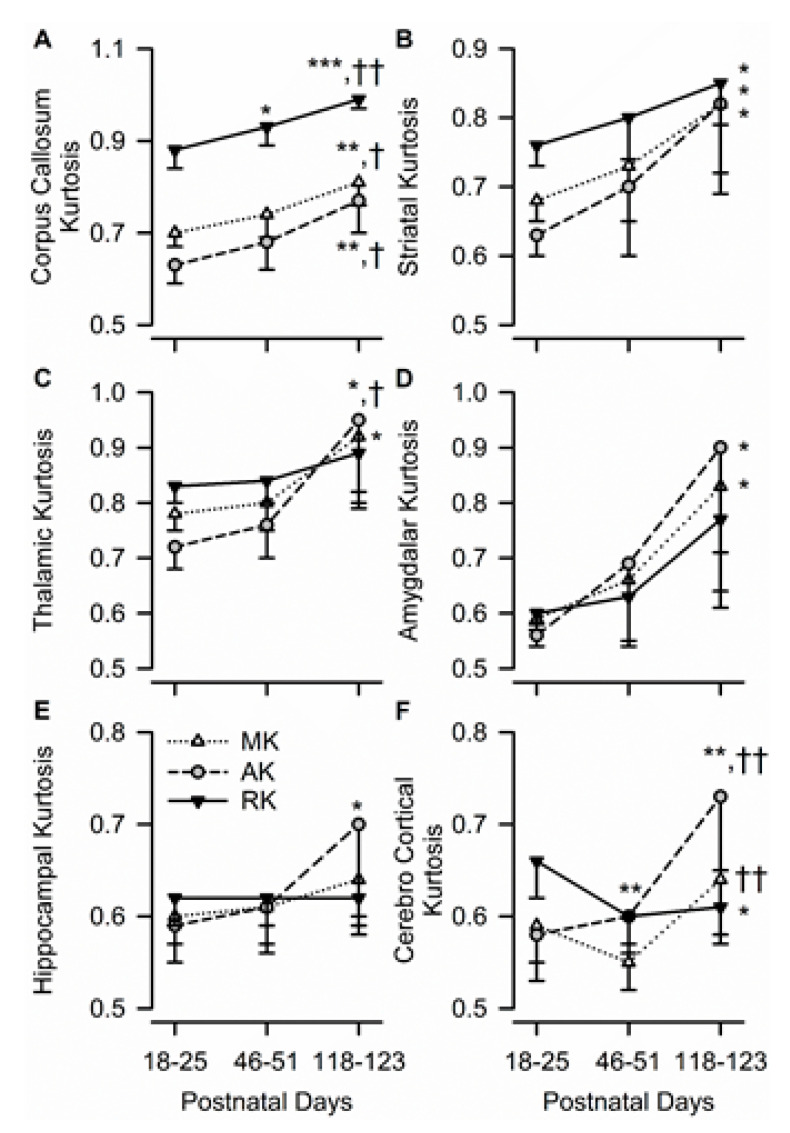
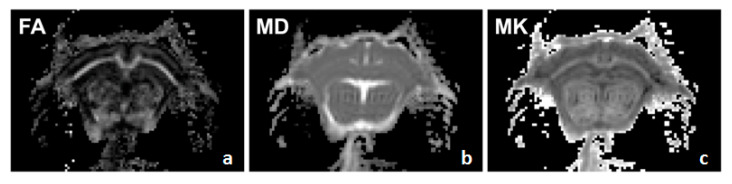
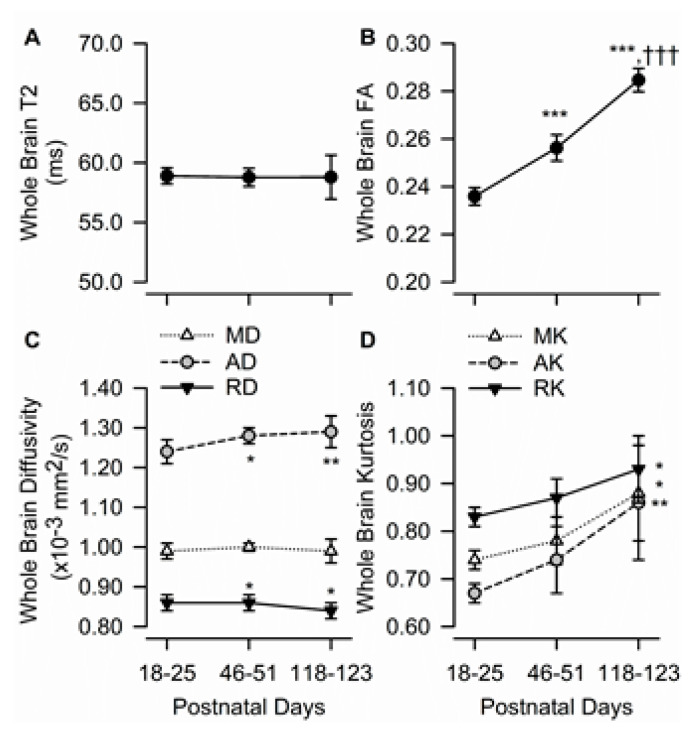
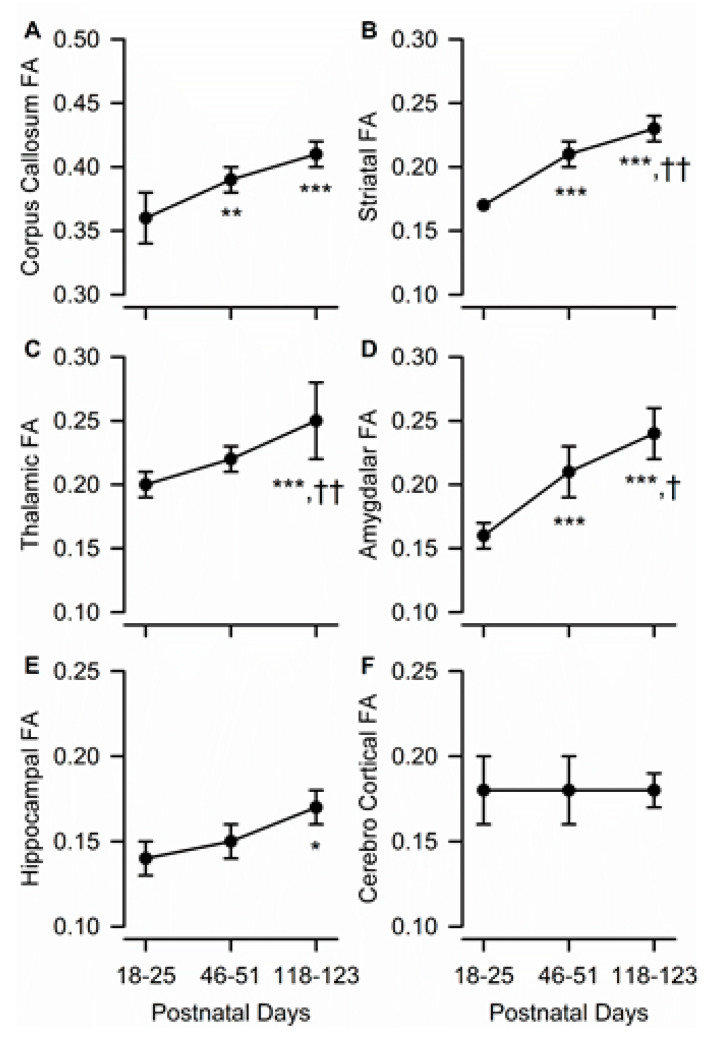
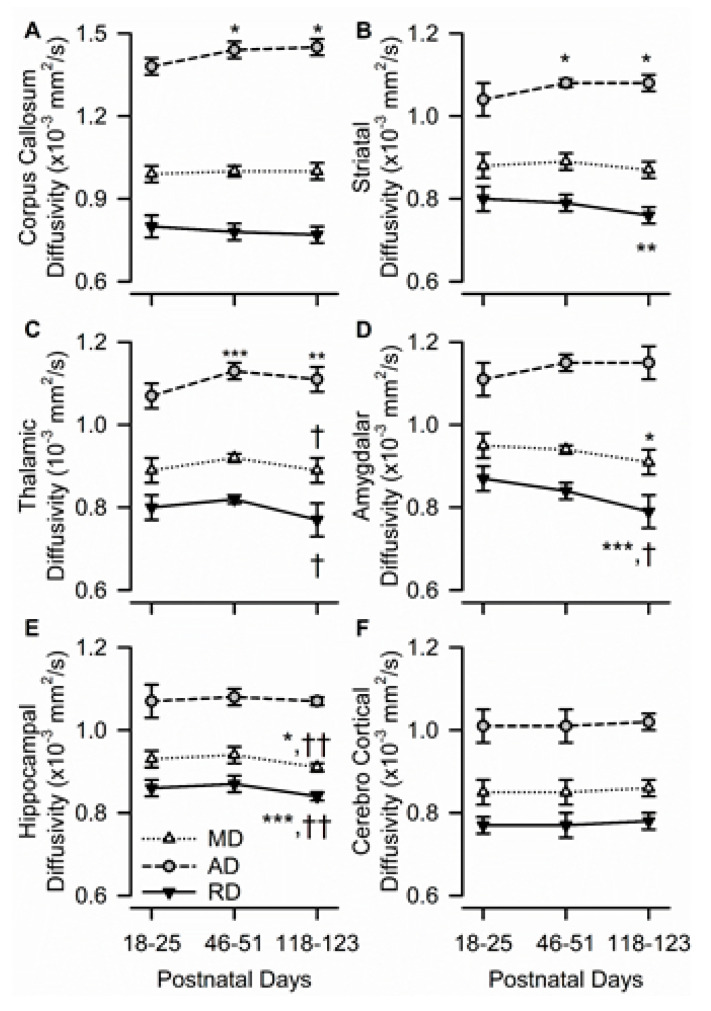
This study used magnetic resonance imaging (MRI) to identify age dependent brain structural characteristics in Dunkin Hartley guinea pigs. Anatomical T-weighted images, diffusion kurtosis (DKI) imaging, and T relaxometry measures were acquired from a cohort of male guinea pigs from postnatal day (PND) 18-25 (juvenile) to PND 46-51 (adolescent) and PND 118-123 (young adult). Whole-brain diffusion measures revealed the distinct effects of maturation on the microstructural complexity of the male guinea pig brain. Specifically, fractional anisotropy (FA), as well as mean, axial, and radial kurtosis in the corpus callosum, amygdala, dorsal-ventral striatum, and thalamus significantly increased from PND 18-25 to PND 118-123. Age-related alterations in DKI measures within these brain regions paralleled the overall alterations observed in the whole brain. Age-related changes in FA and kurtosis in the gray matter-dominant parietal cerebral cortex and dorsal hippocampus were less pronounced than in the other brain regions. The regional data analysis revealed that between-age changes of diffusion kurtosis metrics were more pronounced than those observed in diffusion tensor metrics. The age-related anatomical differences reported here may be important determinants of the age-dependent neurobehavior of guinea pigs in different tasks.
本研究使用磁共振成像(MRI)来确定邓金·哈特利豚鼠大脑结构特征的年龄依赖性。从一组雄性豚鼠中获取了解剖T加权图像、扩散峰度成像(DKI)和T弛豫测量值,这些豚鼠的年龄从出生后第18 - 25天(幼年)到第46 - 51天(青春期)以及第118 - 123天(青年期)。全脑扩散测量揭示了成熟对雄性豚鼠大脑微观结构复杂性的不同影响。具体而言,胼胝体、杏仁核、背腹侧纹状体和丘脑的分数各向异性(FA)以及平均、轴向和径向峰度从出生后第18 - 25天到第118 - 123天显著增加。这些脑区内DKI测量值的年龄相关变化与全脑观察到的总体变化相似。灰质占主导的顶叶大脑皮层和背侧海马体中FA和峰度的年龄相关变化不如其他脑区明显。区域数据分析表明,扩散峰度指标的年龄间变化比扩散张量指标更明显。这里报告的年龄相关解剖差异可能是豚鼠在不同任务中年龄依赖性神经行为的重要决定因素。