Muscle Disease Unit, Laboratory of Muscle Stem Cells and Gene Regulation, National Institute of Arthritis and Musculoskeletal and Skin Diseases, National Insititutes of Health, Bethesda, Maryland, USA.
Department of Neurology, Johns Hopkins University School of Medicine, Baltimore, Maryland, USA.
Ann Rheum Dis. 2020 Sep;79(9):1234-1242. doi: 10.1136/annrheumdis-2019-216599. Epub 2020 Jun 16.
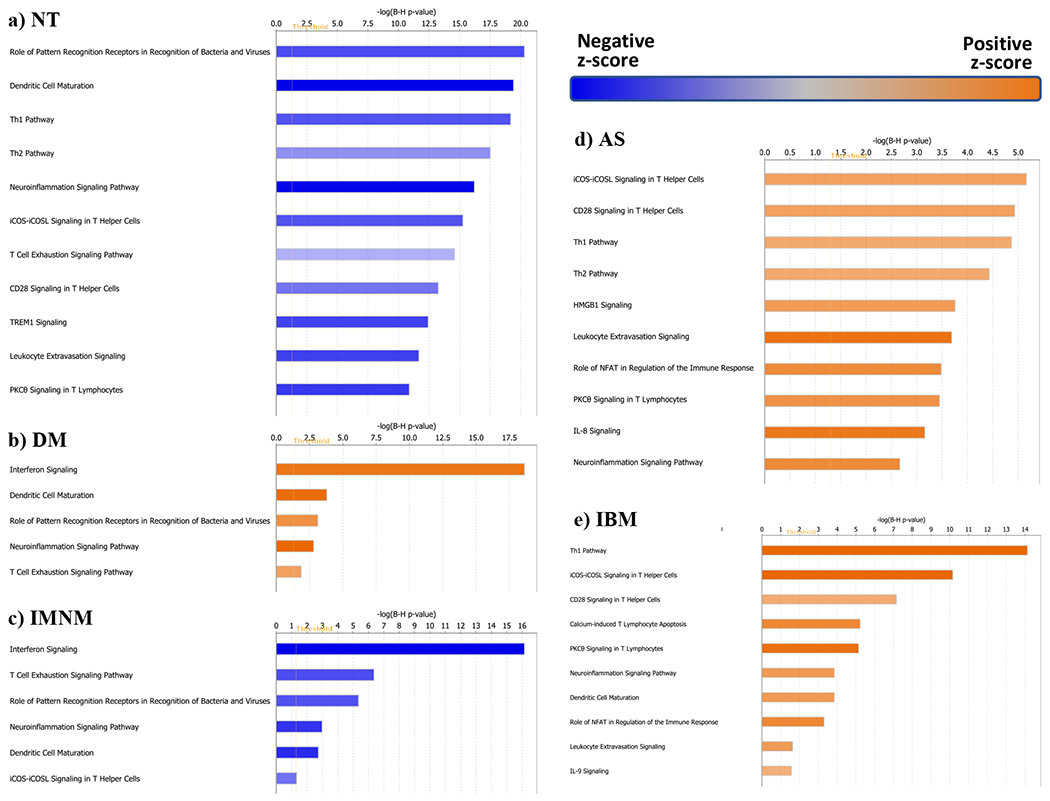
Myositis is a heterogeneous family of diseases that includes dermatomyositis (DM), antisynthetase syndrome (AS), immune-mediated necrotising myopathy (IMNM), inclusion body myositis (IBM), polymyositis and overlap myositis. Additional subtypes of myositis can be defined by the presence of myositis-specific autoantibodies (MSAs). The purpose of this study was to define unique gene expression profiles in muscle biopsies from patients with MSA-positive DM, AS and IMNM as well as IBM.
RNA-seq was performed on muscle biopsies from 119 myositis patients with IBM or defined MSAs and 20 controls. Machine learning algorithms were trained on transcriptomic data and recursive feature elimination was used to determine which genes were most useful for classifying muscle biopsies into each type and MSA-defined subtype of myositis.
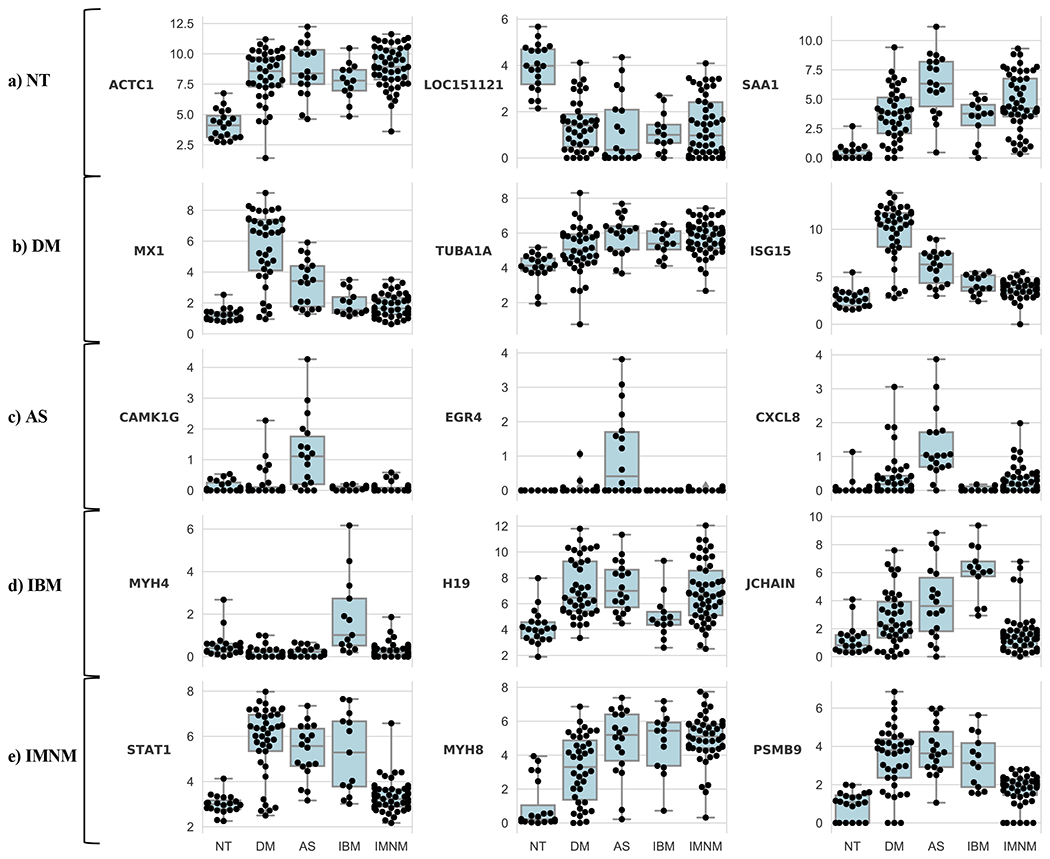
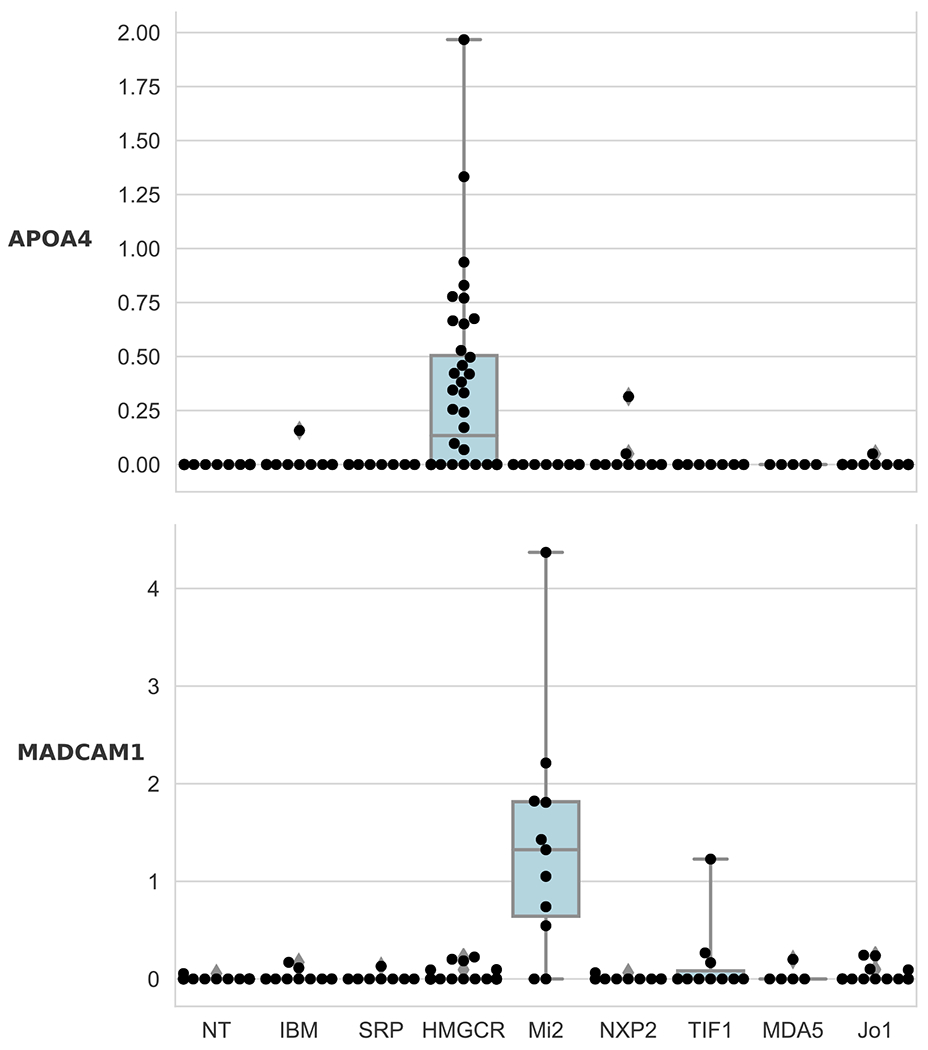
The support vector machine learning algorithm classified the muscle biopsies with >90% accuracy. Recursive feature elimination identified genes that are most useful to the machine learning algorithm and that are only overexpressed in one type of myositis. For example, CAMK1G (calcium/calmodulin-dependent protein kinase IG), EGR4 (early growth response protein 4) and CXCL8 (interleukin 8) are highly expressed in AS but not in DM or other types of myositis. Using the same computational approach, we also identified genes that are uniquely overexpressed in different MSA-defined subtypes. These included apolipoprotein A4 (APOA4), which is only expressed in anti-3-hydroxy-3-methylglutaryl-CoA reductase (HMGCR) myopathy, and MADCAM1 (mucosal vascular addressin cell adhesion molecule 1), which is only expressed in anti-Mi2-positive DM.
Unique gene expression profiles in muscle biopsies from patients with MSA-defined subtypes of myositis and IBM suggest that different pathological mechanisms underly muscle damage in each of these diseases.
肌炎是一组异质性疾病,包括皮肌炎(DM)、抗合成酶综合征(AS)、免疫介导的坏死性肌病(IMNM)、包涵体肌炎(IBM)、多发性肌炎和重叠性肌炎。肌炎的其他亚型可以通过肌炎特异性自身抗体(MSAs)的存在来定义。本研究的目的是确定 MSA 阳性 DM、AS 和 IMNM 以及 IBM 患者肌肉活检中的独特基因表达谱。
对 119 例 IBM 或特定 MSAs 阳性的肌炎患者和 20 例对照的肌肉活检进行 RNA-seq。将机器学习算法应用于转录组数据,并使用递归特征消除来确定哪些基因最有助于将肌肉活检分类为每种类型和 MSA 定义的肌炎亚型。
支持向量机学习算法以>90%的准确率对肌肉活检进行分类。递归特征消除确定了对机器学习算法最有用的基因,这些基因仅在一种肌炎中过度表达。例如,CAMK1G(钙/钙调蛋白依赖性蛋白激酶 IG)、EGR4(早期生长反应蛋白 4)和 CXCL8(白细胞介素 8)在 AS 中高度表达,但在 DM 或其他类型的肌炎中不表达。使用相同的计算方法,我们还确定了在不同 MSA 定义的亚型中独特过度表达的基因。这些基因包括仅在抗 3-羟基-3-甲基戊二酰辅酶 A 还原酶(HMGCR)肌病中表达的载脂蛋白 A4(APOA4),以及仅在抗 Mi2 阳性 DM 中表达的黏膜血管地址素细胞黏附分子 1(MADCAM1)。
MSA 定义的肌炎和 IBM 患者肌肉活检中的独特基因表达谱表明,这些疾病中每种疾病的肌肉损伤都有不同的病理机制。