Wang Yufei, Deblonde Gauthier J-P, Abergel Rebecca J
Department of Nuclear Engineering, University of California, Berkeley, Berkeley, California 94720, United States.
Chemical Sciences Division, Lawrence Berkeley National Laboratory, Berkeley, California 94720, United States.
ACS Omega. 2020 May 28;5(22):12996-13005. doi: 10.1021/acsomega.0c00873. eCollection 2020 Jun 9.
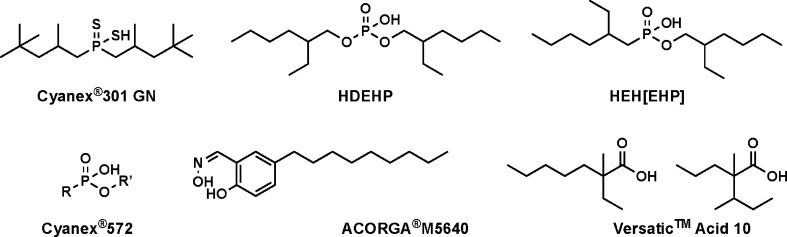
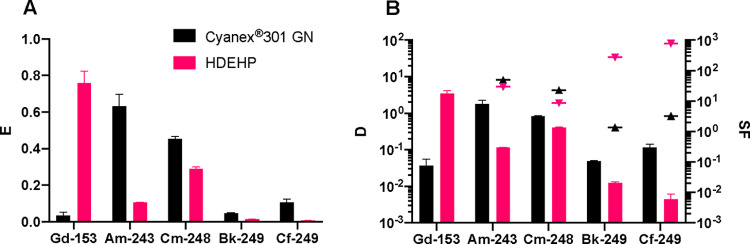
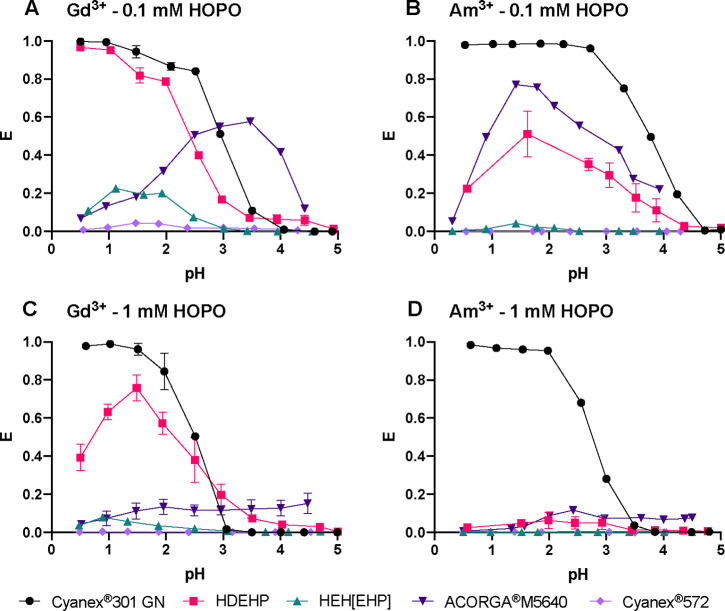
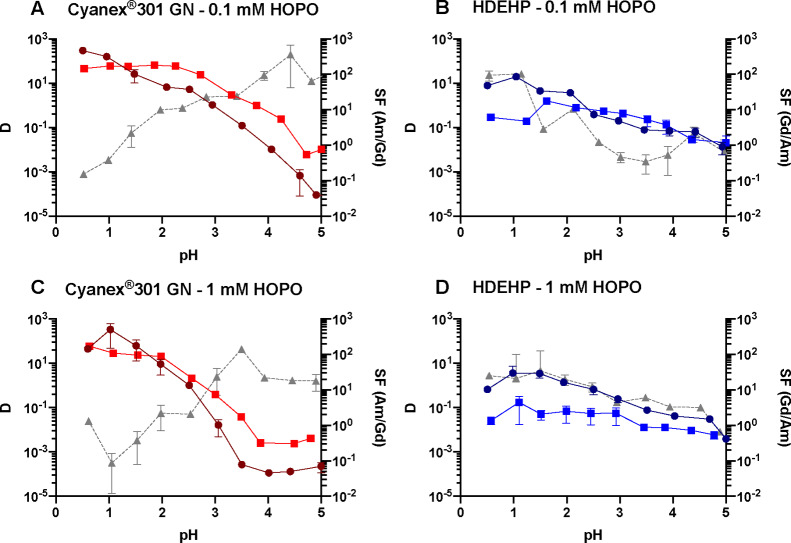
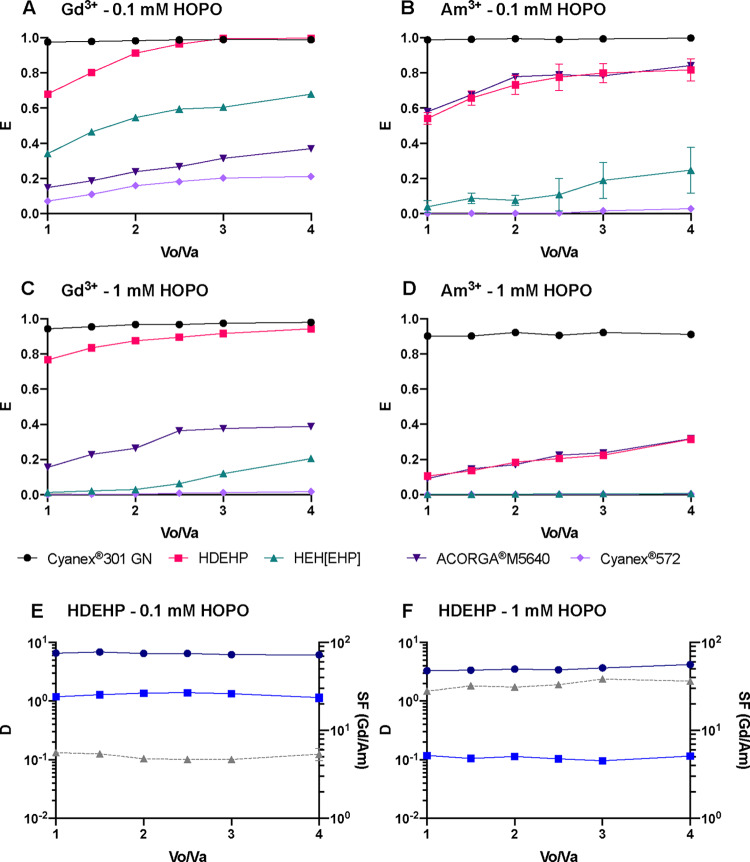
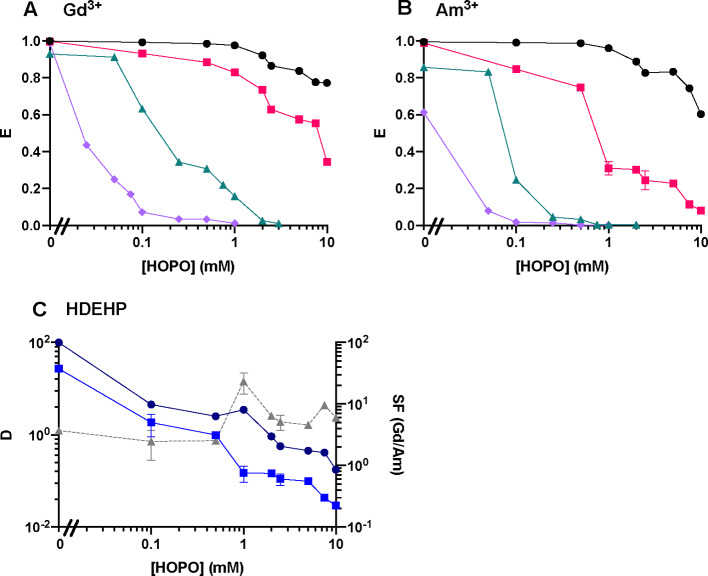
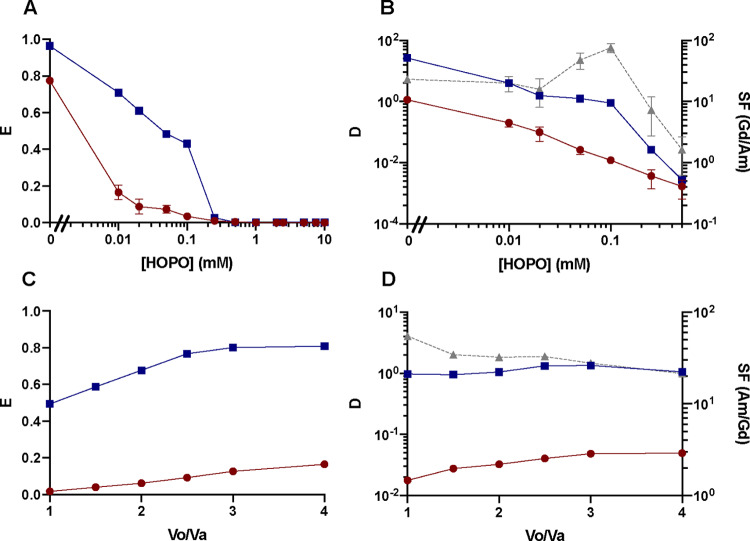
Separation of lanthanides (Ln) from actinides (An) is unanimously challenging in reprocessing used nuclear fuel despite of much dedicated efforts over the past several decades. The TALSPEAK process is the current reference method in the United States for Ln/An separation but suffers from several limitations, such as a narrow working pH window (3.5-4.0), costly pH buffers, and slow extraction kinetics. Studies aiming at improving TALSPEAK have so far focused on polyaminocarboxylates hold-back reagents. Here, a new class of water-soluble ligands comprising hydroxypyridinone metal-binding units are evaluated for Ln/An separation. The model octadentate chelator 3,4,3-LI(1,2-HOPO) (abbreviated as HOPO) was used in combination with several industry-relevant organic extractants to separate Gd from four transplutonium elements (Am, Cm, Bk, and Cf). Cyanex 301 GN and HDEHP worked best in combination with HOPO, whereas HEH[EHP], Cyanex 572, and ACORGA M5640 did not yield practical Ln/An separation. Separation factors between Gd and Am reach about 50 with the HOPO/Cyanex 301 GN system and 30 with the HOPO/HDEHP system. The results using HDEHP (SF = 30, SF = 8.5, and SF = 773) are high enough for industrial applications, and the proposed system works at pH values as low as 1.5, which simplifies the process by eliminating the need for pH buffers. In contrast to previously proposed methods, the HOPO-based process is also highly selective at separating Bk from Ln (SF = 273) owing to , spontaneous oxidation of Bk(III) to Bk(IV) by HOPO. The optimal pH in the case of HOPO/Cyanex 301 GN is 3.6 (SF = 50, SF = 23, SF = 1.4, and SF = 3.2), but this system has the advantage of extracting An ions into the organic phase while keeping Ln ions in the aqueous phase, which is opposite to the conventional TALSPEAK process. This study represents the first optimization of a TALSPEAK-like Ln/An separation method using a HOPO chelator and paves the avenue for further developments of analytical science and reprocessing of used nuclear fuel.
尽管在过去几十年里付出了诸多努力,但在乏核燃料后处理中,镧系元素(Ln)与锕系元素(An)的分离一直是一项极具挑战性的工作。TALSPEAK工艺是美国目前用于Ln/An分离的参考方法,但存在一些局限性,如工作pH窗口较窄(3.5 - 4.0)、pH缓冲剂成本高以及萃取动力学缓慢。迄今为止,旨在改进TALSPEAK的研究主要集中在聚氨基羧酸盐抑制试剂上。在此,对一类包含羟基吡啶酮金属结合单元的新型水溶性配体进行了Ln/An分离评估。使用模型八齿螯合剂3,4,3-LI(1,2-HOPO)(简称为HOPO)与几种与工业相关的有机萃取剂结合,从四种超钚元素(镅、锔、锫和锎)中分离钆。Cyanex 301 GN和HDEHP与HOPO结合效果最佳,而HEH[EHP]、Cyanex 572和ACORGA M5640无法实现实际的Ln/An分离。在HOPO/Cyanex 301 GN体系中,钆与镅之间的分离因子达到约50,在HOPO/HDEHP体系中为30。使用HDEHP得到的结果(分离因子分别为30、8.5和773)高到足以用于工业应用,并且所提出的体系在低至1.5的pH值下即可工作,无需pH缓冲剂,从而简化了工艺。与先前提出的方法不同,基于HOPO的工艺在将锫与镧系元素分离方面也具有高度选择性(分离因子为273),这是由于HOPO能将Bk(III)自发氧化为Bk(IV)。在HOPO/Cyanex 301 GN体系中,最佳pH值为3.6(分离因子分别为50、23、1.4和3.2),但该体系的优势在于能将锕系离子萃取到有机相中,同时使镧系离子保留在水相中,这与传统的TALSPEAK工艺相反。本研究首次使用HOPO螯合剂对类似TALSPEAK的Ln/An分离方法进行了优化,为分析科学的进一步发展以及乏核燃料后处理铺平了道路。