Vedder D, Gerritsen M, Duvvuri B, van Vollenhoven R F, Nurmohamed M T, Lood C
Amsterdam Rheumatology & Immunology Center, Reade, 1056 AB, Amsterdam, Netherlands.
Amsterdam Cardiovascular Sciences, Amsterdam, Netherlands.
Arthritis Res Ther. 2020 Jun 18;22(1):148. doi: 10.1186/s13075-020-02244-6.
Gout is the most prevalent inflammatory arthritis in developed countries. A gout flare is mediated by phagocytosis of monosodium urate crystals by macrophages and neutrophils leading to subsequent activation of neutrophils contributing to synovitis, local joint destruction, and systemic inflammation. We hypothesize that biomarkers from activated neutrophils reflect gout disease activity. The objective of this study therefore was to investigate the clinical utility of neutrophil-derived biomarkers in gout disease activity.
Plasma samples from 75 gout patients participating in the "Reade gout cohort Amsterdam" were compared with 30 healthy controls (HC). Levels of neutrophil extracellular traps (NETs) and neutrophil activation markers (calprotectin and peroxidase activity) were analyzed by ELISA and fluorimetry, compared to healthy controls, and related to markers of inflammation and disease activity.
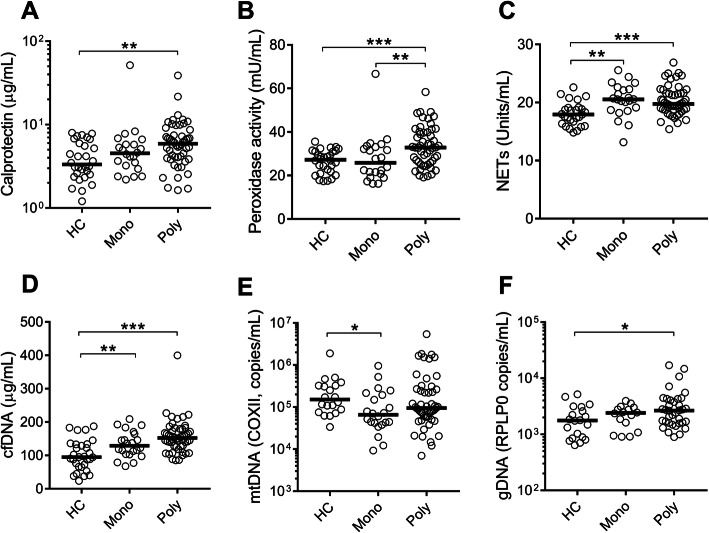
Levels of NETs, as well as neutrophil activation markers, were increased in gout patients compared to HC (p < 0.01). No associations were found between markers of cell death (cell-free DNA and NETs) and disease activity. Cell-free levels of genomic DNA were elevated among gout patients compared to HC (p < 0.05) and related to the number of gout attacks in the last year (β = 0.35, p < 0.01). Peroxidase activity correlated with disease activity (RAPID score: β = 0.49, p < 0.01, MHAQ: β = 0.66, p < 0.01) and inflammation markers (CRP: β = 0.25, p = 0.04, and ESR: β = 0.57, p < 0.001). Involvement of ankle or wrist resulted in significant higher peroxidase levels compared to mono-articular disease (β = 0.34, p < 0.01), indicating that peroxidase activity is a marker of poly-articular gout. Calprotectin (S100A8/A9) correlated with the inflammation marker CRP (β = 0.23, p = 0.05) and morning stiffness, especially in patients with chronic poly-articular gout (β = 0.71, p < 0.01).
Neutrophil activation markers are associated with characteristics of active, polyarticular gout. Furthermore, NETs are present in the peripheral blood of gout patients. However, NETs do not associate with markers of disease activity or inflammation. Future research should point out if peroxidase and calprotectin could be used in clinical practice as biomarkers for monitoring gout disease activity.
痛风是发达国家最常见的炎性关节炎。痛风发作由巨噬细胞和中性粒细胞吞噬尿酸单钠晶体介导,导致中性粒细胞随后被激活,进而引发滑膜炎、局部关节破坏和全身炎症。我们推测,来自活化中性粒细胞的生物标志物可反映痛风疾病活动情况。因此,本研究的目的是探讨中性粒细胞衍生生物标志物在痛风疾病活动中的临床应用价值。
将参与“阿姆斯特丹里德痛风队列研究”的75例痛风患者的血浆样本与30例健康对照者(HC)的样本进行比较。通过酶联免疫吸附测定(ELISA)和荧光测定法分析中性粒细胞胞外诱捕网(NETs)和中性粒细胞活化标志物(钙卫蛋白和过氧化物酶活性)的水平,并与健康对照者进行比较,同时分析这些指标与炎症和疾病活动标志物的相关性。
与健康对照者相比,痛风患者的NETs水平以及中性粒细胞活化标志物水平均升高(p < 0.01)。未发现细胞死亡标志物(游离DNA和NETs)与疾病活动之间存在关联。与健康对照者相比,痛风患者的游离基因组DNA水平升高(p < 0.05),且与过去一年痛风发作次数相关(β = 0.35,p < 0.01)。过氧化物酶活性与疾病活动(RAPID评分:β = 0.49,p < 0.01,MHAQ:β = 0.66,p < 0.01)及炎症标志物(CRP:β = 0.25,p = 0.04,ESR:β = 0.57,p < 0.001)相关。与单关节疾病相比,踝关节或腕关节受累患者的过氧化物酶水平显著更高(β = 0.34,p < 0.01),这表明过氧化物酶活性是多关节痛风的一个标志物。钙卫蛋白(S100A8/A9)与炎症标志物CRP(β = 0.23,p = 0.05)及晨僵相关,尤其是在慢性多关节痛风患者中(β = 0.71,p < 0.01)。
中性粒细胞活化标志物与活动性多关节痛风的特征相关。此外,痛风患者外周血中存在NETs。然而,NETs与疾病活动或炎症标志物无关。未来的研究应指出过氧化物酶和钙卫蛋白是否可在临床实践中用作监测痛风疾病活动的生物标志物。