Amsterdam Rheumatology and Immunology Center Reade, Amsterdam, The Netherlands.
Vrije Universiteit, Amsterdam Cardiovascular Sciences, Amsterdam, The Netherlands.
Rheumatology (Oxford). 2021 Jun 18;60(6):2783-2790. doi: 10.1093/rheumatology/keaa712.
To investigate the association between neutrophil activation and cardiovascular risk in gout patients. We hypothesize that neutrophil activation mediates inflammation and therefore takes part in atherogenesis in gout patients.
Patient data were collected from 75 consecutive gout patients participating in the Reade gout cohort Amsterdam. Levels of neutrophil extracellular traps (NETs) and neutrophil activation (calprotectin and peroxidase activity) were analysed by ELISA and fluorimetry in plasma and compared with healthy controls. Markers of neutrophil activation were related to clinical markers of cardiovascular risk, including BMI, smoking, blood pressure, lipid profile and 10 year risk of cardiovascular mortality (EU-SCORE).
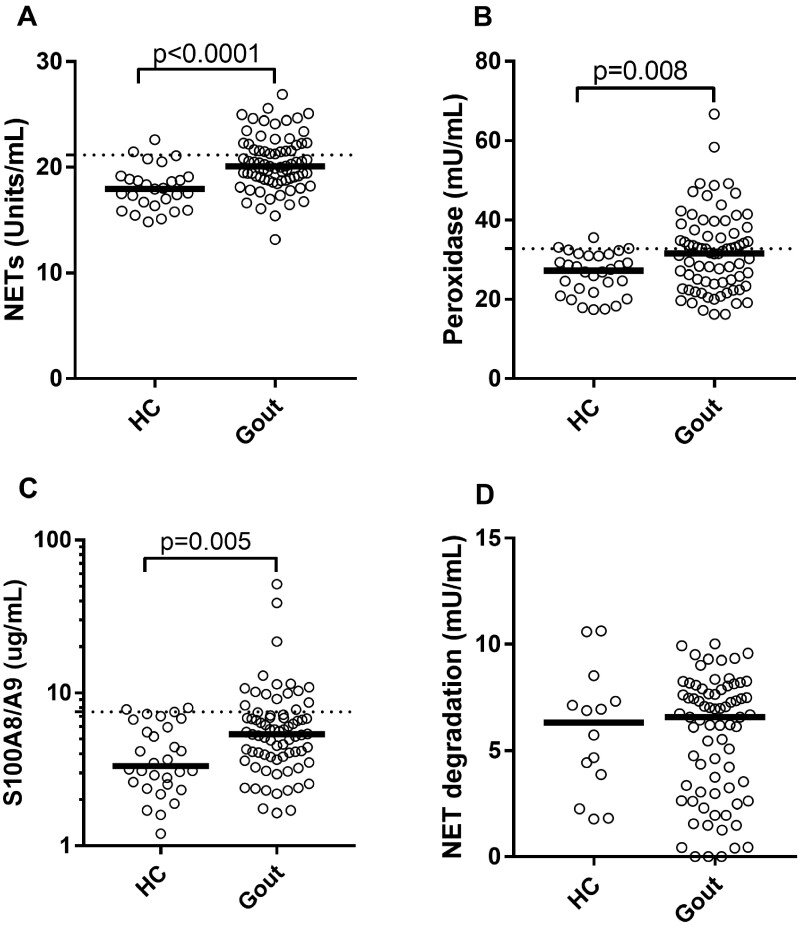
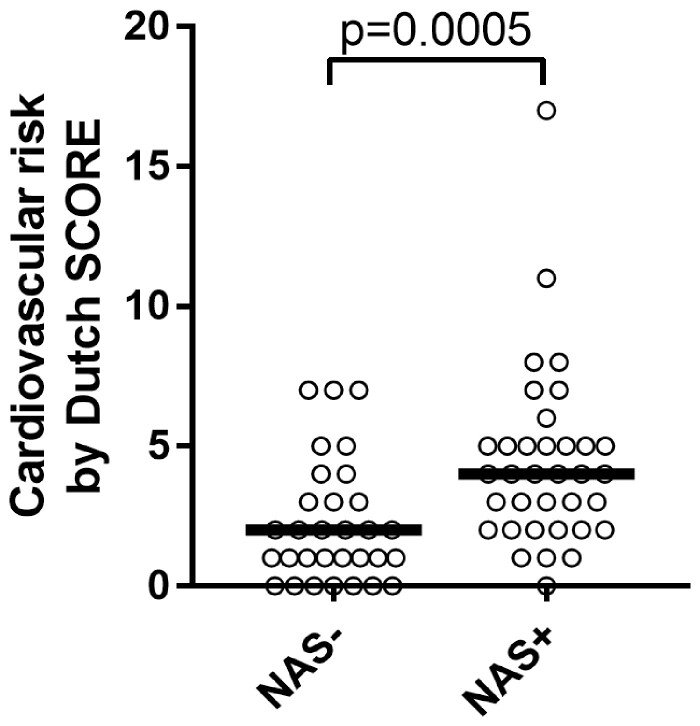
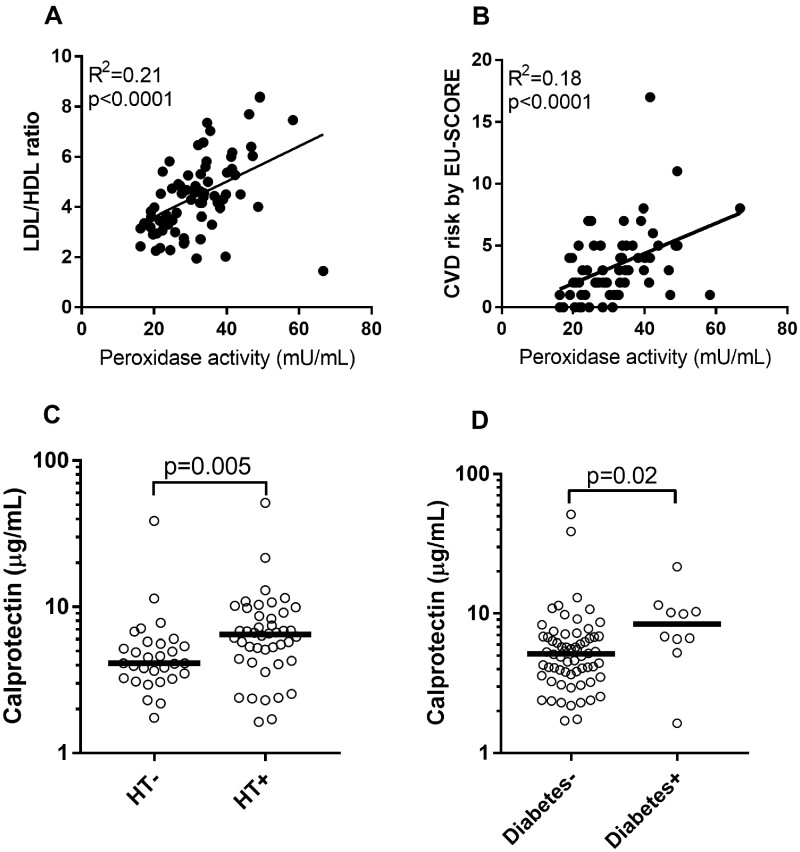
Increased levels of NETs were found in gout patients, although increased levels were not associated with cardiovascular risk. However, markers of neutrophil activation, including peroxidase activity correlated with waist:hip ratio (β = 0.33, P < 0.001), cholesterol ratio (β = 0.46, P < 0.005) and triglycerides (β = 0.60, P < 0.001) as well as the 10 year risk of cardiovascular mortality (β = 0.44, P = 0.001). Calprotectin levels were elevated in hypertension (P = 0.005) and diabetes (P = 0.02). Finally, gout patients with high levels of both peroxidase and calprotectin ('neutrophil activation signature') had a markedly elevated cardiovascular risk score (P = 0.001), with 68% of the patients having high cardiovascular risk (odds ratio 2.9, P = 0.03).
We demonstrated elevated levels of neutrophil activation markers, MPO and calprotectin in gout patients as compared with healthy controls. Of note, neutrophil activation markers were associated with several risk factors for cardiovascular disease, including hyperlipidaemia, hypertension and diabetes. Finally, the presence of a neutrophil activation signature was strongly associated with an increased 10 year risk of cardiovascular mortality. Further studies are needed to determine whether gout-specific factors and/or cardiovascular risk factors contribute to the elevated neutrophil activation observed in these patients.
研究痛风患者中性粒细胞激活与心血管风险之间的关联。我们假设,中性粒细胞激活介导炎症,因此参与痛风患者的动脉粥样硬化形成。
从参与阿姆斯特丹 Reade 痛风队列的 75 例连续痛风患者中收集患者数据。通过酶联免疫吸附试验和荧光法分析血浆中中性粒细胞胞外陷阱 (NETs) 和中性粒细胞激活 (钙卫蛋白和过氧化物酶活性) 的水平,并与健康对照组进行比较。中性粒细胞激活标志物与心血管风险的临床标志物相关,包括 BMI、吸烟、血压、血脂谱和 10 年心血管死亡率的欧洲心脏评分 (EU-SCORE)。
发现痛风患者的 NETs 水平升高,尽管升高的水平与心血管风险无关。然而,中性粒细胞激活标志物,包括过氧化物酶活性与腰臀比 (β=0.33,P<0.001)、胆固醇比值 (β=0.46,P<0.005) 和甘油三酯 (β=0.60,P<0.001) 以及 10 年心血管死亡率的风险 (β=0.44,P=0.001) 相关。高血压 (P=0.005) 和糖尿病 (P=0.02) 患者的钙卫蛋白水平升高。最后,同时具有高过氧化物酶和钙卫蛋白水平的痛风患者 ('中性粒细胞激活特征') 的心血管风险评分显著升高 (P=0.001),68%的患者有高心血管风险 (比值比 2.9,P=0.03)。
与健康对照组相比,我们发现痛风患者的中性粒细胞激活标志物 MPO 和钙卫蛋白水平升高。值得注意的是,中性粒细胞激活标志物与心血管疾病的多个危险因素相关,包括高脂血症、高血压和糖尿病。最后,中性粒细胞激活特征的存在与 10 年心血管死亡率升高密切相关。需要进一步的研究来确定痛风特异性因素和/或心血管危险因素是否导致这些患者观察到的中性粒细胞激活增加。