
WNT 和炎症信号通路区分人输卵管上皮细胞群体。
WNT and inflammatory signaling distinguish human Fallopian tube epithelial cell populations.
机构信息
Department of Biomedical Sciences and Cornell Stem Cell Program, Cornell University, Ithaca, New York, USA.
University of Kansas Cancer Center, Kansas City, Kansas, USA.
出版信息
Sci Rep. 2020 Jun 17;10(1):9837. doi: 10.1038/s41598-020-66556-y.
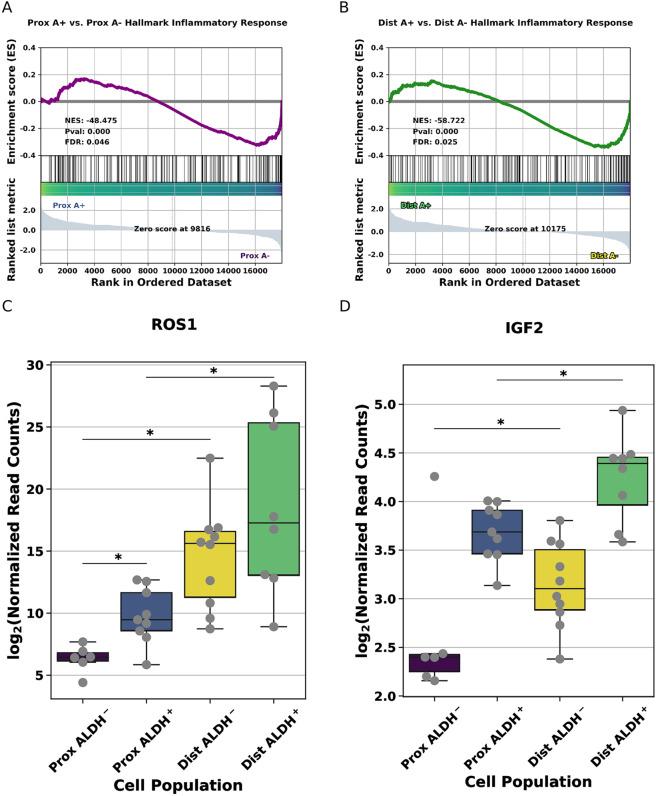
Many high-grade serous carcinomas (HGSCs) likely originate in the distal region of the Fallopian tube's epithelium (TE) before metastasizing to the ovary. Unfortunately, molecular mechanisms promoting malignancy in the distal TE are obfuscated, largely due to limited primary human TE gene expression data. Here we report an in depth bioinformatic characterization of 34 primary TE mRNA-seq samples. These samples were prepared from proximal and distal TE regions of 12 normal Fallopian tubes. Samples were segregated based on their aldehyde dehydrogenase (ALDH) activity. Distal cells form organoids with higher frequency and larger size during serial organoid formation assays when compared to proximal cells. Consistent with enrichment for stem/progenitor cells, ALDH+ cells have greater WNT signaling. Comparative evaluation of proximal and distal TE cell population's shows heightened inflammatory signaling in distal differentiated (ALDH-) TE. Furthermore, comparisons of proximal and distal TE cell populations finds that the distal ALDH+ TE cells exhibit pronounced expression of gene sets characteristic of HGSC sub-types. Overall, our study indicates increased organoid forming capacity, WNT/inflammatory signaling, and HGSC signatures underlie differences between distal and proximal regions of the human TE. These findings provide the basis for further mechanistic studies of distal TE susceptibility to the malignant transformation.
许多高级别浆液性卵巢癌(HGSCs)可能起源于输卵管远端上皮(TE),然后转移到卵巢。不幸的是,由于缺乏原发性人 TE 基因表达数据,促进远端 TE 恶变的分子机制仍不清楚。在这里,我们报告了对 34 个原发性 TE mRNA-seq 样本的深入生物信息学特征分析。这些样本来自 12 个正常输卵管的近端和远端 TE 区域。根据醛脱氢酶(ALDH)活性对样本进行了分类。与近端细胞相比,在连续类器官形成实验中,远端细胞形成类器官的频率更高,体积更大。与干细胞/祖细胞富集一致,ALDH+细胞具有更高的 WNT 信号。对近端和远端 TE 细胞群体的比较分析表明,远端分化(ALDH-)TE 中的炎症信号增强。此外,对近端和远端 TE 细胞群体的比较发现,远端 ALDH+ TE 细胞表现出与 HGSC 亚型特征相关的基因集的显著表达。总的来说,我们的研究表明,远端和近端 TE 之间的差异与类器官形成能力增强、WNT/炎症信号和 HGSC 特征有关。这些发现为进一步研究远端 TE 对恶性转化的易感性提供了基础。



 Zotero 插件