
带或不带干扰螺钉的前交叉韧带双束重建中腘绳肌腱胫骨固定的力学评估。
Mechanical evaluation of tibial fixation of the hamstring tendon in anterior cruciate ligament double-bundle reconstruction with and without interference screws.
机构信息
Departamento de Ortopedia e Traumatologia, Escola Paulista de Medicina, Universidade Federal de Sao Paulo, Sao Paulo, SP, BR.
Instituto de Ortopedia e Traumatologia (IOT), Hospital das Clinicas HCFMUSP, Faculdade de Medicina, Universidade de Sao Paulo, Sao Paulo, SP, BR.
出版信息
Clinics (Sao Paulo). 2020 Apr 30;75:e1123. doi: 10.6061/clinics/2020/e1123. eCollection 2020.
OBJECTIVE
The objective of this study was to compare two postero-lateral bundle (PLB) tibial fixation techniques for the reconstruction of the anterior cruciate ligament with double bundle: a technique without the use of an interference screw, preserving the native tibial insertion of the tendons of the gracilis and semitendineous muscles, and a technique with the use of an interference screw and without preserving the insertion of the tendons.
METHODS
A comparative study was conducted in cadavers with a universal mechanical test machine. In total, 23 cadaver knees were randomized for tibial fixation of the PLB using the two techniques: Maintaining the tibial insertion of the tendons during reconstruction, without the use of an interference screw (group A, 11 cases); and fixating the graft with an interference screw, without maintaining the insertion of the tendons (group B, 12 cases). A continuous traction was performed (20 mm/min) in the same direction as the produced tunnel, and force (N), elongation (mm), rigidity (N/mm), and tension (N/mm2) were objectively determined in each group.
RESULTS
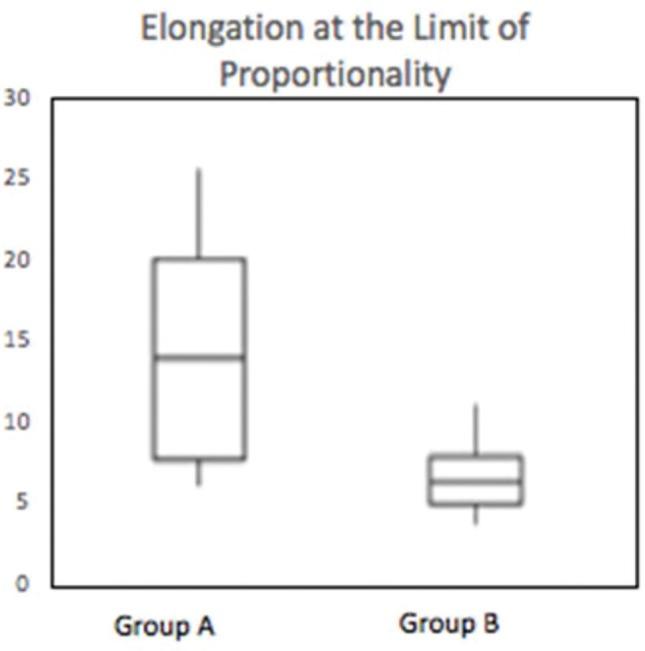
Group A exhibited a maximum force (MF) of 315.4±124.7 N; maximum tension of 13.57±3.65 N/mm2; maximum elongation of 19.73±4.76 mm; force at the limit of proportionality (FLP) of 240.6±144.0 N; and an elongation at the limit of proportionality of 14.37±6.58 mm. Group B exhibited a MF of 195.7±71.8 N; maximum tension of 8.8±3.81 N/mm2; maximum elongation of 15.3±10.73 mm; FLP of 150.1±68.7 N; and an elongation at the limit of proportionality of 6.86±2.42 mm. When comparing the two groups, significant differences were observed in the variables of maximum force (p=0.016), maximum tension (p=0.019), maximum elongation (p=0.007), and elongation at the limit of proportionality (p=0.003).
CONCLUSION
The use of the native insertion of the semitendineous and gracilis tendons, without an additional fixation device, presented mechanical superiority over their fixation with interference screws.
目的
本研究旨在比较两种后外侧束(PLB)胫骨固定技术在双束重建前交叉韧带中的应用:一种技术不使用干扰螺钉,保留了腘绳肌腱和半腱肌腱的原始胫骨止点;另一种技术使用干扰螺钉,但不保留肌腱止点。
方法
在万能力学试验机上进行尸体对照研究。共随机选择 23 个尸体膝关节进行 PLB 胫骨固定:重建时保留肌腱的胫骨止点,不使用干扰螺钉(A 组,11 例);用干扰螺钉固定移植物,不保留肌腱止点(B 组,12 例)。以与产生隧道相同的方向进行连续牵引(20mm/min),并在每组中客观地确定力(N)、伸长(mm)、刚度(N/mm)和张力(N/mm2)。
结果
A 组的最大力(MF)为 315.4±124.7N;最大张力为 13.57±3.65N/mm2;最大伸长率为 19.73±4.76mm;比例极限力(FLP)为 240.6±144.0N;比例极限伸长率为 14.37±6.58mm。B 组的 MF 为 195.7±71.8N;最大张力为 8.8±3.81N/mm2;最大伸长率为 15.3±10.73mm;FLP 为 150.1±68.7N;比例极限伸长率为 6.86±2.42mm。两组比较,最大力(p=0.016)、最大张力(p=0.019)、最大伸长率(p=0.007)和比例极限伸长率(p=0.003)差异有统计学意义。
结论
不使用额外的固定装置保留半腱肌腱和股薄肌腱的原始止点,其力学性能优于使用干扰螺钉固定。


 Zotero 插件