van der Geer Sarah J, van Rijn Phillip V, Roodenburg Jan L N, Dijkstra Pieter U
Department of Oral and Maxillofacial Surgery, University of Groningen, University Medical Center Groningen, Groningen, The Netherlands.
Department of Rehabilitation, University of Groningen, University Medical Center Groningen, Groningen, The Netherlands.
Head Neck. 2020 Sep;42(9):2696-2721. doi: 10.1002/hed.26327. Epub 2020 Jun 18.
To prescribe early trismus therapy, prognostic factors influencing the restricted mouth opening should be identified first. Our aim is to present an overview of these factors in patients with head and neck cancer.
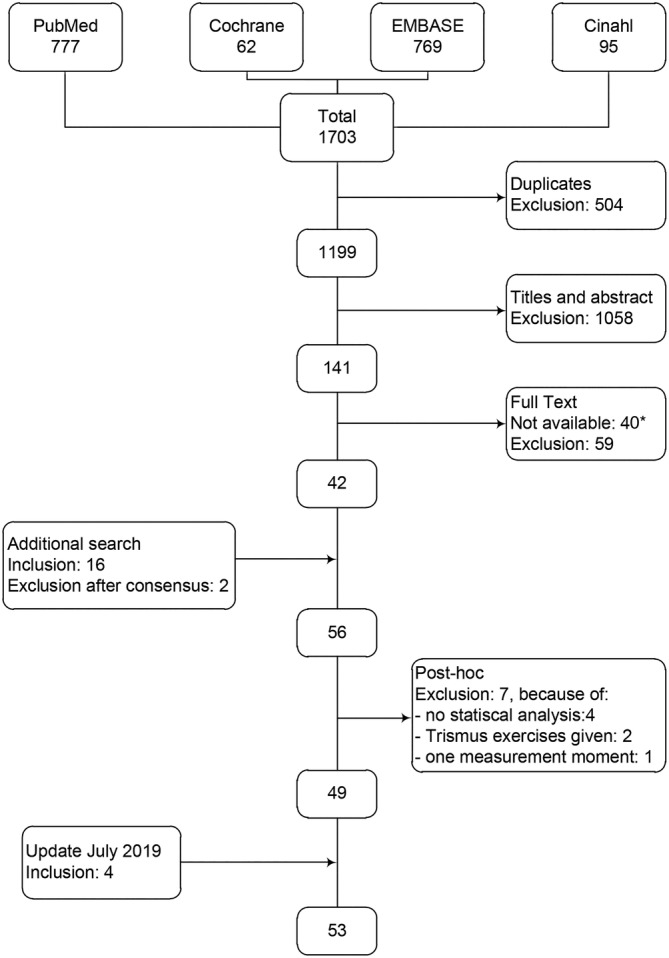
PubMed, Cochrane, EMBASE, and CINAHL were searched using terms related to head and neck cancer and mouth opening. Risk of bias was assessed using the "Quality in Prognosis Studies" tool. A best evidence synthesis was performed.
Of the identified 1418 studies, 53 were included. Three studies contained a prognostic multivariate model for a restricted mouth opening.
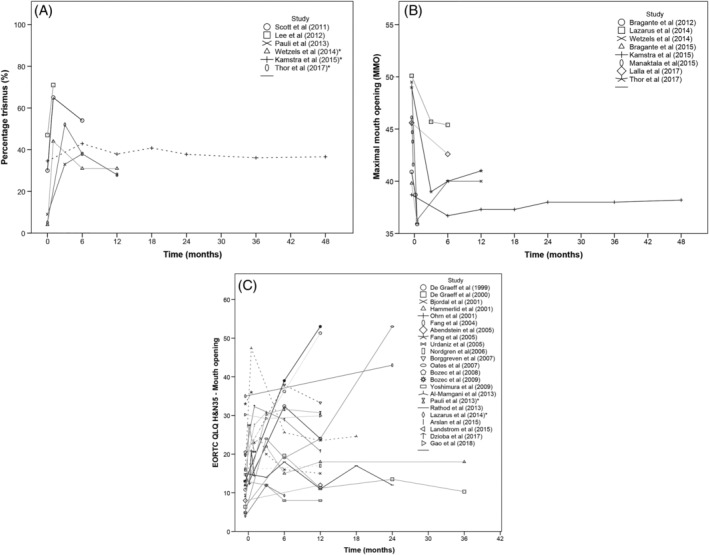
Patients with head and neck cancer will most likely develop a restricted mouth opening when they have a large tumor near the masticatory muscles that requires extensive cancer treatment. A restricted mouth opening most likely occurs within 6 months after cancer treatment. Further research is necessary on factors related to healing tendency or pain intensity.
为了制定早期牙关紧闭治疗方案,首先应确定影响张口受限的预后因素。我们的目的是概述这些因素在头颈癌患者中的情况。
使用与头颈癌和张口相关的术语在PubMed、Cochrane、EMBASE和CINAHL数据库中进行检索。使用“预后研究质量”工具评估偏倚风险。进行最佳证据综合分析。
在检索到的1418项研究中,纳入了53项。三项研究包含了张口受限的预后多变量模型。
当患有咀嚼肌附近的大肿瘤且需要进行广泛癌症治疗时,头颈癌患者最有可能出现张口受限。张口受限最有可能在癌症治疗后6个月内发生。有必要对与愈合倾向或疼痛强度相关的因素进行进一步研究。