von Stosch Moritz, Schenkendorf René, Geldhof Geoffroy, Varsakelis Christos, Mariti Marco, Dessoy Sandrine, Vandercammen Annick, Pysik Alexander, Sanders Matthew
GSK, B-1330 Rixensart, Belgium.
Institute of Energy and Process Systems Engineering, TU Braunschweig, 38106 Braunschweig, Germany.
Pharmaceutics. 2020 Jun 17;12(6):562. doi: 10.3390/pharmaceutics12060562.
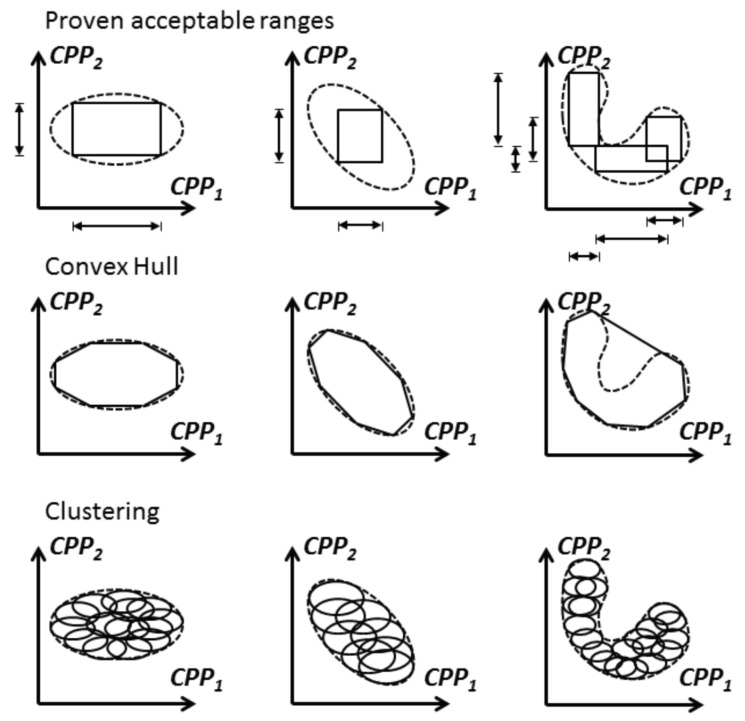
The Process Analytical Technology initiative and Quality by Design paradigm have led to changes in the guidelines and views of how to develop drug manufacturing processes. On this occasion the concept of the design space, which describes the impact of process parameters and material attributes on the attributes of the product, was introduced in the ICH Q8 guideline. The way the design space is defined and can be presented for regulatory approval seems to be left to the applicants, among who at least a consensus on how to characterize the design space seems to have evolved. The large majority of design spaces described in publications seem to follow a "static" statistical experimentation and modeling approach. Given that temporal deviations in the process parameters (i.e., moving within the design space) are of a dynamic nature, static approaches might not suffice for the consideration of the implications of variations in the values of the process parameters. In this paper, different forms of design space representations are discussed and the current consensus is challenged, which in turn, establishes the need for a dynamic representation and characterization of the design space. Subsequently, selected approaches for a dynamic representation, characterization and validation which are proposed in the literature are discussed, also showcasing the opportunity to integrate the activities of process characterization, process monitoring and process control strategy development.
过程分析技术倡议和质量源于设计范式已导致药物制造工艺开发指南和观点的变化。在此之际,ICH Q8指南引入了设计空间的概念,该概念描述了工艺参数和物料属性对产品属性的影响。设计空间的定义方式以及如何呈现以供监管批准似乎由申请人决定,在这些申请人中,至少在如何表征设计空间方面似乎已形成了共识。出版物中描述的绝大多数设计空间似乎都遵循“静态”统计实验和建模方法。鉴于工艺参数的时间偏差(即在设计空间内变动)具有动态性质,静态方法可能不足以考虑工艺参数值变化的影响。本文讨论了设计空间表示的不同形式,并对当前的共识提出了挑战,这反过来又确立了对设计空间进行动态表示和表征的必要性。随后,讨论了文献中提出的动态表示、表征和验证的选定方法,还展示了整合工艺表征、过程监测和过程控制策略开发活动的机会。