Sun Fei, Xu Bing, Dai Shengyun, Zhang Yi, Lin Zhaozhou, Qiao Yanjiang
Guangdong Pharmaceutical University, Guangzhou 510006, China.
Research Center of Traditional Chinese Medicine Information Engineering, Beijing University of Chinese Medicine, Beijing 100029, China.
Pharmaceutics. 2019 Sep 13;11(9):474. doi: 10.3390/pharmaceutics11090474.
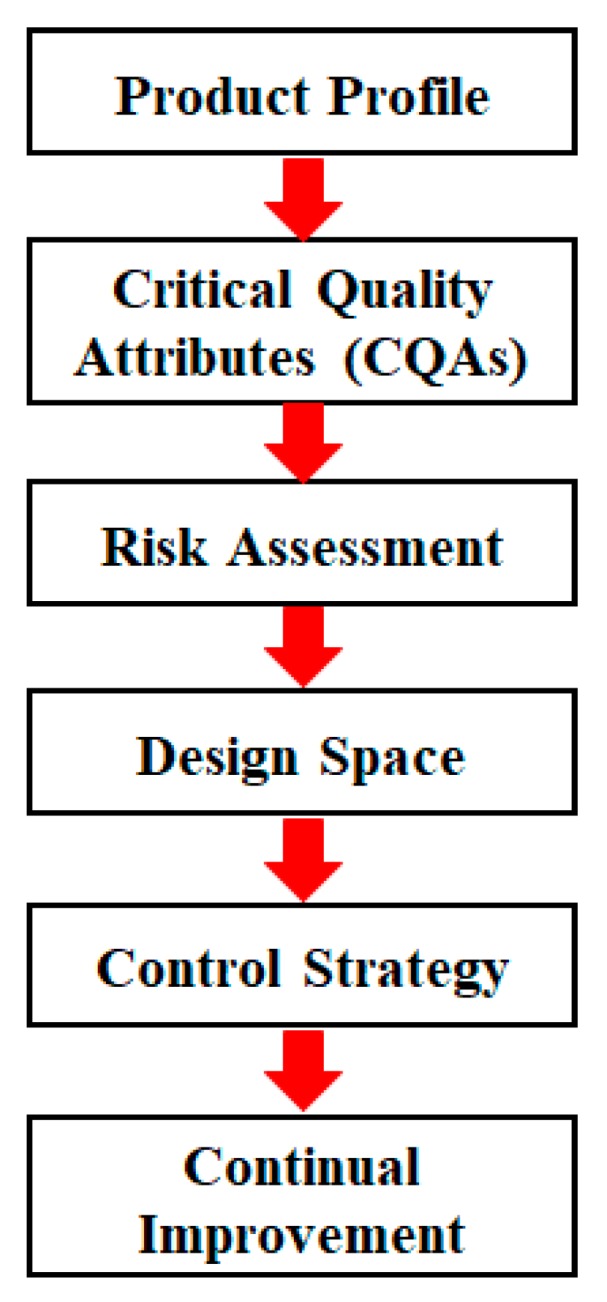
The fundamental principle of Quality by Design (QbD) is that the product quality should be designed into the process through an upstream approach, rather than be tested in the downstream. The keystone of QbD is process modeling, and thus, to develop a process control strategy based on the development of design space. Multivariate statistical analysis is a very useful tool to support the implementation of QbD in pharmaceutical process development and manufacturing. Nowadays, pharmaceutical process modeling is mainly focused on one-unit operations and system modeling for the development of design space across multi-unit operations is still limited. In this study, a general procedure that gives a holistic view for understanding and controlling the process settings for the entire manufacturing process was investigated. The proposed framework was tested on the Saponins immediate release tablet (PNS IRT) production process. The critical variables and the critical units acting on the process were identified according to the importance of explaining the variability in the multi-block partial least squares path model. This improved understanding of the process by illustrating how the properties of the raw materials, the process parameters in the wet granulation and the compaction and the intermediate properties affect the tablet properties. Furthermore, the design space was developed to compensate for the variability source from the upstream. The results demonstrated that the proposed framework was an important tool to gain understanding and control the multi-unit operation process.
质量源于设计(QbD)的基本原则是,产品质量应通过上游方法设计到工艺中,而不是在下游进行测试。QbD的关键是工艺建模,因此,要基于设计空间的开发来制定工艺控制策略。多变量统计分析是支持QbD在制药工艺开发和生产中实施的非常有用的工具。如今,制药工艺建模主要集中在单一单元操作上,而跨多单元操作的设计空间开发的系统建模仍然有限。在本研究中,研究了一种能对整个制造过程的工艺设置进行理解和控制的整体视图的通用程序。所提出的框架在人参皂苷速释片(PNS IRT)生产工艺上进行了测试。根据多块偏最小二乘路径模型中解释变异性的重要性,确定了作用于该工艺的关键变量和关键单元。通过说明原材料的特性、湿法制粒和压片中的工艺参数以及中间特性如何影响片剂特性,提高了对该工艺的理解。此外,开发了设计空间以补偿上游的变异性来源。结果表明,所提出的框架是理解和控制多单元操作过程的重要工具。