The Hormel Institute, University of Minnesota, 801 16th Avenue N.E., Austin, MN, 55912, USA.
Masonic Cancer Center, University of Minnesota, 2231 6th Street S.E., Minneapolis, MN, 55455, USA.
Nat Commun. 2020 Jun 19;11(1):3121. doi: 10.1038/s41467-020-16963-6.
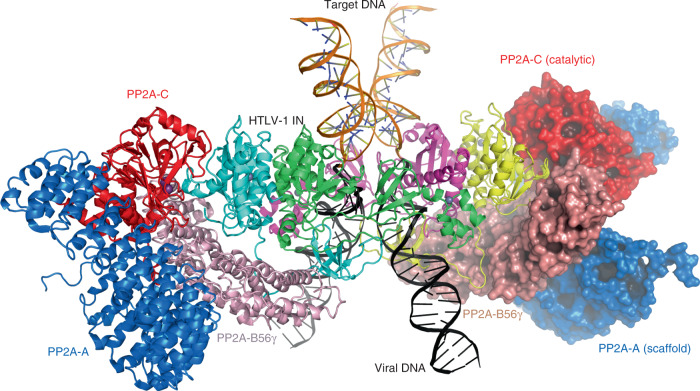
Integration of the reverse-transcribed viral DNA into host chromosomes is a critical step in the life-cycle of retroviruses, including an oncogenic delta(δ)-retrovirus human T-cell leukemia virus type-1 (HTLV-1). Retroviral integrase forms a higher order nucleoprotein assembly (intasome) to catalyze the integration reaction, in which the roles of host factors remain poorly understood. Here, we use cryo-electron microscopy to visualize the HTLV-1 intasome at 3.7-Å resolution. The structure together with functional analyses reveal that the B56γ (B'γ) subunit of an essential host enzyme, protein phosphatase 2 A (PP2A), is repurposed as an integral component of the intasome to mediate HTLV-1 integration. Our studies reveal a key host-virus interaction underlying the replication of an important human pathogen and highlight divergent integration strategies of retroviruses.
逆转录病毒 DNA 整合到宿主染色体中是逆转录病毒生命周期中的一个关键步骤,包括致癌的 δ-逆转录病毒人类 T 细胞白血病病毒 1 型(HTLV-1)。逆转录病毒整合酶形成一个更高阶的核蛋白组装体(intasome)来催化整合反应,但其宿主因子的作用仍知之甚少。在这里,我们使用低温电子显微镜以 3.7-Å 的分辨率可视化 HTLV-1 intasome。该结构与功能分析表明,一种必需的宿主酶,蛋白磷酸酶 2A(PP2A)的 B56γ(B'γ)亚基被重新用作 intasome 的一个组成部分,以介导 HTLV-1 的整合。我们的研究揭示了一个重要人类病原体复制的关键宿主-病毒相互作用,并强调了逆转录病毒的不同整合策略。