Vascular Medicine and Metabolism Unit, Research Unit on Lipids and Atherosclerosis, Sant Joan University Hospital, Universitat Rovira i Virgili, IISPV, C Sant Llorenç, 21, 43201, Reus, Spain.
Spanish Biomedical Research Centre in Diabetes and Associated Metabolic Disorders (CIBERDEM), Madrid, Spain.
Curr Cardiol Rep. 2020 Jun 19;22(8):66. doi: 10.1007/s11886-020-01326-w.
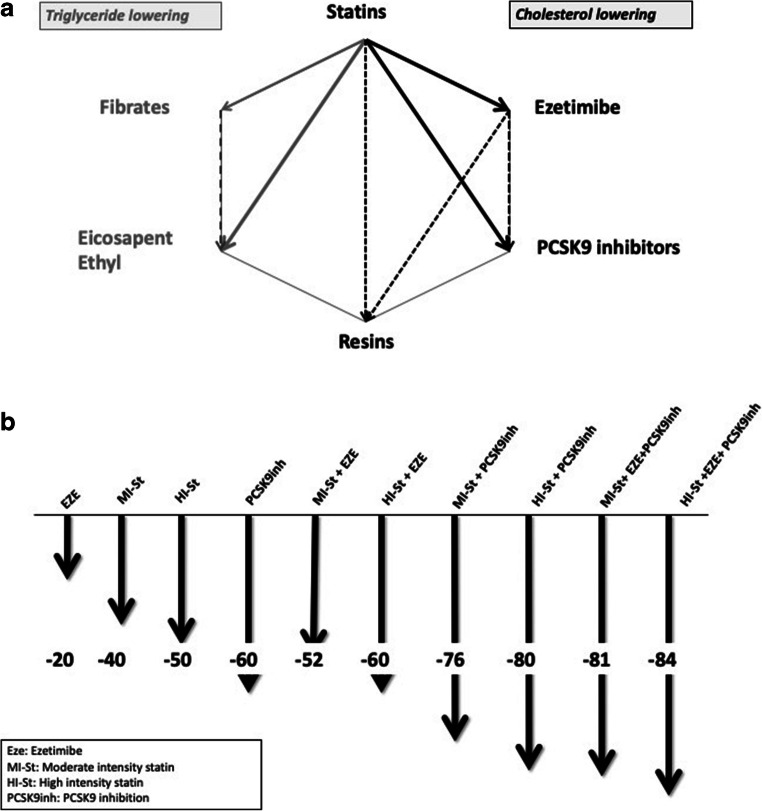
The aim of this report is to review the scientific evidence supporting that lipid lowering therapy (LLT), beyond statins, reduces cardiovascular risk; therefore, treatment strategies based on lipid-lowering drug combination should be implemented.
A strong scientific body of evidence supports the effect of statins on cardiovascular risk reduction. Recent trials using non-statin LLT, ezetimibe, and PCSK9 inhibitors have provide scientific evidence about their impact on cardiovascular prevention. Current clinical guidelines still recommend using high-intensity statin monotherapy before considering combination therapy. The causal effect of LDL-C on atherosclerosis is well established. Moreover, new RCT, meta-analysis, and Mendelian randomization data, support that the main determinant of risk reduction is the absolute LDL reduction regardless of LLT. Accordingly, the "high-intensity statin therapy" concept should be substituted by "high-intensity lipid lowering therapy." Combination therapy must become the standard of care of hypercholesterolemia treatment.
本报告旨在回顾支持降脂治疗(LLT)除他汀类药物以外还能降低心血管风险的科学证据;因此,应实施基于降脂药物联合治疗的策略。
大量科学证据支持他汀类药物降低心血管风险的作用。最近使用非他汀类 LLT、依折麦布和 PCSK9 抑制剂的试验提供了关于其对心血管预防影响的科学证据。目前的临床指南仍建议在考虑联合治疗之前使用高强度他汀类药物单药治疗。LDL-C 对动脉粥样硬化的因果作用已得到充分证实。此外,新的 RCT、荟萃分析和孟德尔随机化数据支持,降低风险的主要决定因素是 LDL 降低的绝对值,而与 LLT 无关。因此,“高强度他汀类药物治疗”的概念应被“高强度降脂治疗”所取代。联合治疗必须成为高胆固醇血症治疗的标准护理。