Department of Psychiatry and Behavioral Sciences, Harborview Medical Center, University of Washington, 325 Ninth Avenue, Box 359911, Seattle, WA, 98104, USA.
Department of Psychiatry and Behavioral Sciences, University of Washington, Seattle, WA, USA.
Community Ment Health J. 2021 Apr;57(3):405-415. doi: 10.1007/s10597-020-00662-z. Epub 2020 Jun 19.
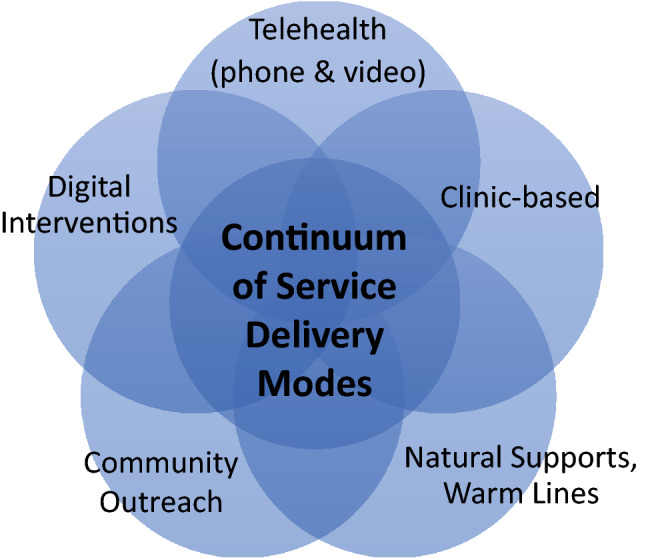
The COVID-19 pandemic has presented a formidable challenge to care continuity for community mental health clients with serious mental illness and for providers who have had to quickly pivot the modes of delivering critical services. Despite these challenges, many of the changes implemented during the pandemic can and should be maintained. These include offering a spectrum of options for remote and in-person care, greater integration of behavioral and physical healthcare, prevention of viral exposure, increased collaborative decision-making related to long-acting injectable and clozapine use, modifying safety plans and psychiatric advance directives to include new technologies and broader support systems, leveraging natural supports, and integration of digital health interventions. This paper represents the authors' collaborative attempt to both reflect the changes to clinical practice we have observed in CMHCs across the US during this pandemic and to suggest how these changes can align with best practices identified in the empirical literature.
新冠疫情对有严重精神疾病的社区心理健康客户的护理连续性以及提供者带来了巨大挑战,他们不得不迅速调整提供关键服务的模式。尽管面临这些挑战,但在疫情期间实施的许多变革可以而且应该保留。这些变革包括提供远程和面对面护理的一系列选择、更大程度地整合行为和身体保健、预防病毒暴露、增加与长效注射和氯氮平使用相关的协作决策、修改安全计划和精神科预立指示以纳入新技术和更广泛的支持系统、利用自然支持以及整合数字健康干预措施。本文代表作者的共同努力,既要反映我们在美国各地的社区心理健康中心在这场大流行中观察到的临床实践变化,又要提出这些变化如何与实证文献中确定的最佳实践保持一致。