Department of Epidemiology and Biostatistics, University of California, San Francisco, CA, USA; Malaria Elimination Initiative, Global Health Group, University of California, San Francisco, CA, USA.
Liverpool School of Tropical Medicine, Liverpool, UK.
Lancet Glob Health. 2020 Jul;8(7):e942-e953. doi: 10.1016/S2214-109X(20)30119-4.
Trials of intermittent preventive treatment (IPTp) of malaria in pregnant women that compared dihydroartemisinin-piperaquine with the standard of care, sulfadoxine-pyrimethamine, showed dihydroartemisinin-piperaquine was superior at preventing malaria infection, but not at improving birthweight. We aimed to assess whether sulfadoxine-pyrimethamine shows greater non-malarial benefits for birth outcomes than does dihydroartemisinin-piperaquine, and whether dihydroartemisinin-piperaquine shows greater antimalarial benefits for birth outcomes than does sulfadoxine-pyrimethamine.
We defined treatment as random assignment to sulfadoxine-pyrimethamine or dihydroartemisinin-piperaquine before pooling individual participant-level data from 1617 HIV-uninfected pregnant women in Kenya (one trial; n=806) and Uganda (two trials; n=811). We quantified the relative effect of treatment on birthweight (primary outcome) attributed to preventing placental malaria infection (mediator). We estimated antimalarial (indirect) and non-malarial (direct) effects of IPTp on birth outcomes using causal mediation analyses, accounting for confounders. We used two-stage individual participant data meta-analyses to calculate pooled-effect sizes.
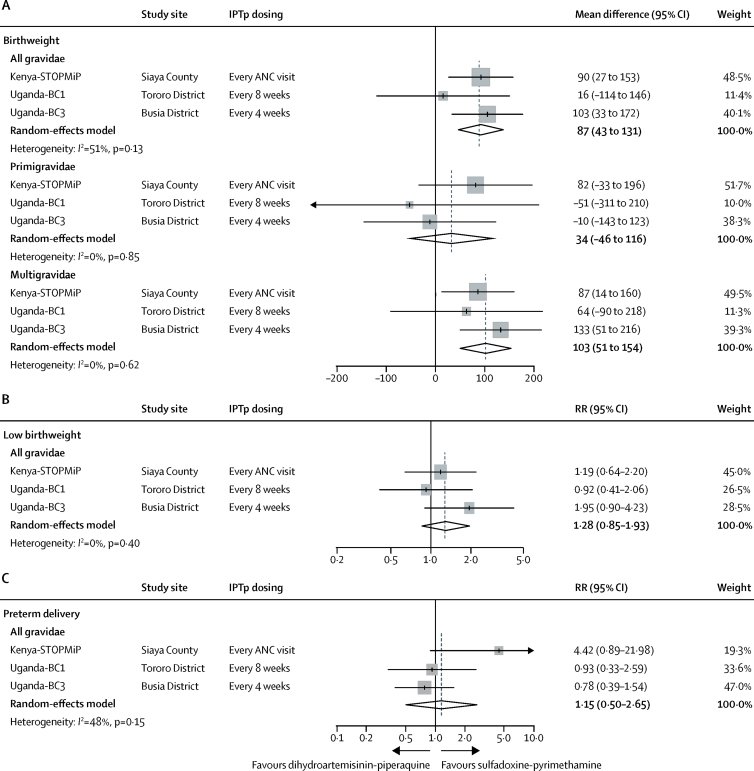
Overall, birthweight was higher among neonates of women randomly assigned to sulfadoxine-pyrimethamine compared with women assigned to dihydroartemisinin-piperaquine (mean difference 69 g, 95% CI 26 to 112), despite placental malaria infection being lower in the dihydroartemisinin-piperaquine group (relative risk [RR] 0·64, 95% CI 0·39 to 1·04). Mediation analyses showed sulfadoxine-pyrimethamine conferred a greater non-malarial effect than did dihydroartemisinin-piperaquine (mean difference 87 g, 95% CI 43 to 131), whereas dihydroartemisinin-piperaquine conferred a slightly larger antimalarial effect than did sulfadoxine-pyrimethamine (8 g, -9 to 26), although more frequent dosing increased the antimalarial effect (31 g, 3 to 60).
IPTp with sulfadoxine-pyrimethamine appears to have potent non-malarial effects on birthweight. Further research is needed to evaluate monthly dihydroartemisinin-piperaquine with sulfadoxine-pyrimethamine (or another compound with non-malarial effects) to achieve greater protection against malarial and non-malarial causes of low birthweight.
Eunice Kennedy Shriver National Institute of Child Health and Human Development, Bill & Melinda Gates Foundation, and Worldwide Antimalarial Resistance Network.
比较二氢青蒿素-哌喹与标准护理(磺胺多辛-乙胺嘧啶)的间歇性预防治疗(IPT)试验表明,二氢青蒿素-哌喹在预防疟疾感染方面更有效,但在提高出生体重方面效果不明显。我们旨在评估磺胺多辛-乙胺嘧啶在改善出生结局方面是否比二氢青蒿素-哌喹具有更大的非疟疾益处,以及二氢青蒿素-哌喹在改善出生结局方面是否比磺胺多辛-乙胺嘧啶具有更大的抗疟疾益处。
我们将治疗定义为随机分配磺胺多辛-乙胺嘧啶或二氢青蒿素-哌喹,然后汇总来自肯尼亚(一项试验;n=806)和乌干达(两项试验;n=811)1617 名未感染艾滋病毒的孕妇的个体参与者水平数据。我们量化了治疗对出生体重(主要结局)的影响归因于预防胎盘疟疾感染(中介)。我们使用因果中介分析估计 IPTp 对出生结局的抗疟疾(间接)和非疟疾(直接)作用,同时考虑混杂因素。我们使用两阶段个体参与者数据荟萃分析来计算汇总效应大小。
总体而言,与接受二氢青蒿素-哌喹治疗的女性相比,接受磺胺多辛-乙胺嘧啶治疗的女性的新生儿出生体重更高(平均差异 69 克,95%CI 26 至 112),尽管二氢青蒿素-哌喹组的胎盘疟疾感染率较低(相对风险 [RR] 0.64,95%CI 0.39 至 1.04)。中介分析表明,磺胺多辛-乙胺嘧啶比二氢青蒿素-哌喹具有更大的非疟疾作用(平均差异 87 克,95%CI 43 至 131),而二氢青蒿素-哌喹比磺胺多辛-乙胺嘧啶具有略大的抗疟疾作用(8 克,-9 至 26),尽管更频繁的给药会增加抗疟疾作用(31 克,3 至 60)。
IPTp 用磺胺多辛-乙胺嘧啶似乎对出生体重有很强的非疟疾作用。需要进一步研究评估每月用二氢青蒿素-哌喹与磺胺多辛-乙胺嘧啶(或另一种具有非疟疾作用的化合物)联合使用,以更好地预防疟疾和非疟疾导致的低出生体重。
美国国立儿童健康与人类发育研究所、比尔及梅琳达·盖茨基金会和全球抗疟耐药网络。