Roh Michelle E, Gutman Julie, Murphy Maxwell, Hill Jenny, Madanitsa Mywayiwawo, Kakuru Abel, Barsosio Hellen C, Kariuki Simon, Lusingu John P A, Mosha Frank, Kajubi Richard, Kamya Moses R, Mathanga Don, Chinkhumba Jobiba, Laufer Miriam K, Mlugu Eulambius, Kamuhabwa Appolinary A R, Aklillu Eleni, Minzi Omary, Okoro Roland Nnaemeka, Geidam Ado Danazumi, Ohieku John David, Desai Meghna, Jagannathan Prasanna, Dorsey Grant, Ter Kuile Feiko O
Institute for Global Health Sciences, University of California, San Francisco, San Francisco, CA, USA.
Malaria Branch, Division of Parasitic Diseases and Malaria, Centers for Disease Control and Prevention (CDC), Atlanta, GA, USA.
medRxiv. 2024 Nov 26:2024.11.23.24315401. doi: 10.1101/2024.11.23.24315401.
High-grade resistance to sulfadoxine-pyrimethamine in East and Southern Africa has prompted numerous trials evaluating intermittent preventive treatment in pregnancy (IPTp) with dihydroartemisinin-piperaquine as an alternative to sulfadoxine-pyrimethamine.
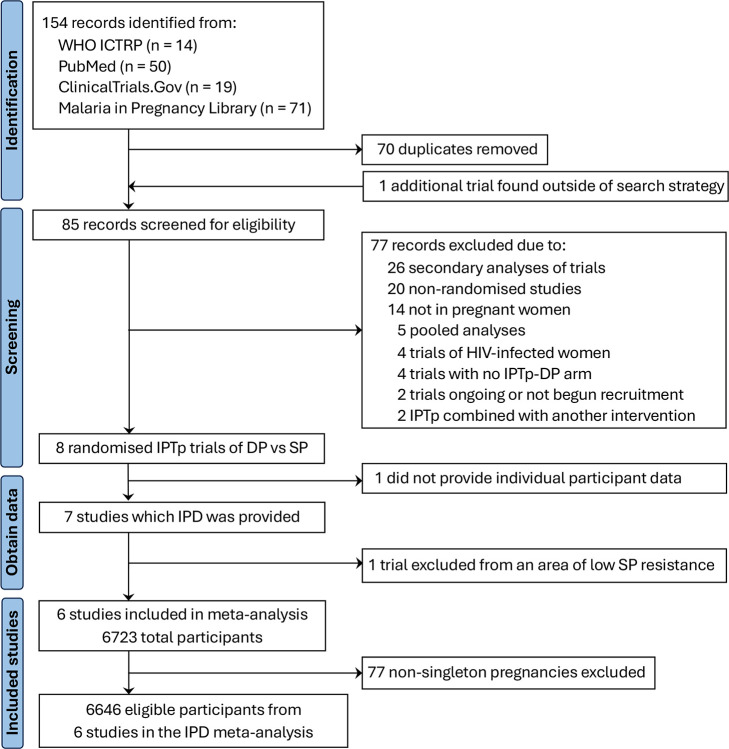
We conducted individual participant data meta-analyses of randomised trials comparing IPTp with dihydroartemisinin-piperaquine to sulfadoxine-pyrimethamine on maternal, birth, and infant outcomes. We searched the WHO International Clinical Trials Registry Platform, ClinicalTrials.Gov, PubMed, and the Malaria in Pregnancy Consortium Library. Eligible trials enrolled HIV-uninfected pregnant women, followed participants to delivery, included participants with no prior IPTp use during the current pregnancy, and were conducted in areas with high-level parasite resistance to sulfadoxine-pyrimethamine (i.e., PfDHPS 540E≥90% and/or 581G>0%). Only singleton pregnancies were analysed. Meta-analyses used a two-stage approach: first, study-specific estimates were generated and then pooled using a random-effects model. Gravidity subgroup analyses were performed. Causal mediation analyses were used to investigate the maternal mechanisms underlying the effect of IPTp regimens on birth outcomes. The meta-analysis is registered in PROSPERO (CRD42020196127).
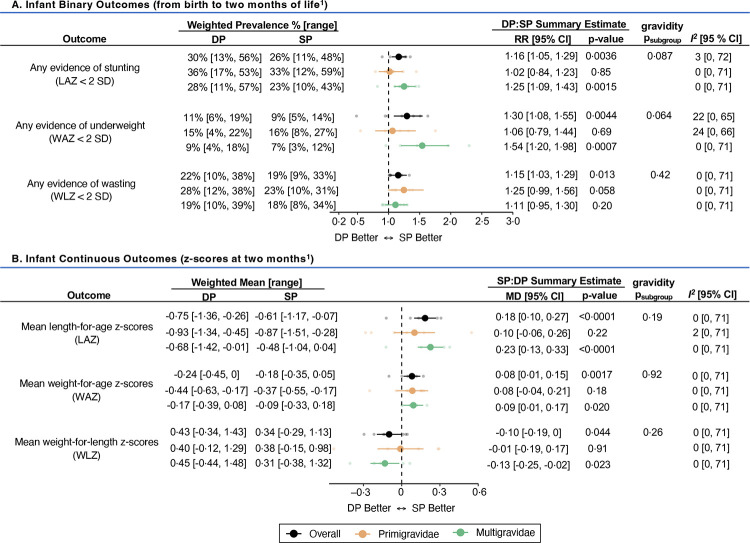
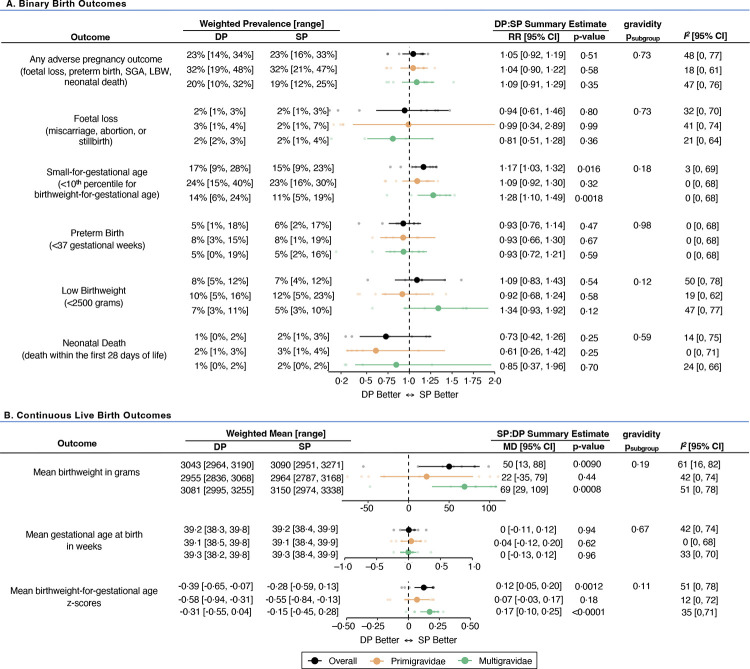
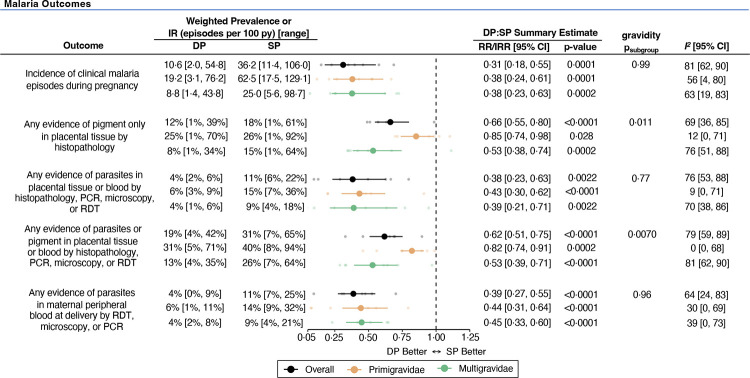
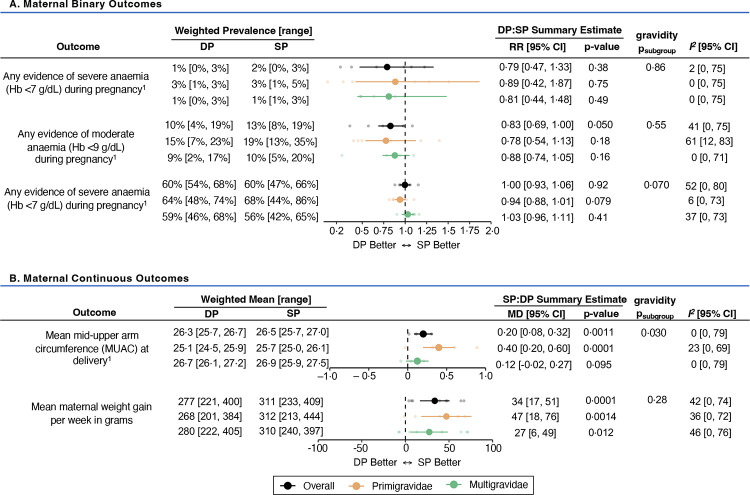
Of 85 screened records, six trials (one multi-country trial) contributed data on 6646 pregnancies. Compared to sulfadoxine-pyrimethamine, dihydroarteminsinin-piperaquine was associated with a 69% [95% CI: 45%-82%] lower incidence of clinical malaria during pregnancy, a 62% [37%-77%] lower risk of placental parasitaemia, and a 17% [0%-31%] lower incidence of moderate maternal anaemia (Hb<9 g/dL). In contrast, sulfadoxine-pyrimethamine was associated with higher mean weekly maternal weight gain (34 grams/week [17-51]). There were no statistically significant differences in the composite adverse pregnancy outcome between the two IPTp regimens (RR=1·05 [95% CI: 0·92-1·19]; =48%), although the risk of small-for-gestational-age was 15% [3%-24%] lower in the sulfadoxine-pyrimethamine arm. Among multigravidae, participants of the sulfadoxine-pyrimethamine arm were 20% [8%-30%] and 35% [17%-49%] less likely to have stunted and underweight infants by two months compared to the dihydroartemisinin-piperaquine arm. Infant wasting by two months was 13% [3%-22%] lower in the sulfadoxine-pyrimethamine arm, regardless of gravidity. Mediation analyses indicated that 15% [0%-19%] of sulfadoxine-pyrimethamine's superior effect on reducing small-for-gestational-age risk was mediated by its greater impact on gestational weight gain.
In areas of high sulfadoxine-pyrimethamine resistance, dihydroartemisin-inpiperaquine is a more efficacious antimalarial than sulfadoxine-pyrimethamine. However, replacing sulfadoxine-pyrimethamine with dihydroartemisinin-piperaquine alone will not result in better maternal, birth, or infant outcomes. It could increase the risk of SGA, since much of the effect of sulfadoxine-pyrimethamine may be exerted through non-malarial mechanisms. Future research evaluating the alternative strategies for IPTp are needed, including with the combination of sulfadoxine-pyrimethamine and dihydroartemisinin-piperaquine.
This work was supported by the Bill and Melinda Gates Foundation and Eunice Kennedy Shriver National Institute of Child Health and Human Development.
在东非和南非,对磺胺多辛-乙胺嘧啶的高度耐药性促使开展了多项试验,评估以双氢青蒿素-哌喹进行孕期间歇性预防治疗(IPTp)作为磺胺多辛-乙胺嘧啶的替代方案。
我们对随机试验进行了个体参与者数据荟萃分析,比较了以双氢青蒿素-哌喹进行IPTp与磺胺多辛-乙胺嘧啶在孕产妇、分娩及婴儿结局方面的差异。我们检索了世界卫生组织国际临床试验注册平台、ClinicalTrials.Gov、PubMed以及妊娠疟疾联盟图书馆。符合条件的试验纳入未感染艾滋病毒的孕妇,对参与者进行随访直至分娩,纳入在本次孕期未使用过IPTp的参与者,并在对磺胺多辛-乙胺嘧啶具有高水平寄生虫耐药性的地区开展(即,PfDHPS 540E≥90%和/或581G>0%)。仅分析单胎妊娠。荟萃分析采用两阶段方法:首先,生成研究特异性估计值,然后使用随机效应模型进行汇总。进行了产次亚组分析。采用因果中介分析来研究IPTp方案对分娩结局影响的孕产妇机制。该荟萃分析已在国际前瞻性系统评价注册库(PROSPERO)注册(CRD42020196127)。
在85条筛选记录中,六项试验(一项多国试验)提供了6646例妊娠的数据。与磺胺多辛-乙胺嘧啶相比,双氢青蒿素-哌喹与孕期临床疟疾发病率降低69%[95%CI:45%-82%]、胎盘寄生虫血症风险降低62%[37%-77%]以及中度孕产妇贫血(血红蛋白<9 g/dL)发病率降低17%[0%-31%]相关。相比之下,磺胺多辛-乙胺嘧啶与孕产妇每周平均体重增加较高相关(34克/周[17-51])。两种IPTp方案在复合不良妊娠结局方面无统计学显著差异(RR = 1.05[95%CI:0.92-1.19];P = 48%),尽管在磺胺多辛-乙胺嘧啶组中,小于胎龄儿的风险降低了15%[3%-24%]。在多产妇中,与双氢青蒿素-哌喹组相比,磺胺多辛-乙胺嘧啶组的参与者在两个月时婴儿发育迟缓及体重不足的可能性分别降低20%[8%-30%]和35%[17%-49%]。无论产次如何,在磺胺多辛-乙胺嘧啶组中,两个月时婴儿消瘦的情况降低了13%[3%-22%]。中介分析表明,磺胺多辛-乙胺嘧啶在降低小于胎龄儿风险方面的优势效应中有15%[0%-19%]是通过其对孕期体重增加的更大影响介导的。
在磺胺多辛-乙胺嘧啶耐药性高的地区,双氢青蒿素-哌喹是比磺胺多辛-乙胺嘧啶更有效的抗疟药。然而,仅用双氢青蒿素-哌喹替代磺胺多辛-乙胺嘧啶不会带来更好的孕产妇、分娩或婴儿结局。这可能会增加小于胎龄儿的风险,因为磺胺多辛-乙胺嘧啶的许多效应可能是通过非疟疾机制发挥的。需要开展未来研究来评估IPTp的替代策略,包括磺胺多辛-乙胺嘧啶与双氢青蒿素-哌喹联合使用。
本研究得到了比尔及梅琳达·盖茨基金会以及尤妮斯·肯尼迪·施莱佛国家儿童健康与人类发展研究所的支持。