Zombori Tamás, Sejben Anita, Tiszlavicz László, Cserni Gábor, Pálföldi Regina, Csada Edit, Furák József
Department of Pathology, Faculty of Medicine, University of Szeged, Állomás u. 1., H6725, Szeged, Hungary.
Department of Pathology, Bács-Kiskun County Teaching Hospital, Nyíri út 38, Kecskemét, H6000, Hungary.
Pathol Oncol Res. 2020 Oct;26(4):2451-2458. doi: 10.1007/s12253-020-00855-7. Epub 2020 Jun 20.
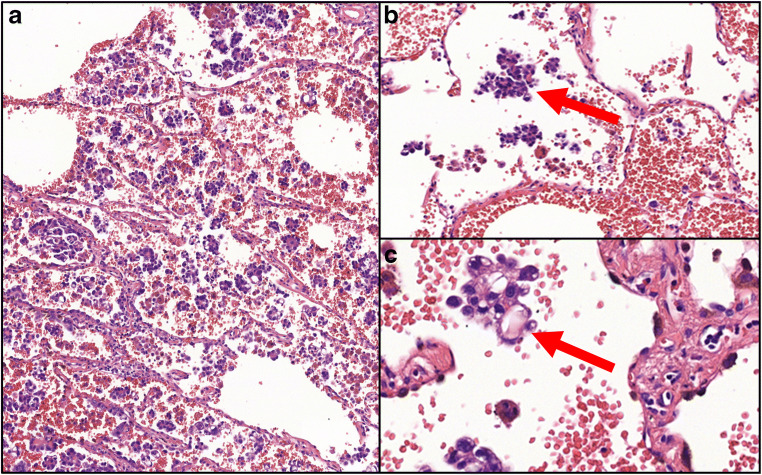
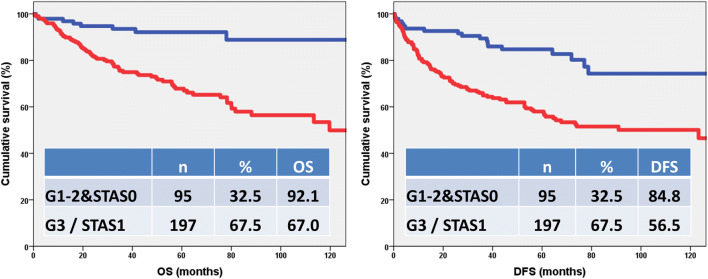
The spread through air spaces (STAS) has a main role in local recurrence of stage I lung adenocarcinomas (LAs), therefore its presence might question sublobar resection as a therapeutic option. The aim of our study was to evaluate the distribution of STAS in stage I LAs, to stratify patients according to local recurrence and to identify a group of patients who might be suitable for sublobar surgery. Patients resected with LA were included. The presence of STAS was recorded on hematoxylin eosin stained slides and clinicopathological data were obtained from medical charts. Overall survival (OS) and disease-free survival (DFS) were registered. Statistical methods included Kruskal-Wallis tests, Kaplan-Meier analyses, log-rank tests and Cox-regressions. 292 patients were included. STAS was identified in 38.7% and 95.7% of micropapillary carcinomas showed STAS. Significant correlation was found between STAS and high-grade patterns. Significant differences were found between OS and DFS estimates of STAS0 and STAS1 cases (5-y-OS: 80.0% vs. 68.4%; 5-y-DFS: 71.1% vs. 57.1%). The presence of STAS was associated with unfavorable prognosis in low and intermediate architectural grades, but not in high-grade. Multivariate analysis revealed that architectural grade (HR:2.09; HR:1.52) and STAS (HR:1.51; HR:1.48) were independent prognostic markers in stage I LA. Architectural grade combined with STAS was superior to other prognostic grades. The combination of architectural grade and STAS proved to be a prognostic factor that is superior to previously introduced grading systems. Patients having low and intermediate grade LAs without STAS might be eligible for sublobar resection.
气腔播散(STAS)在Ⅰ期肺腺癌(LA)的局部复发中起主要作用,因此其存在可能使肺叶下切除作为一种治疗选择受到质疑。我们研究的目的是评估STAS在Ⅰ期LA中的分布,根据局部复发对患者进行分层,并确定一组可能适合肺叶下手术的患者。纳入接受LA切除的患者。在苏木精伊红染色切片上记录STAS的存在,并从病历中获取临床病理数据。记录总生存期(OS)和无病生存期(DFS)。统计方法包括Kruskal-Wallis检验、Kaplan-Meier分析、对数秩检验和Cox回归。共纳入292例患者。38.7%的患者发现有STAS,95.7%的微乳头癌显示有STAS。发现STAS与高级别模式之间存在显著相关性。STAS0和STAS1病例的OS和DFS估计值之间存在显著差异(5年OS:80.0%对68.4%;5年DFS:71.1%对57.1%)。在低和中等结构分级中,STAS的存在与不良预后相关,但在高级别中并非如此。多变量分析显示,结构分级(HR:2.09;HR:1.52)和STAS(HR:1.51;HR:1.48)是Ⅰ期LA的独立预后标志物。结构分级与STAS相结合优于其他预后分级。结构分级和STAS的组合被证明是一个优于先前引入的分级系统的预后因素。没有STAS的低和中等分级LA患者可能适合肺叶下切除。