Romo-Ibáñez Álvaro, Calatrava-Hernández Elisabeth, Gutiérrez-Soto Blanca, Pérez-Ruiz Mercedes, Navarro-Marí José María, Gutiérrez-Fernández José
Department of Microbiology, School of Medicine, University of Granada-Instituto de Investigación Biosanitaria, Granada, Spain.
Department of Microbiology, Hospital Universitario Virgen de las Nieves-Instituto de Investigación Biosanitaria, Granada, Spain.
Ann Transl Med. 2020 May;8(9):604. doi: 10.21037/atm.2020.02.158.
Antibiotic resistance is a serious public health challenge exacerbated by the widespread use of β-lactam and glycopeptide antibiotics. The identification of resistances is crucial, and CHROMID ESBL medium has been developed to detect enterobacteria with extended-spectrum β-lactamases (ESBL). The objective of this study was to evaluate the potential of this medium to detect other types of resistant bacteria.
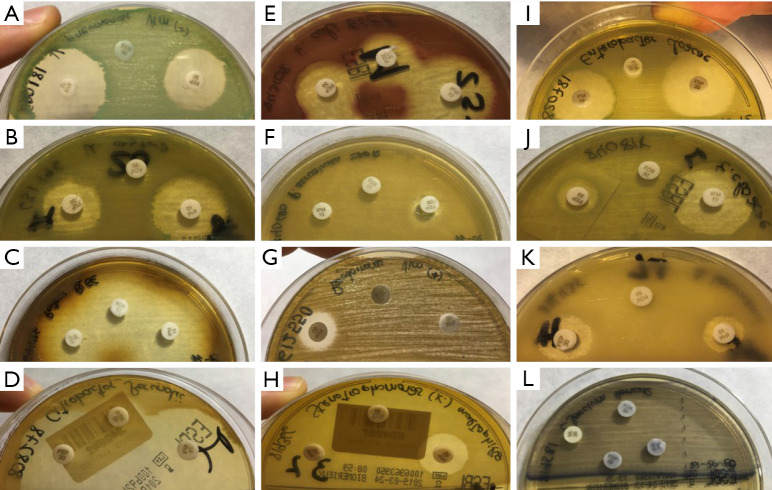
Vancomycin, cefoxitin, imipenem, and cefepime disks were used to measure growth on CHROMID ESBL medium of β-lactam-resistant Gram-negative (83 with ESBL, 57 with carbapenemases, 35 with AmpC and 3 ) and Gram-positive [37 vancomycin-susceptible (vancoS) microorganisms and 21 vancomycin-resistant (vancoR) ] clinical isolates (retrospective study) and colonization by the aforementioned bacteria (prospective study), using 649 rectal swabs, 314 pharyngeal swabs, and 44 swabs from other localizations.
Retrospective study: species grown on the medium exhibited different colors. Growth on the medium was observed for: all ESBL enterobacteria, which were susceptible to imipenem and cefoxitin; 95% of isolates with carbapenemases, mostly resistant to imipenem; 80% of those with AmpC; 86% of vancoR isolates; and 42% of vancoS isolates, with large growth inhibition halos around the vancomycin disk. Prospective study: vancoR , ESBL , with carbapenemases, (mostly from rectal swabs), , and (mostly from pharyngeal swabs) were isolated from the 246 positive samples.
CHROMID ESBL medium permitted the differential growth of Gram-negative bacteria, many with ESBL and carbapenemases. ESBL enterobacteria were susceptible to imipenem, carbapenemase-producing microorganisms grew around the imipenem disk, and vancoR was isolated on the medium. Results of the prospective study demonstrate the potential clinical relevance of this medium. was more frequently detected with pharyngeal swabs and ESBL , A. and with rectal swabs.
抗生素耐药性是一个严重的公共卫生挑战,β-内酰胺类和糖肽类抗生素的广泛使用加剧了这一挑战。耐药性的鉴定至关重要,CHROMID ESBL培养基已被开发用于检测产超广谱β-内酰胺酶(ESBL)的肠杆菌。本研究的目的是评估该培养基检测其他类型耐药菌的潜力。
使用万古霉素、头孢西丁、亚胺培南和美罗培南纸片,检测β-内酰胺耐药革兰氏阴性菌(83株产ESBL、57株产碳青霉烯酶、35株产AmpC和3株其他)和革兰氏阳性菌[37株万古霉素敏感(vancoS)微生物和21株万古霉素耐药(vancoR)]临床分离株在CHROMID ESBL培养基上的生长情况(回顾性研究),以及上述细菌的定植情况(前瞻性研究),使用了649份直肠拭子、314份咽拭子和44份其他部位的拭子。
回顾性研究:在培养基上生长的菌种呈现不同颜色。观察到以下菌种在培养基上生长:所有对亚胺培南和头孢西丁敏感的产ESBL肠杆菌;95%的产碳青霉烯酶分离株,大多对亚胺培南耐药;80%的产AmpC分离株;86%的vancoR分离株;以及42%的vancoS分离株,在万古霉素纸片周围有较大的生长抑制圈。前瞻性研究:从246份阳性样本中分离出vancoR、产ESBL、产碳青霉烯酶(大多来自直肠拭子)、其他(大多来自咽拭子)。
CHROMID ESBL培养基允许革兰氏阴性菌进行差异生长,许多产ESBL和碳青霉烯酶。产ESBL肠杆菌对亚胺培南敏感,产碳青霉烯酶的微生物在亚胺培南纸片周围生长,vancoR在该培养基上被分离出来。前瞻性研究结果证明了该培养基潜在的临床相关性。其他在咽拭子中更频繁检测到,产ESBL、不动杆菌属和其他在直肠拭子中更常见。