Yin Jianjian, Jiang Yuqing, Nong Luming
Department of Orthopedics, The Affiliated Changzhou No.2 People's Hospital with Nanjing Medical University, Changzhou, China.
Medicine (Baltimore). 2020 Jun 19;99(25):e20709. doi: 10.1097/MD.0000000000020709.
To systematically analyze the differences of complications between percutaneous transforaminal endoscopic discectomy (PTED) and percutaneous interlaminar endoscopic discectomy (PIED) in the treatment of lumbar disc herniation.
We performed a systematic search in MEDLINE, EMBASE, PubMed, Web of Science, Cochrane databases, Chinese Biomedical Literature Database, CNKI, and Wanfang Data for all relevant studies. All statistical analysis was performed using Review Manager Version 5.3.
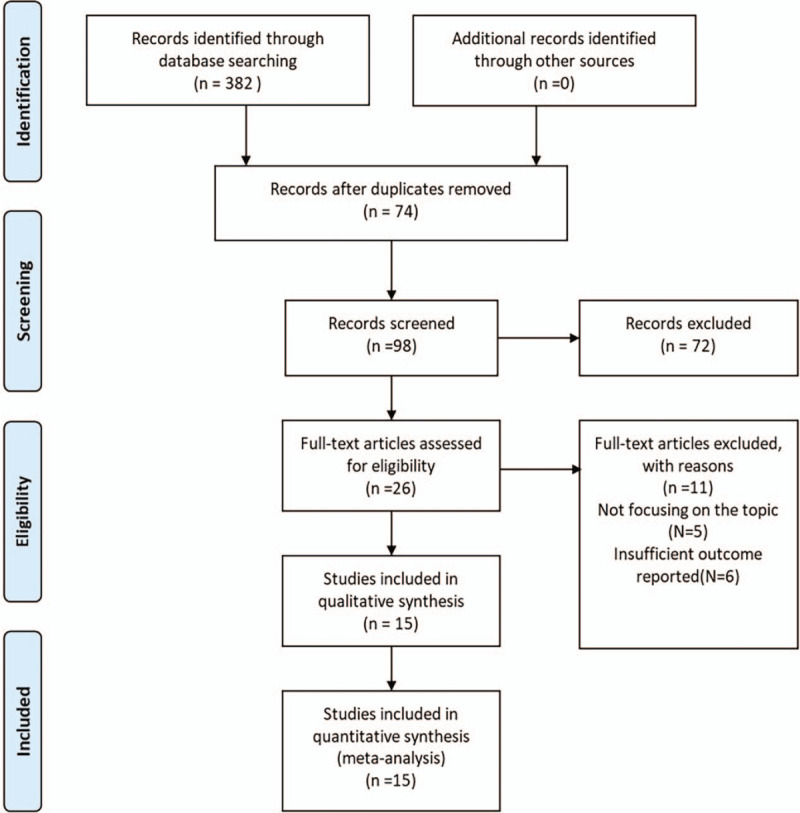
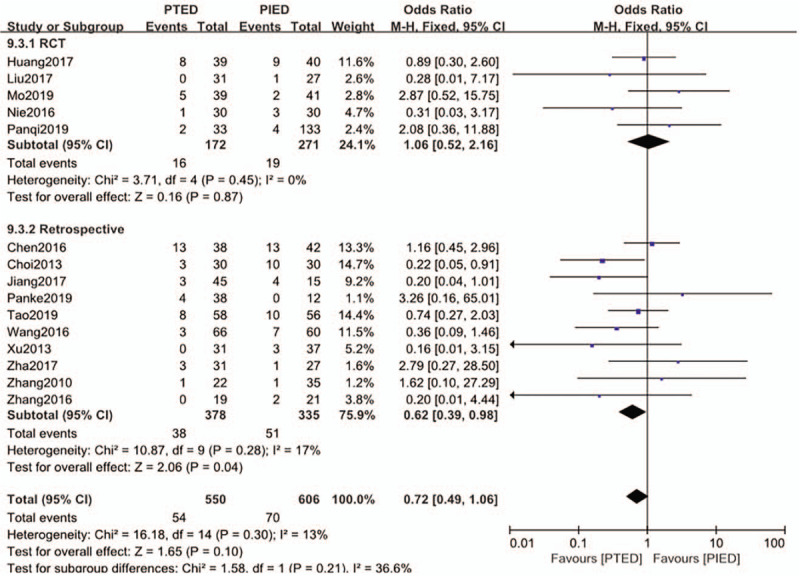
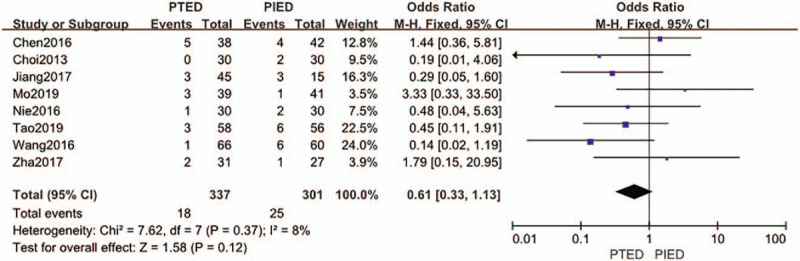
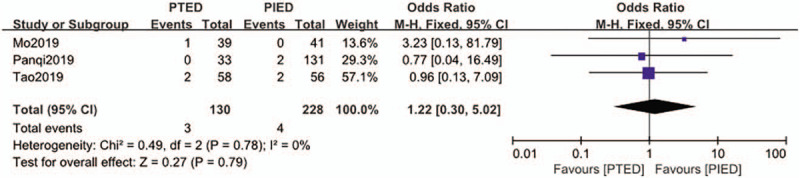
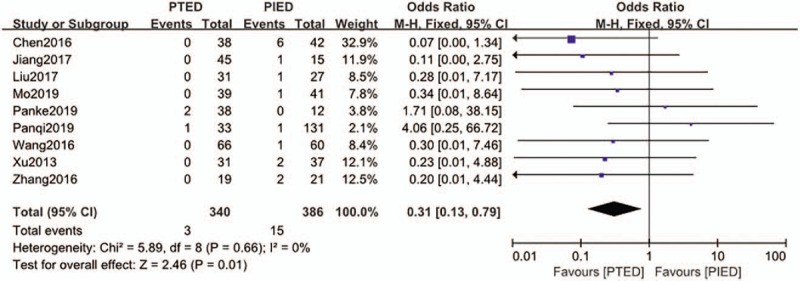
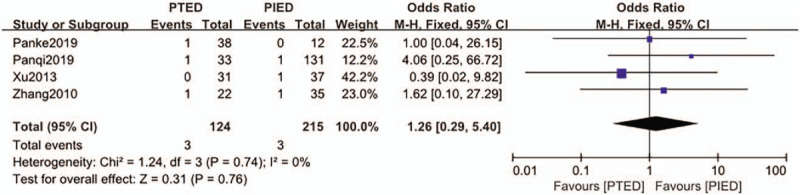
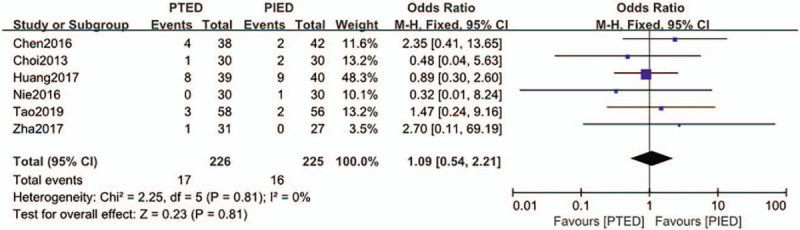
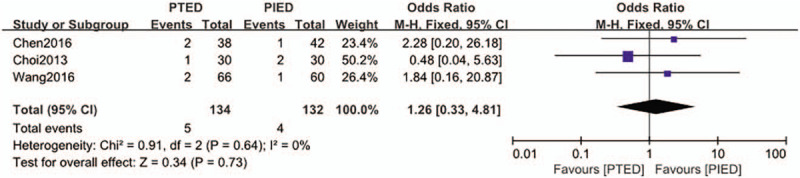
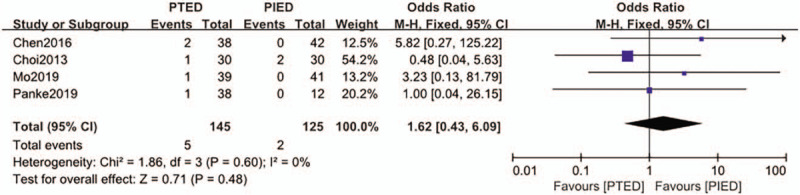
A total of 15 articles with 1156 study subjects were included, with 550 patients in PTED group and 606 patients in PIED group. The results of the meta-analysis showed that postoperative dysesthesia (odds ratio [OR] = 0.61, 95% confidence interval [CI], 0.33-1.13), nerve root injury (OR = 1.22, 95% CI, 0.30-5.02), surgical site wound complications (OR = 1.26, 95% CI, 0.29-5.40), recurrence (OR = 1.09, 95% CI, 0.54-2.21), conversion to open surgery (OR = 1.26, 95% CI, 0.33-4.81), incomplete decompression (OR = 1.62, 95% CI, 0.43-6.09), and total complication (OR = 0.72, 95% CI, 0.49-1.06) showed no significant differences between the PTED group and the PIED group, while the PTED group had significantly better results in dural tear compared with the PIED group (OR = 0.31, 95% CI, 0.13-0.79).
Dural tear was significantly less occured in PTED compared with PIED. The postoperative dysesthesia, nerve root injury, surgical site wound complications, recurrence, conversion to open surgery, incomplete decompression, and total complication did not differ significantly between PTED and PIED in the treatment of lumbar disc herniation.
系统分析经皮椎间孔镜下椎间盘切除术(PTED)与经皮椎板间孔镜下椎间盘切除术(PIED)治疗腰椎间盘突出症并发症的差异。
在MEDLINE、EMBASE、PubMed、Web of Science、Cochrane数据库、中国生物医学文献数据库、CNKI和万方数据中对所有相关研究进行系统检索。所有统计分析均使用Review Manager 5.3版进行。
共纳入15篇文章,1156例研究对象,PTED组550例患者,PIED组606例患者。荟萃分析结果显示,术后感觉异常(比值比[OR]=0.61,95%置信区间[CI],0.33-1.13)、神经根损伤(OR=1.22,95%CI,0.30-5.02)、手术部位伤口并发症(OR=1.26,95%CI,0.29-5.40)、复发(OR=1.09,95%CI,0.54-2.21)、转为开放手术(OR=1.26,95%CI,0.33-4.81)、减压不完全(OR=1.62,95%CI,0.43-6.09)和总并发症(OR=0.72,95%CI,0.49-1.06)在PTED组和PIED组之间无显著差异,而PTED组在硬脊膜撕裂方面的结果明显优于PIED组(OR=0.31,95%CI,0.13-0.79)。
与PIED相比,PTED中硬脊膜撕裂的发生率明显更低。在治疗腰椎间盘突出症方面,PTED和PIED在术后感觉异常、神经根损伤、手术部位伤口并发症、复发、转为开放手术、减压不完全和总并发症方面无显著差异。