Department of Molecular and Cellular Biology, Baylor College of Medicine, Houston, TX 77030, USA
Department of Molecular and Cellular Biology, Baylor College of Medicine, Houston, TX 77030, USA.
Dis Model Mech. 2020 Aug 18;13(8):dmm044412. doi: 10.1242/dmm.044412.
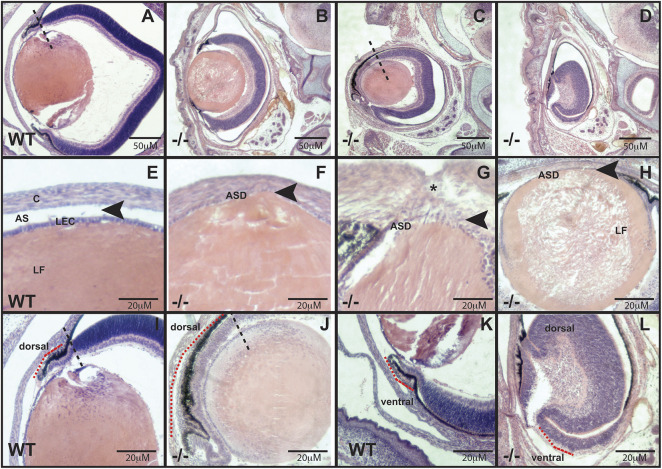
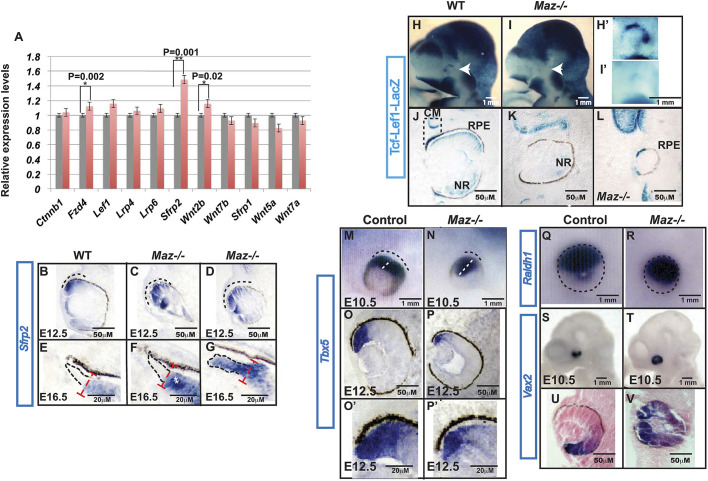
Wnt/β-catenin signaling has an essential role in eye development. Faulty regulation of this pathway results in ocular malformations, owing to defects in cell-fate determination and differentiation. Herein, we show that disruption of , the gene encoding -associated zinc-finger transcription factor, produces developmental eye defects in mice and humans. Expression of key genes involved in the Wnt cascade, , and , was significantly increased in mice with targeted inactivation of , resulting in abnormal peripheral eye formation with reduced proliferation of the progenitor cells in the region. Paradoxically, the Wnt reporter TCF-Lef1 displayed a significant downregulation in -deficient eyes. Molecular analysis indicates that is necessary for the activation of the Wnt/β-catenin pathway and participates in the network controlling ciliary margin patterning. Copy-number variations and single-nucleotide variants of were identified in humans that result in abnormal ocular development. The data support as a key contributor to the eye comorbidities associated with chromosome 16p11.2 copy-number variants and as a transcriptional regulator of ocular development.
Wnt/β-catenin 信号通路在眼睛发育中起着至关重要的作用。由于细胞命运决定和分化缺陷,该途径的调节失灵会导致眼部畸形。在此,我们发现编码与 β-catenin 相关的锌指转录因子的基因的破坏会导致小鼠和人类的发育性眼部缺陷。靶向敲除 导致关键基因在 Wnt 级联中的表达显著增加,导致周边眼部形成异常,祖细胞在该区域的增殖减少。矛盾的是,Wnt 报告基因 TCF-Lef1 在 缺陷眼中显著下调。分子分析表明,对于 Wnt/β-catenin 通路的激活是必需的,并参与控制纤毛边缘模式形成的网络。在人类中发现了 的拷贝数变异和单核苷酸变异,导致眼部发育异常。这些数据支持作为与 16p11.2 拷贝数变异相关的染色体眼部并发症的关键贡献者,以及作为眼部发育的转录调节剂。