Department of Medical Bioengineering, Graduate School of Natural Science and Technology, Okayama University, Okayama, 700-8530, Japan.
Department of Pathology, Tianjin Central Hospital of Gynecology Obstetrics, Tianjin, 300100, People's Republic of China.
Sci Rep. 2020 Jun 22;10(1):9955. doi: 10.1038/s41598-020-66471-2.
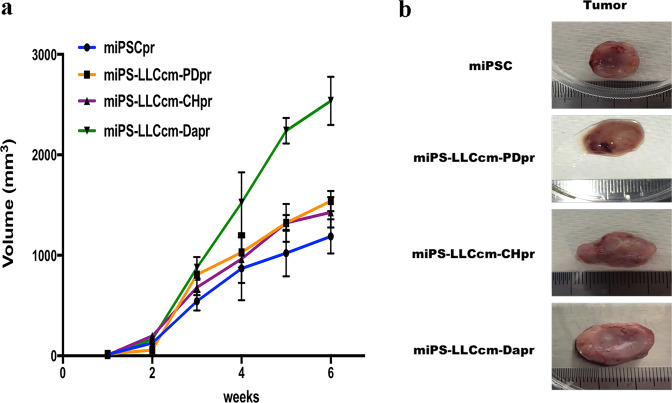
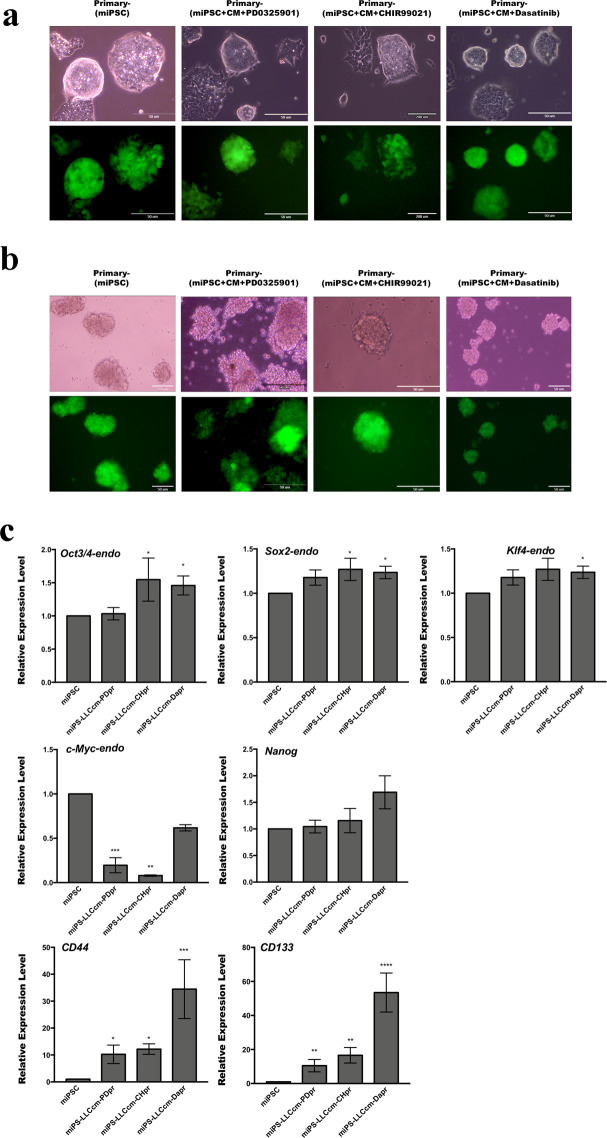
Cancer stem cells (CSCs) are a class of cancer cells characterized by self-renewal, differentiation and tumorigenic potential. We previously established a model of CSCs by culturing mouse induced pluripotent stem cells (miPSCs) for four weeks in the presence of a conditioned medium (CM) of cancer cell lines, which functioned as the tumor microenvironment. Based on this methodology of developing CSCs from miPSCs, we assessed the risk of 110 non-mutagenic chemical compounds, most of which are known as inhibitors of cytoplasmic signaling pathways, as potential carcinogens. We treated miPSCs with each compound for one week in the presence of a CM of Lewis lung carcinoma (LLC) cells. However, one-week period was too short for the CM to convert miPSCs into CSCs. Consequently, PDO325901 (MEK inhibitor), CHIR99021 (GSK-3β inhibitor) and Dasatinib (Abl, Src and c-Kit inhibitor) were found to confer miPSCs with the CSC phenotype in one week. The tumor cells that survived exhibited stemness markers, spheroid formation and tumorigenesis in Balb/c nude mice. Hence, we concluded that the three signal inhibitors accelerated the conversion of miPSCs into CSCs. Similarly to our previous study, we found that the PI3K-Akt signaling pathway was upregulated in the CSCs. Herein, we focused on the expression of relative genes after the treatment with these three inhibitors. Our results demonstrated an increased expression of pik3ca, pik3cb, pik3r5 and pik3r1 genes indicating class IA PI3K as the responsible signaling pathway. Hence, AKT phosphorylation was found to be up-regulated in the obtained CSCs. Inhibition of Erk1/2, tyrosine kinase, and/or GSK-3β was implied to be involved in the enhancement of the PI3K-AKT signaling pathway in the undifferentiated cells, resulting in the sustained stemness, and subsequent conversion of miPSCs into CSCs in the tumor microenvironment.
癌症干细胞(CSC)是一类具有自我更新、分化和致瘤潜能的肿瘤细胞。我们之前通过在含有癌细胞系条件培养基(CM)的情况下培养诱导多能干细胞(miPSC)四周,建立了 CSC 模型,该模型模拟了肿瘤微环境。基于这种从 miPSC 中开发 CSC 的方法,我们评估了 110 种非致突变化学化合物的风险,其中大多数是已知的细胞质信号通路抑制剂,作为潜在的致癌物质。我们将 miPSC 与每种化合物在 Lewis 肺癌(LLC)细胞的 CM 中孵育一周。然而,对于 CM 将 miPSC 转化为 CSC 来说,一周的时间太短了。因此,我们发现 PDO325901(MEK 抑制剂)、CHIR99021(GSK-3β 抑制剂)和 Dasatinib(Abl、Src 和 c-Kit 抑制剂)在一周内使 miPSC 具有 CSC 表型。存活下来的肿瘤细胞表现出干细胞标志物、球体形成和在 Balb/c 裸鼠中的肿瘤发生。因此,我们得出结论,三种信号抑制剂加速了 miPSC 向 CSC 的转化。与我们之前的研究类似,我们发现 CSC 中 PI3K-Akt 信号通路被上调。在此,我们专注于这三种抑制剂处理后相关基因的表达。我们的结果表明,pik3ca、pik3cb、pik3r5 和 pik3r1 基因的表达增加,表明 IA 类 PI3K 是负责的信号通路。因此,在获得的 CSC 中发现 AKT 磷酸化被上调。ERK1/2、酪氨酸激酶和/或 GSK-3β 的抑制被认为参与了未分化细胞中 PI3K-AKT 信号通路的增强,导致持续的干细胞特性,随后在肿瘤微环境中使 miPSC 转化为 CSC。