Array.
Department of Biomedicine and Prevention, University of Rome Tor Vergata, Italy.
Acta Biomed. 2020 Jun 20;91(6-S):28-37. doi: 10.23750/abm.v91i6-S.9290.
A safer drug therapy is a relevant aspect of nursing care and an essential component of the clinical governance function. Nurses are key players in the identification and prevention of medication errors that could occur in the drug management process. In the literature there is a particular interest to environmental and organizational factors, while, as we know, the subjective components are little considered. In psychology, the theory that prefers individual factor, at the expense of the environmental one, is Theory of Planned Behavior (TPB), although it has been little applied in the health field. The aim is to search the existing literature on the medication errors and the TPB to predict the intentions that foreshadow risk behaviours of nursing interns.
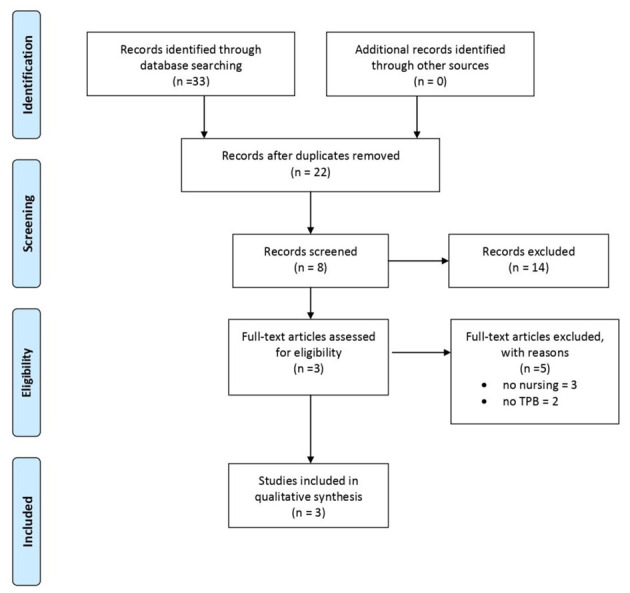
This scoping review is grounded by Arksey and O'Malley's framework.
Attitude is the most determining predictor of intention. For many students reporting an error would lead to a loss of trust in the nursing profession and this could prevent the report. Nevertheless, some of them affirmed to be positively judged when they did it. It was then observed that a better education on safety raised the level of self-confidence and the sense of responsibility of the students, making them more inclined to the drug therapy management.
The Theory of planned behaviour is essential to forerun the behavioural intention of students on the pharmacological safety and the collaborative practice through predictive factors, as attitude, subjective norms and perceived behavioural control.
更安全的药物治疗是护理的一个相关方面,也是临床治理功能的重要组成部分。护士是识别和预防药物管理过程中可能发生的药物错误的关键角色。在文献中,人们特别关注环境和组织因素,而我们知道,主观因素考虑得很少。在心理学中,以个人因素为代价、而不是以环境因素为代价的理论是计划行为理论(TPB),尽管它在卫生领域的应用较少。目的是搜索关于药物错误和 TPB 的现有文献,以预测预示护理实习生风险行为的意图。
本范围综述以 Arksey 和 O'Malley 的框架为基础。
态度是意图的最决定性预测因素。对于许多报告错误的学生来说,这将导致他们对护理行业失去信任,从而阻止他们报告。然而,他们中的一些人在这样做时表示自己会得到积极的评价。然后观察到,更多的关于安全的教育提高了学生的自信水平和责任感,使他们更倾向于药物治疗管理。
计划行为理论对于预测学生在药物安全和协作实践方面的行为意图至关重要,预测因素包括态度、主观规范和感知行为控制。