Exercise and Health Laboratory, CIPER, Faculdade de Motricidade Humana, Universidade de Lisboa, 1499-002 Lisboa, Portugal.
Physiology and Biochemistry of Exercise Laboratory, CIPER, Faculdade de Motricidade Humana, Universidade Lisboa, 1499-002 Lisboa, Portugal.
Int J Environ Res Public Health. 2020 Jun 21;17(12):4452. doi: 10.3390/ijerph17124452.
accurate prognostic tools are relevant for decision-making in cancer care. Objective measures, such as bioelectrical impedance (BI), have the potential to improve prognostic accuracy for these patients. This cross-sectional study aimed to investigate whether phase angle (PhA) derived from the electrical properties of the body tissues is a predictor of muscular strength in breast cancer survivors (BCS).
a total of 41 BCS (age 54.6 ± 9.2 years) were evaluated. PhA, obtained at frequency 50 kHz, was assessed with BI spectroscopy, and muscular strength with a handgrip dynamometer. Moderate-to-vigorous physical activity (MVPA) was assessed using the International Physical Activity Questionnaire (IPAQ). Measurements were performed in the morning after an overnight fast.
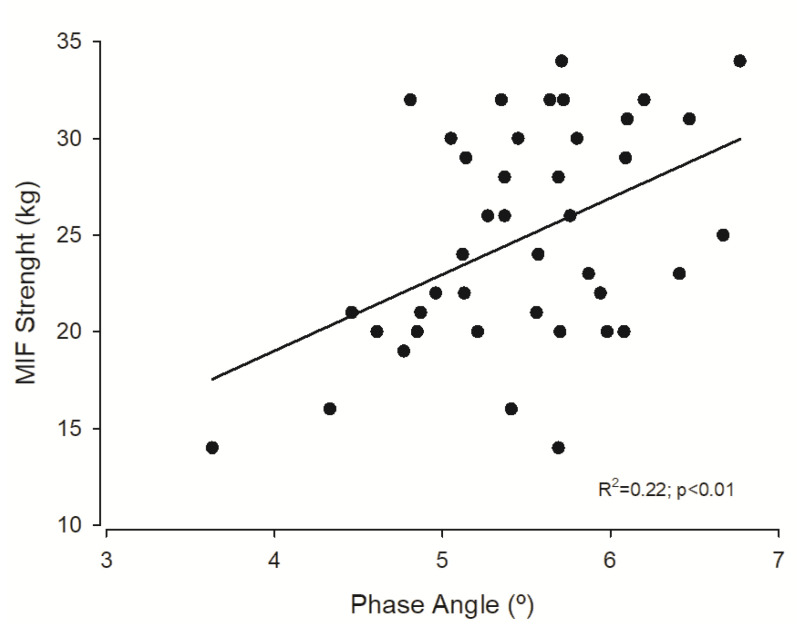
linear regression analysis showed that PhA accounted for 22% (r = 0.22) of muscular strength variance. PhA remained a borderline predictor of muscular strength variance independently of age and MVPA.
the findings of this study suggest that PhA is a significant predictor of maximal forearm isometric strength and a potential indicator of disease-related functionality in BCS.
准确的预后工具对于癌症患者的治疗决策至关重要。客观指标,如生物电阻抗(BI),有可能提高这些患者的预后准确性。本横断面研究旨在探讨身体组织电特性得出的相位角(PhA)是否可预测乳腺癌幸存者(BCS)的肌肉力量。
共评估了 41 名 BCS(年龄 54.6±9.2 岁)。使用 BI 光谱仪测量在 50 kHz 频率下获得的 PhA,使用握力计测量肌肉力量。使用国际体力活动问卷(IPAQ)评估中等到剧烈体力活动(MVPA)。测量在禁食过夜后的早晨进行。
线性回归分析表明,PhA 可解释肌肉力量变异的 22%(r=0.22)。PhA 仍然是肌肉力量变异的边缘预测因子,独立于年龄和 MVPA。
本研究结果表明,PhA 是最大前臂等长力量的重要预测因子,也是 BCS 与疾病相关功能的潜在指标。