Department of General Surgery, Chiba University Graduate School of Medicine, 1-8-1 Inohana, Chuo-Ku, Chiba, 260-8670, Japan.
Department of Surgery, Oami Municipal Hospital, 884-1 Tomida, Oami-Shirasato-shi, Chiba, 299-3221, Japan.
World J Surg Oncol. 2020 Jun 23;18(1):139. doi: 10.1186/s12957-020-01918-4.
Conversion chemotherapy may downsize unresectable colorectal liver metastases (CRLMs), but may cause liver injury and splenic enlargement. The effect of preoperative chemotherapy on liver regeneration after liver resection remains undetermined. The aim of this study was to examine whether splenic enlargement induced by preoperative chemotherapy is an indicator to identify high-risk patients for impaired liver regeneration and liver dysfunction after resection.
We retrospectively reviewed 118 Japanese patients with CRLMs. Fifty-one patients had conversion chemotherapy. The other 67 patients underwent up-front liver resection. We clarified effects of conversion chemotherapy on splenic volume, liver function, and postoperative liver regeneration. Perioperative outcome was also analyzed.
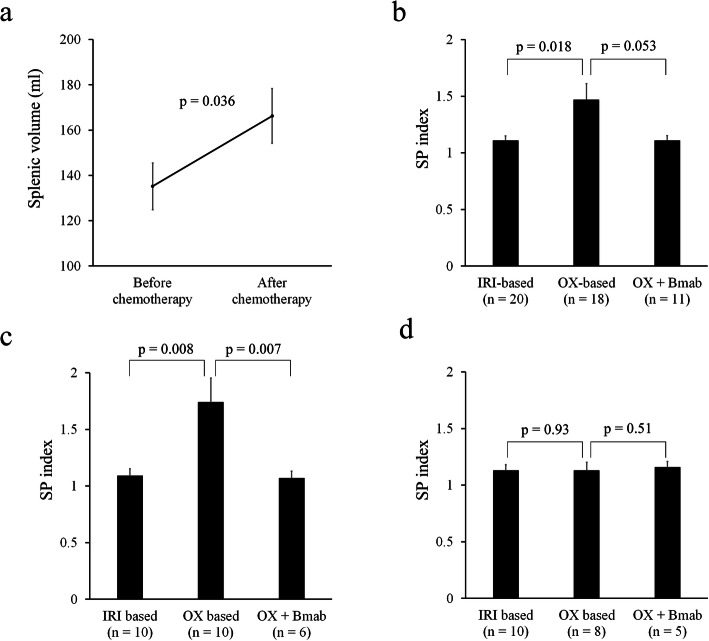
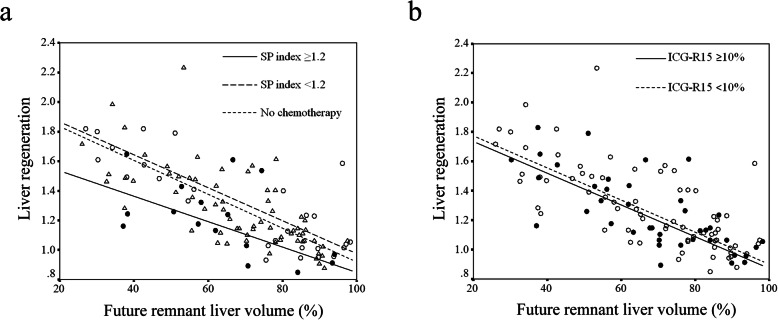
A ratio of the splenic volume before and after chemotherapy (SP index) in the oxaliplatin-based chemotherapy group was significantly greater than other chemotherapy groups after 9 or more chemotherapy cycles. Patients whose SP index was 1.2 or more had significantly higher indocyanine green retention rate at 15 min (ICG-R15) than patients without chemotherapy. Analyses of covariance showed liver regeneration rate after resection was decreased in patients whose SP index was 1.2 or more. The incidence of postoperative liver dysfunction in patients whose SP index was 1.2 or more was significantly greater than patients without chemotherapy. Multivariate analysis showed SP index was a significant predictive factor of impaired liver regeneration.
Splenic enlargement induced by preoperative chemotherapy was a useful indicator for impaired liver regeneration after resection and a decision-making tool of treatment strategy for unresectable CRLMs.
转化化疗可能会缩小不可切除的结直肠癌肝转移(CRLM)的大小,但可能会导致肝损伤和脾肿大。术前化疗对肝切除术后肝再生的影响仍不确定。本研究旨在探讨术前化疗引起的脾肿大是否是识别肝切除术后肝再生受损和肝功能障碍高危患者的指标。
我们回顾性分析了 118 例 CRLM 日本患者。51 例患者接受了转化化疗。另外 67 例患者接受了 upfront 肝切除术。我们阐明了转化化疗对脾体积、肝功能和术后肝再生的影响。还分析了围手术期结果。
奥沙利铂为基础的化疗组的化疗前后脾体积比(SP 指数)在 9 个周期以上的化疗组中显著大于其他化疗组。SP 指数为 1.2 或更高的患者的吲哚菁绿 15 分钟滞留率(ICG-R15)明显高于未接受化疗的患者。协方差分析显示,SP 指数为 1.2 或更高的患者肝切除术后肝再生率降低。SP 指数为 1.2 或更高的患者术后肝功能障碍的发生率明显高于未接受化疗的患者。多变量分析显示,SP 指数是肝再生受损的显著预测因子。
术前化疗引起的脾肿大是肝切除术后肝再生受损的有用指标,也是不可切除 CRLM 治疗策略决策的工具。