Department of Biosciences, Bioanalytical Research Laboratories and Molecular Cancer Research and Tumor Immunology, Cancer Cluster Salzburg, University of Salzburg, Hellbrunner Straße 34, 5020, Salzburg, Austria.
Institute for Bioinformatics and Medical Informatics, University of Tübingen, Sand 14, 72076, Tübingen, Germany.
Cell Commun Signal. 2020 Jun 23;18(1):99. doi: 10.1186/s12964-020-00591-0.
Aberrant hedgehog (HH) signaling is implicated in the development of various cancer entities such as medulloblastoma. Activation of GLI transcription factors was revealed as the driving force upon pathway activation. Increased phosphorylation of essential effectors such as Smoothened (SMO) and GLI proteins by kinases including Protein Kinase A, Casein Kinase 1, and Glycogen Synthase Kinase 3 β controls effector activity, stability and processing. However, a deeper and more comprehensive understanding of phosphorylation in the signal transduction remains unclear, particularly during early response processes involved in SMO activation and preceding GLI target gene regulation.
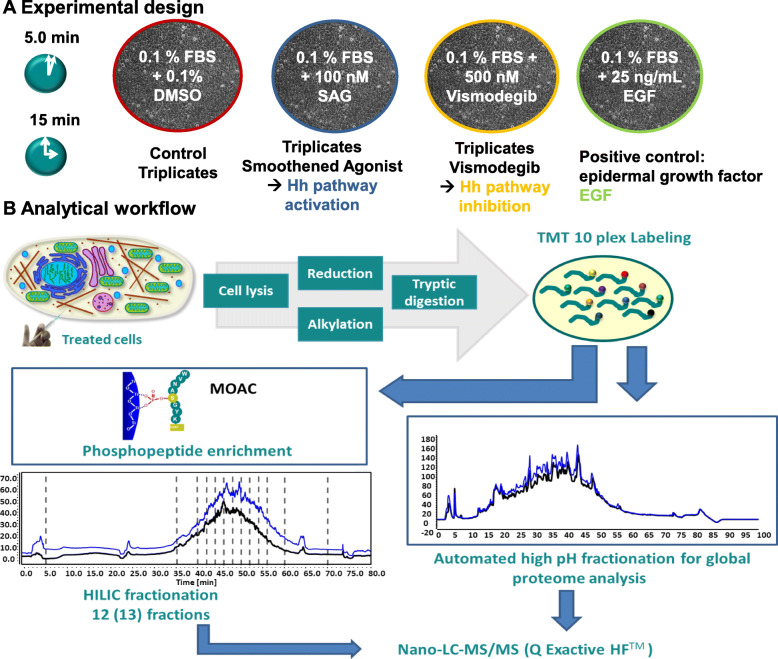
We applied temporal quantitative phosphoproteomics to reveal phosphorylation dynamics underlying the short-term chemical activation and inhibition of early hedgehog signaling in HH responsive human medulloblastoma cells. Medulloblastoma cells were treated for 5.0 and 15 min with Smoothened Agonist (SAG) to induce and with vismodegib to inhibit the HH pathway.
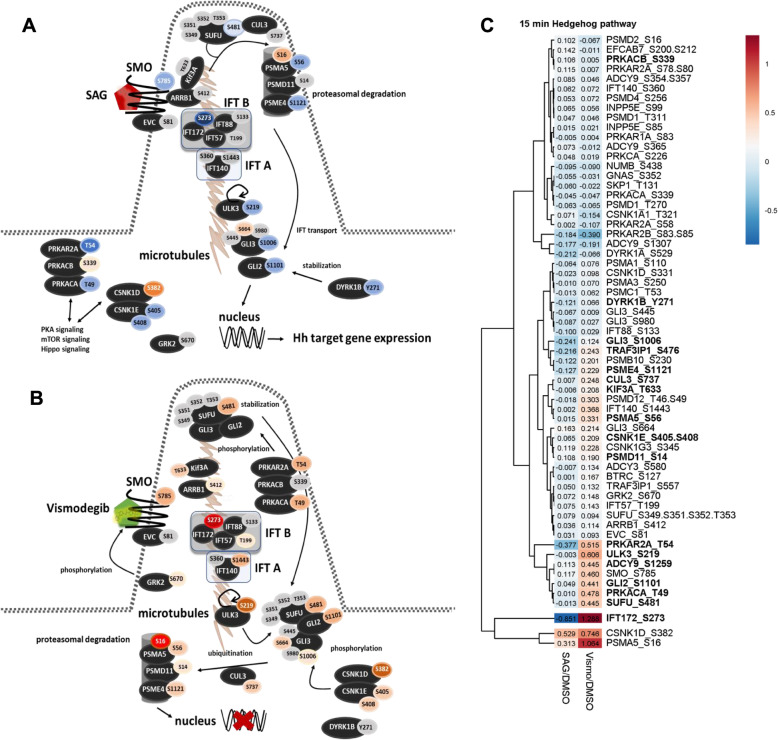
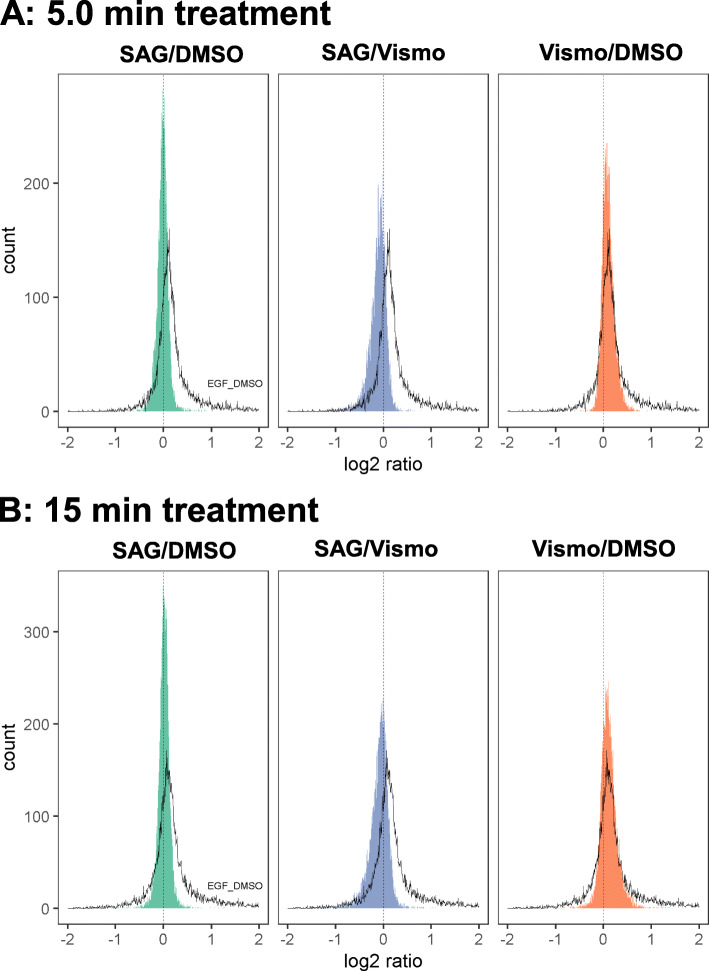
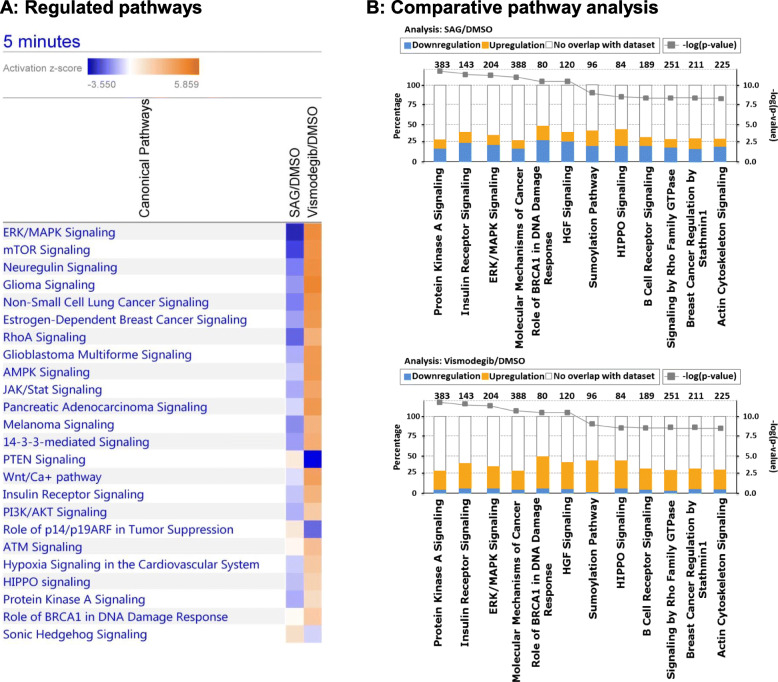
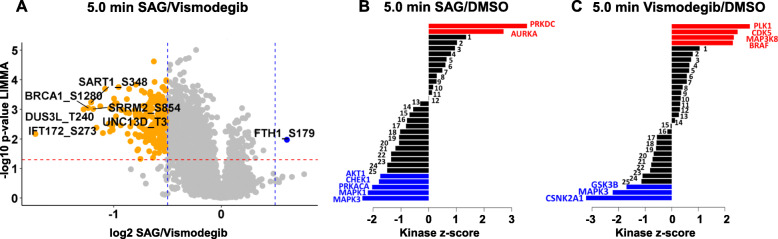
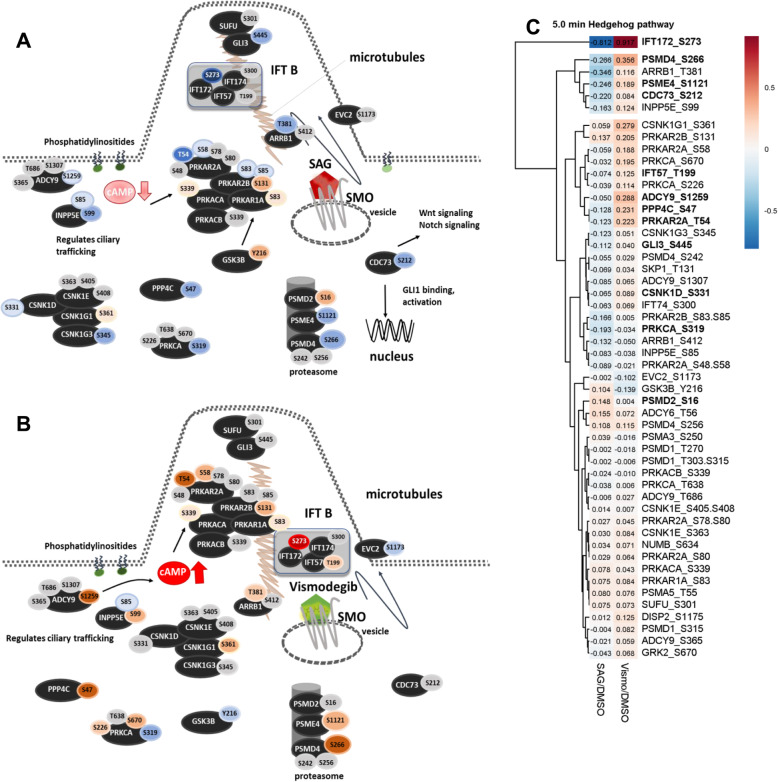
Our phosphoproteomic profiling resulted in the quantification of 7700 and 10,000 phosphosites after 5.0 and 15 min treatment, respectively. The data suggest a central role of phosphorylation in the regulation of ciliary assembly, trafficking, and signal transduction already after 5.0 min treatment. ERK/MAPK signaling, besides Protein Kinase A signaling and mTOR signaling, were differentially regulated after short-term treatment. Activation of Polo-like Kinase 1 and inhibition of Casein Kinase 2A1 were characteristic for vismodegib treatment, while SAG treatment induced Aurora Kinase A activity. Distinctive phosphorylation of central players of HH signaling such as SMO, SUFU, GLI2 and GLI3 was observed only after 15 min treatment.
This study provides evidence that phosphorylation triggered in response to SMO modulation dictates the localization of hedgehog pathway components within the primary cilium and affects the regulation of the SMO-SUFU-GLI axis. The data are relevant for the development of targeted therapies of HH-associated cancers including sonic HH-type medulloblastoma. A deeper understanding of the mechanisms of action of SMO inhibitors such as vismodegib may lead to the development of compounds causing fewer adverse effects and lower frequencies of drug resistance. Video Abstract.
异常的 hedgehog(HH)信号在各种癌症实体的发展中起作用,例如髓母细胞瘤。当通路被激活时,GLI 转录因子的激活被揭示为驱动力。包括蛋白激酶 A、酪蛋白激酶 1 和糖原合酶激酶 3β在内的激酶使 Smoothened(SMO)和 GLI 蛋白等必需效应物的磷酸化增加,控制效应物的活性、稳定性和加工。然而,对于信号转导中的磷酸化的更深入和更全面的理解仍然不清楚,特别是在 SMO 激活和 GLI 靶基因调节之前涉及的早期反应过程中。
我们应用时间定量磷酸蛋白质组学来揭示短期化学激活和抑制 HH 反应性人髓母细胞瘤细胞中的早期 hedgehog 信号转导所涉及的磷酸化动力学。用 Smoothened 激动剂(SAG)处理髓母细胞瘤细胞 5.0 和 15 分钟以诱导 HH 通路,并用维莫德吉抑制 HH 通路。
我们的磷酸蛋白质组学分析分别在 5.0 和 15 分钟处理后定量了 7700 和 10000 个磷酸化位点。数据表明,在 5.0 分钟处理后,磷酸化在纤毛组装、运输和信号转导的调节中起核心作用。ERK/MAPK 信号通路,除蛋白激酶 A 信号通路和 mTOR 信号通路外,在短期处理后也被差异化调节。Polo 样激酶 1 的激活和酪蛋白激酶 2A1 的抑制是维莫德吉治疗的特征,而 SAG 处理诱导了 Aurora 激酶 A 的活性。HH 信号通路的中央参与者的独特磷酸化,如 SMO、SUFU、GLI2 和 GLI3,仅在 15 分钟处理后观察到。
本研究提供的证据表明,SMO 调节触发的磷酸化决定了 hedgehog 通路成分在初级纤毛内的定位,并影响 SMO-SUFU-GLI 轴的调节。这些数据对于开发包括 sonic HH 型髓母细胞瘤在内的 HH 相关癌症的靶向治疗具有重要意义。对维莫德吉等 SMO 抑制剂作用机制的更深入了解可能会导致开发出引起更少不良反应和更低耐药频率的化合物。