Department of Urology, Uro-Oncology, Robot Assisted and Reconstructive Urologic Surgery, University Hospital Cologne, Cologne, Germany.
Department of Intensive Care Medicine and Intermediate Care, University Hospital RWTH, Aachen, Germany.
Eur Urol Focus. 2020 Sep 15;6(5):1111-1119. doi: 10.1016/j.euf.2020.06.001. Epub 2020 Jun 8.
In order to contain the coronavirus disease 2019 (COVID-19) pandemic, Germany has implemented drastic restrictions on public or social life, while health institutions are invoked to postpone elective procedures. Although urologists are less involved in the direct treatment of COVID-19 patients, the current situation strongly affects the urological work routine.
To analyze the impact of the COVID-19 pandemic on various aspects of work and personal life among urologists in Germany.
DESIGN, SETTING, AND PARTICIPANTS: A total of 589 urologists in Germany participated in an online survey between March 27 and April 11, 2020.
Participants were stratified into subgroups according to professional characteristics.
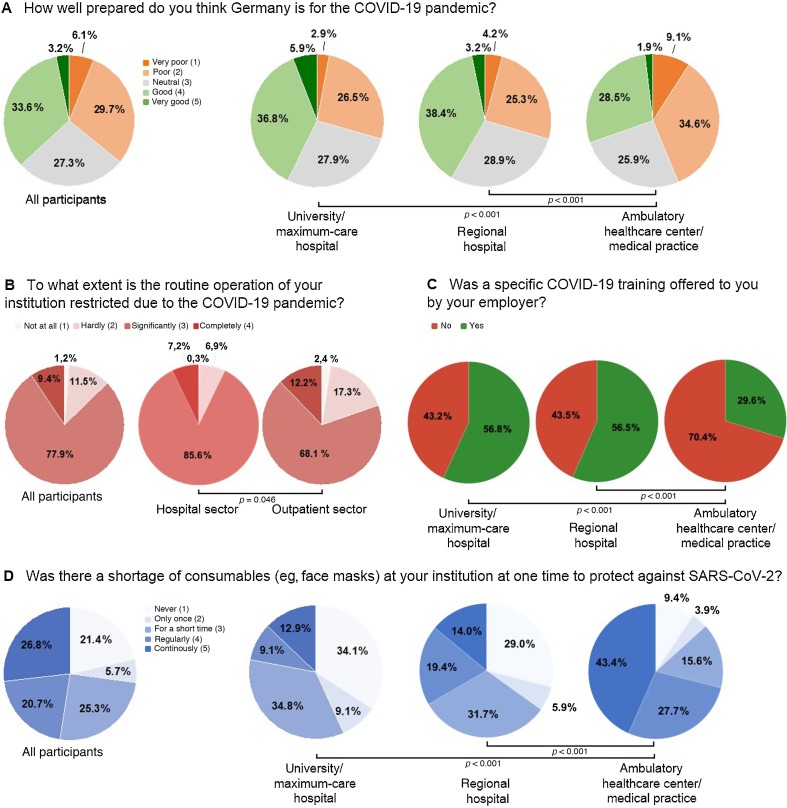
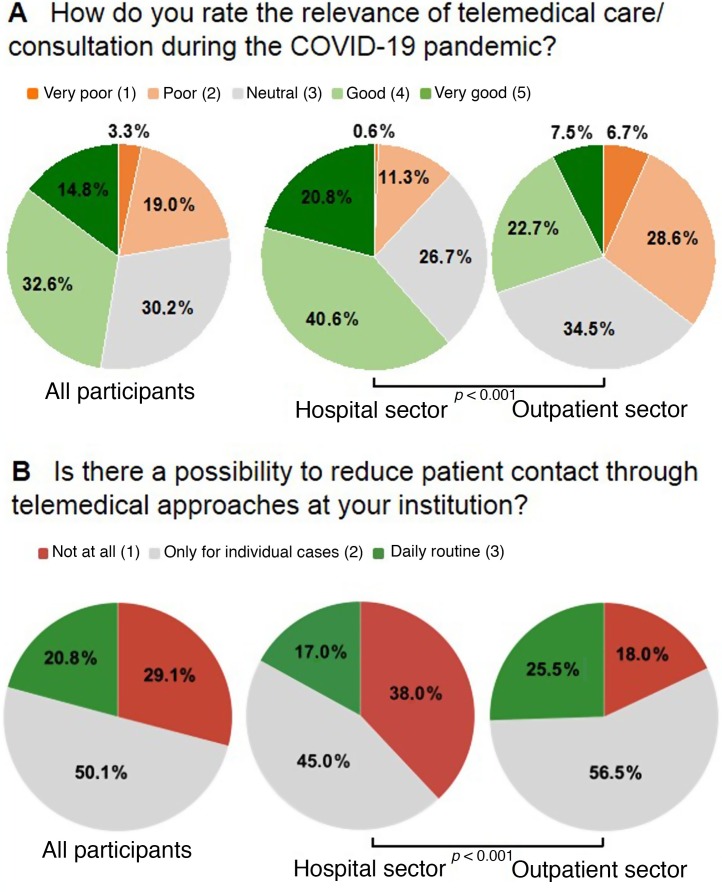
Most urologists rated Germany as "well prepared" and the increasing restrictions of social life as "very positive." Routine operation was more restricted in hospitals than in the outpatient sector (p = 0.046). Moreover, urologists from the outpatient sector felt significantly less prepared for the COVID-19 pandemic (p = 0.001), reported a higher shortage of protective medical equipment (p < 0.001), and described a tendency toward a higher level of threat (p = 0.054). Although restrictions regarding telemedicine approaches were reported by 60% of participants, the outpatient sector used telehealth more frequently than hospitals (25.5% vs 17.0%, p < 0.001). Limitations include the national design and the restricted survey period.
This survey systematically evaluates the impact of the COVID-19 pandemic on personal and professional aspects of German urologists. We identified several issues, such as a higher shortage of medical protective equipment in the outpatient sector that could trigger specific measures to further improve the quality of urological care in Germany.
We evaluated a potential impact of the coronavirus disease 2019 (COVID-19) pandemic on professional and personal aspects of the urologists in Germany. Our results suggest that the outpatient sector should receive specific attention as, for example, shortage of protective equipment was more common.
为了控制 2019 年冠状病毒病(COVID-19)大流行,德国对公共或社会生活实施了严格限制,同时医疗机构被要求推迟选择性手术。尽管泌尿科医生较少直接治疗 COVID-19 患者,但当前情况强烈影响了泌尿科的日常工作。
分析 COVID-19 大流行对德国泌尿科医生工作和个人生活各个方面的影响。
设计、地点和参与者:2020 年 3 月 27 日至 4 月 11 日期间,共有 589 名德国泌尿科医生参与了在线调查。
根据专业特点,将参与者分为亚组。
大多数泌尿科医生认为德国“准备充分”,对社会生活日益限制的评价是“非常积极”。与门诊部门相比,医院的常规运营受到更多限制(p = 0.046)。此外,来自门诊部门的泌尿科医生对 COVID-19 大流行的准备明显不足(p = 0.001),报告防护医疗设备严重短缺(p < 0.001),并描述了更高水平的威胁倾向(p = 0.054)。尽管有 60%的参与者报告了远程医疗方法的限制,但门诊部门比医院更频繁地使用远程医疗(25.5%比 17.0%,p < 0.001)。限制包括全国性设计和有限的调查期限。
本调查系统地评估了 COVID-19 大流行对德国泌尿科医生个人和专业方面的影响。我们发现了一些问题,例如门诊部门医疗防护设备短缺,这可能需要采取具体措施进一步提高德国泌尿科护理的质量。
我们评估了 2019 年冠状病毒病(COVID-19)大流行对德国泌尿科医生专业和个人方面的潜在影响。我们的结果表明,门诊部门应受到特别关注,例如,防护设备短缺更为普遍。