Shi Xinli, Li Shenghao, Wang Li, Li Hui, Li Zhen, Wang Weiyi, Bai Jing, Sun Yajing, Li Jianchun, Li Xiaoming
Department of Otolaryngology Head and Neck Surgery, Bethune International Peace Hospital, Shijiazhuang, 050081 China.
Department of Pathobiology and Immunology, Hebei University of Chinese Medicine, Shijiazhuang, 050200 China.
Chin Med. 2020 Jun 19;15:64. doi: 10.1186/s13020-020-00340-y. eCollection 2020.
Interferon-inducible 16 (IFI16)/caspase-1 inflammasome activates and secretes IL-1β. However, it is still unclear whether the IFI16 inflammasome is involved in human laryngeal squamous cell carcinoma. Autophagy directly removed inflammasome components and limited early IL-1β production. RalB is required for the crosstalk between inflammasome and autophagy in macrophages. Dihydroartemisinin (DHA), the main derived ingredient of artemisinin, has a variety of biological activities. The mechanism of DHA in regulating the crosstalk between IFI16 inflammasome and autophagy by inhibiting RalB expression was analyzed in order to provide clues for new therapeutic methods in laryngeal cancer.
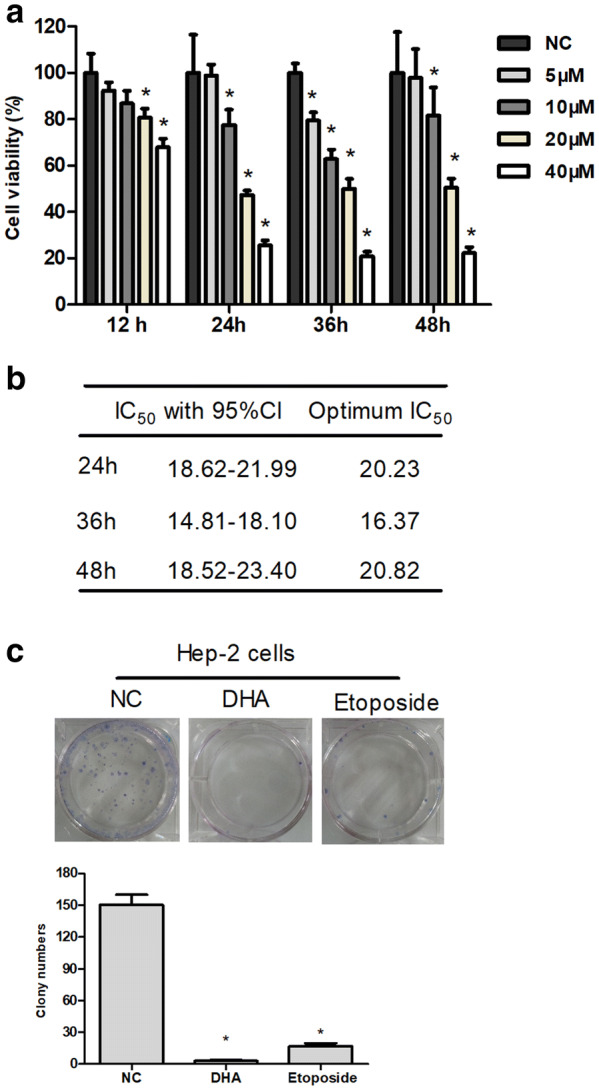
The expression of IFI16 was analyzed by Oncomine and GEPIA databases and detected by Western blot and immunohistochemistry. The relationship between IFI16 inflammasome and autophagy was investigated by transmission electron microscopy, immunofluorescence assay, etc. in Hep-2, Cal-27 and HeLa cells treated with DHA. The xenograft tumor of hep-2 cell in nude mice were used to assess the effect of DHA on laryngeal cancer.
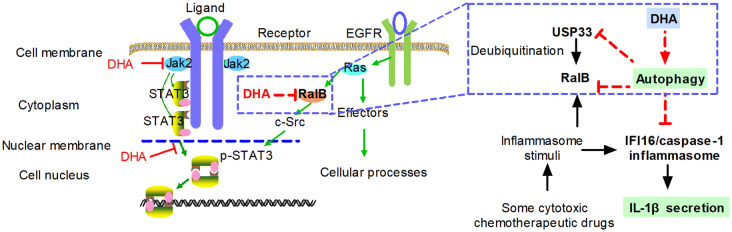
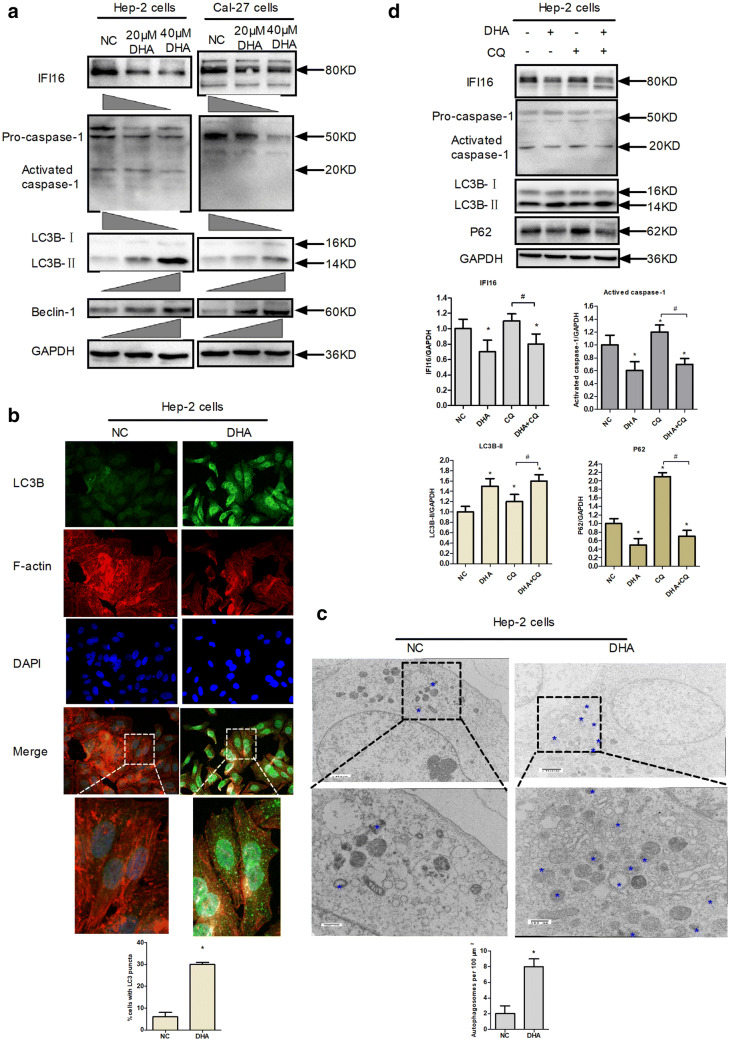
It was reported for the first time in this study that IFI16 was overexpressed and positively correlated with caspase-1 in laryngeal carcinoma tissues. DHA significantly inhibited the activation of inflammasome and reduced IL-1β production in the microenvironment of Hep-2 cell xenograft tumor in nude mice. Mechanistically, we found that DHA degraded RalB, inhibited USP33 expression, and triggered autophagy. Meanwhile, enhanced autophagy can reduce the expression of RalB and USP33. Furthermore, DHA promotes autophagy, which suppresses the activation of IFI16/caspase-1 inflammasome and IL-1β production.
Therefore, our findings demonstrate that DHA may act as a RalB inhibitor to regulate the crosstalk between autophagy and IFI16/caspase-1 inflammasome, which inhibits IL-1β production in tumor microenvironment.
干扰素诱导蛋白16(IFI16)/半胱天冬酶-1炎性小体可激活并分泌白细胞介素-1β(IL-1β)。然而,IFI16炎性小体是否参与人类喉鳞状细胞癌仍不清楚。自噬可直接清除炎性小体成分并限制早期IL-1β的产生。RalB是巨噬细胞中炎性小体与自噬之间相互作用所必需的。双氢青蒿素(DHA)是青蒿素的主要衍生成分,具有多种生物学活性。分析DHA通过抑制RalB表达来调节IFI16炎性小体与自噬之间相互作用的机制,为喉癌新的治疗方法提供线索。
通过Oncomine和GEPIA数据库分析IFI16的表达,并通过蛋白质免疫印迹法和免疫组织化学法进行检测。在用DHA处理的Hep-2、Cal-27和HeLa细胞中,通过透射电子显微镜、免疫荧光测定等方法研究IFI16炎性小体与自噬之间的关系。利用裸鼠体内Hep-2细胞的异种移植瘤评估DHA对喉癌的作用。
本研究首次报道IFI16在喉癌组织中过表达且与半胱天冬酶-1呈正相关。DHA显著抑制裸鼠体内Hep-2细胞异种移植瘤微环境中炎性小体的激活并减少IL-1β的产生。机制上,我们发现DHA降解RalB,抑制USP33表达,并引发自噬。同时,增强的自噬可降低RalB和USP33的表达。此外,DHA促进自噬,从而抑制IFI16/半胱天冬酶-1炎性小体的激活和IL-1β的产生。
因此,我们的研究结果表明,DHA可能作为一种RalB抑制剂来调节自噬与IFI16/半胱天冬酶-1炎性小体之间的相互作用,从而抑制肿瘤微环境中IL-1β的产生。