Williams-Bey Yolanda, Boularan Cedric, Vural Ali, Huang Ning-Na, Hwang Il-Young, Shan-Shi Chong, Kehrl John H
B Cell Molecular Immunology Section, Laboratory of Immunoregulation, National Institute of Allergy and Infectious Diseases, National Institutes of Health, Bethesda, Maryland, United States of America.
PLoS One. 2014 Jun 9;9(6):e97957. doi: 10.1371/journal.pone.0097957. eCollection 2014.
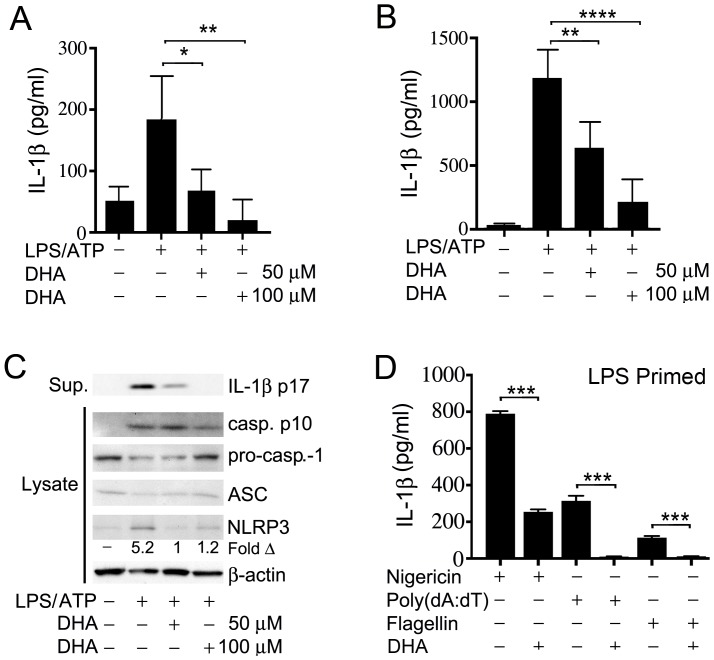
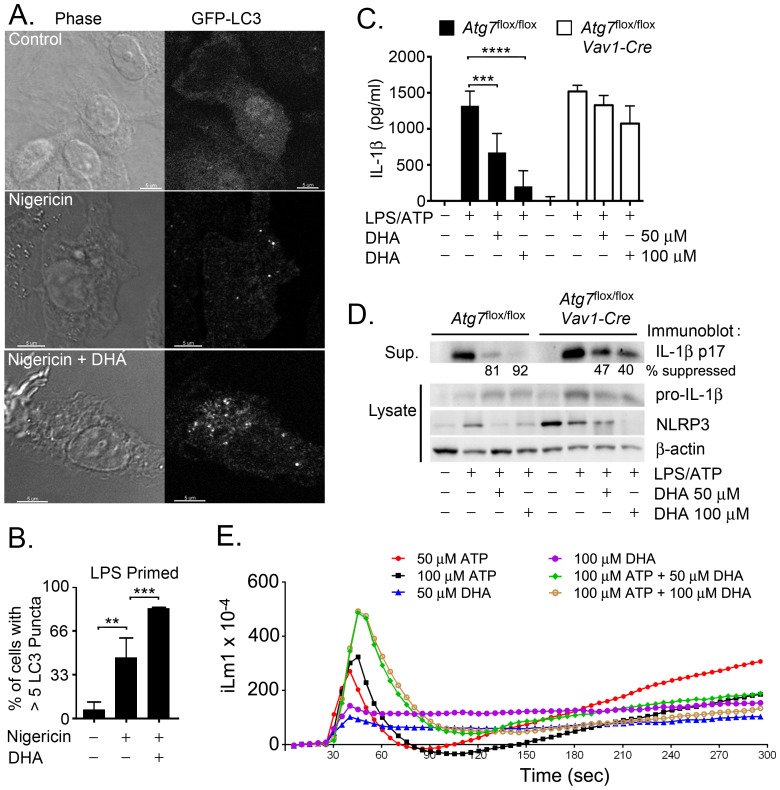
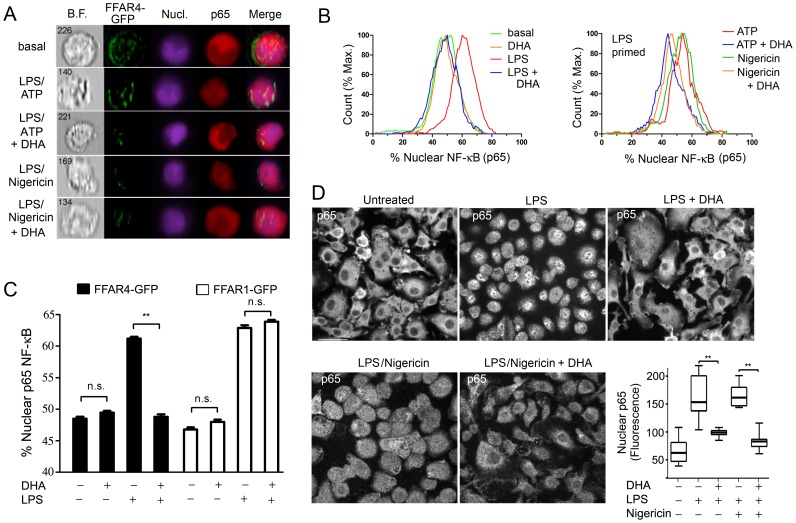
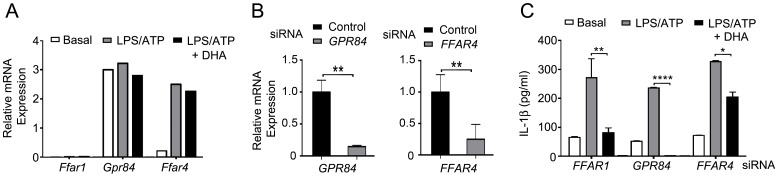
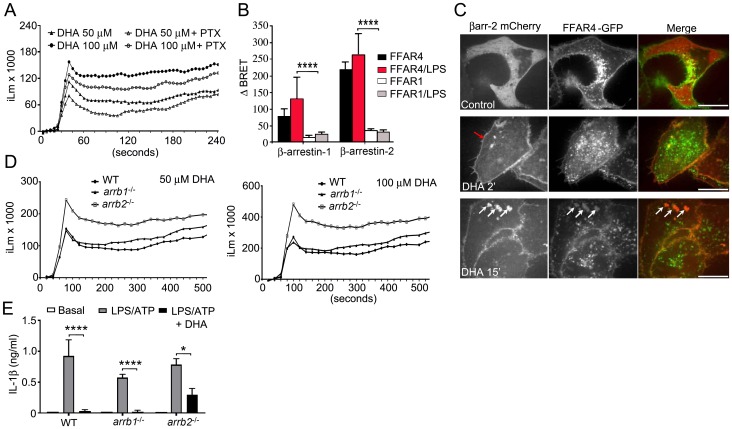
The omega-3 (ω3) fatty acid docosahexaenoic acid (DHA) can suppress inflammation, specifically IL-1β production through poorly understood molecular mechanisms. Here, we show that DHA reduces macrophage IL-1β production by limiting inflammasome activation. Exposure to DHA reduced IL-1β production by ligands that stimulate the NLRP3, AIM2, and NAIP5/NLRC4 inflammasomes. The inhibition required Free Fatty Acid Receptor (FFAR) 4 (also known as GPR120), a G-protein coupled receptor (GPR) known to bind DHA. The exposure of cells to DHA recruited the adapter protein β-arrestin1/2 to FFAR4, but not to a related lipid receptor. DHA treatment reduced the initial inflammasome priming step by suppressing the nuclear translocation of NF-κB. DHA also reduced IL-1β levels by enhancing autophagy in the cells. As a consequence macrophages derived from mice lacking the essential autophagy protein ATG7 were partially resistant to suppressive effects of DHA. Thus, DHA suppresses inflammasome activation by two distinct mechanisms, inhibiting the initial priming step and by augmenting autophagy, which limits inflammasome activity.
ω-3(ω3)脂肪酸二十二碳六烯酸(DHA)可抑制炎症,尤其是通过尚不明确的分子机制抑制白细胞介素-1β(IL-1β)的产生。在此,我们表明DHA通过限制炎性小体激活来减少巨噬细胞IL-1β的产生。暴露于DHA可减少由刺激NLRP3、AIM2和NAIP5/NLRC4炎性小体的配体所诱导的IL-1β产生。这种抑制作用需要游离脂肪酸受体(FFAR)4(也称为GPR120),这是一种已知可结合DHA的G蛋白偶联受体(GPR)。细胞暴露于DHA会使衔接蛋白β-抑制蛋白1/2募集至FFAR4,但不会募集至相关的脂质受体。DHA处理通过抑制核因子κB(NF-κB)的核转位减少了炎性小体的初始启动步骤。DHA还通过增强细胞中的自噬来降低IL-1β水平。因此,源自缺乏必需自噬蛋白ATG7的小鼠的巨噬细胞对DHA 的抑制作用具有部分抗性。因此,DHA通过两种不同机制抑制炎性小体激活,即抑制初始启动步骤和增强自噬,而自噬会限制炎性小体活性。