Pacific Northwest Research Station, USDA Forest Service, Wenatchee, WA, United States of America.
Department of Ecology and Evolution, University of Chicago, Chicago, IL, United States of America.
PLoS One. 2020 Jun 24;15(6):e0234072. doi: 10.1371/journal.pone.0234072. eCollection 2020.
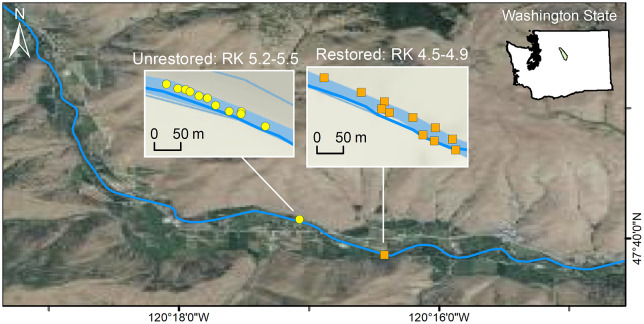
Individual growth data are useful in assessing relative habitat quality, but this approach is less common when evaluating the efficacy of habitat restoration. Furthermore, available models describing growth are infrequently combined with computational approaches capable of handling large data sets. We apply a mechanistic model to evaluate whether selection of restored habitat can affect individual growth. We used mark-recapture to collect size and growth data on sub-yearling Chinook salmon and steelhead in restored and unrestored habitat in five sampling years (2009, 2010, 2012, 2013, 2016). Modeling strategies differed for the two species: For Chinook, we compared growth patterns of individuals recaptured in restored habitat over 15-60 d with those not recaptured regardless of initial habitat at marking. For steelhead, we had enough recaptured fish in each habitat type to use the model to directly compare habitats. The model generated spatially explicit growth parameters describing size of fish over the growing season in restored vs. unrestored habitat. Model parameters showed benefits of restoration for both species, but that varied by year and time of season, consistent with known patterns of habitat partitioning among them. The model was also supported by direct measurement of growth rates in steelhead and by known patterns of spatio-temporal partitioning of habitat between these two species. Model parameters described not only the rate of growth, but the timing of size increases, and is spatially explicit, accounting for habitat differences, making it widely applicable across taxa. The model usually supported data on density differences among habitat types in Chinook, but only in a couple of cases in steelhead. Modeling growth can thus prevent overconfidence in distributional data, which are commonly used as the metric of restoration success.
个体生长数据可用于评估相对生境质量,但在评估生境恢复效果时,这种方法并不常见。此外,现有的描述生长的模型很少与能够处理大数据集的计算方法相结合。我们应用一种机制模型来评估恢复生境的选择是否会影响个体生长。我们使用标记-重捕法收集了五个采样年份(2009、2010、2012、2013、2016)中恢复和未恢复生境中亚成年奇努克鲑鱼和虹鳟的大小和生长数据。两种物种的建模策略有所不同:对于奇努克鲑鱼,我们比较了在恢复生境中被重新捕获的个体在 15-60 天内的生长模式与那些在标记时无论初始生境如何都未被重新捕获的个体的生长模式。对于虹鳟鱼,我们在每种生境类型中都有足够多的被重新捕获的鱼,可以使用模型直接比较生境。该模型生成了空间明确的生长参数,描述了在恢复生境和未恢复生境中鱼类在生长季节的大小。模型参数表明,恢复对两种物种都有好处,但因年份和季节时间而异,这与它们之间已知的栖息地划分模式一致。该模型也得到了虹鳟鱼生长率的直接测量和这两种物种之间栖息地时空划分的已知模式的支持。模型参数不仅描述了生长速度,还描述了大小增加的时间,并且具有空间明确性,考虑到生境差异,使其在广泛的分类群中具有广泛的适用性。该模型通常支持奇努克鲑鱼不同生境类型之间密度差异的数据,但在虹鳟鱼中只有少数情况支持。因此,模型可以防止对分布数据的过度自信,这些数据通常用作恢复成功的衡量标准。