Departamento de Bioquímica, Genética e Inmunología, Universidad de Vigo, Vigo, Spain.
PLoS One. 2012;7(10):e45528. doi: 10.1371/journal.pone.0045528. Epub 2012 Oct 1.
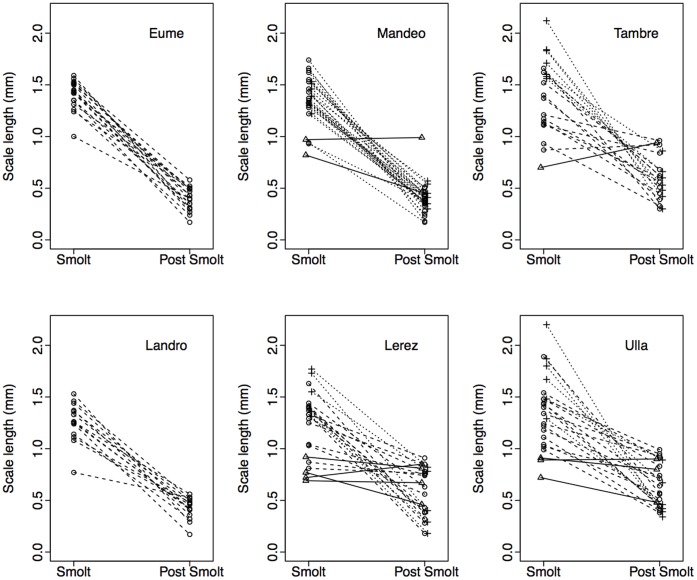
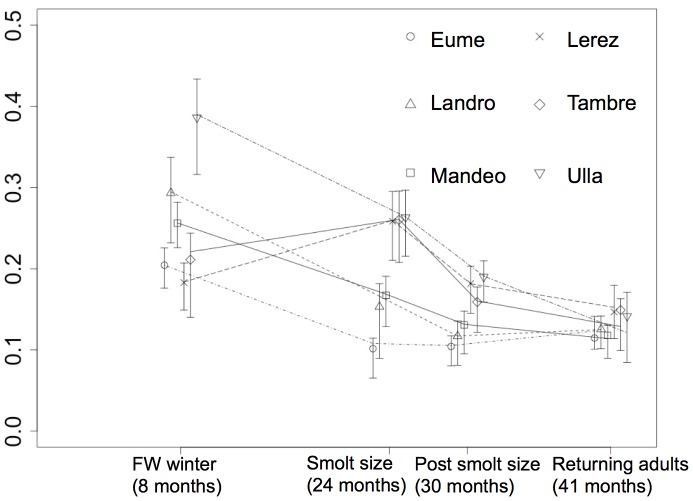
Early juvenile growth is a good indicator of growth later in life in many species because larger than average juveniles tend to have a competitive advantage. However, for migratory species the relationship between juvenile and adult growth remains obscure. We used scale analysis to reconstruct growth trajectories of migratory sea trout (Salmo trutta) from six neighbouring populations, and compared the size individuals attained in freshwater (before migration) with their subsequent growth at sea (after migration). We also calculated the coefficient of variation (CV) to examine how much body size varied across populations and life stages. Specifically, we tested the hypothesis that the CV on body size would differ between freshwater and marine environment, perhaps reflecting different trade-offs during ontogeny. Neighbouring sea trout populations differed significantly in time spent at sea and in age-adjusted size of returning adults, but not on size of seaward migration, which was surprisingly uniform and may be indicative of strong selection pressures. The CV on body size decreased significantly over time and was highest during the first 8 months of life (when juvenile mortality is highest) and lowest during the marine phase. Size attained in freshwater was negatively related to growth during the first marine growing season, suggesting the existence of compensatory growth, whereby individuals that grow poorly in freshwater are able to catch up later at sea. Analysis of 61 datasets indicates that negative or no associations between pre- and post-migratory growth are common amongst migratory salmonids. We suggest that despite a widespread selective advantage of large body size in freshwater, freshwater growth is a poor predictor of final body size amongst migratory fish because selection may favour growth heterochrony during transitions to a novel environment, and marine compensatory growth may negate any initial size advantage acquired in freshwater.
早期的幼体生长是许多物种后期生长的良好指标,因为较大的幼体往往具有竞争优势。然而,对于洄游物种而言,幼体和成年生长之间的关系仍然不清楚。我们使用鳞片分析来重建六个相邻洄游三文鱼种群的生长轨迹,并比较了个体在淡水(洄游前)中达到的大小与其随后在海洋中的生长(洄游后)。我们还计算了变异系数(CV),以检查个体大小在种群和生命阶段之间的变化程度。具体来说,我们检验了这样一个假设,即 CV 上的体型差异会因淡水和海洋环境而异,这可能反映了个体在发育过程中的不同权衡。相邻的三文鱼种群在海洋停留时间和返回成年个体的年龄调整大小上存在显著差异,但在向外迁徙的大小上没有差异,这令人惊讶地一致,可能表明存在强烈的选择压力。体型的 CV 随时间显著降低,在生命的前 8 个月(幼体死亡率最高)最高,在海洋阶段最低。在淡水中获得的体型与第一个海洋生长季节的生长呈负相关,这表明存在补偿性生长,即在淡水中生长不良的个体以后在海洋中能够迎头赶上。对 61 个数据集的分析表明,洄游鲑鱼中预迁徙和后迁徙生长之间的负相关或无相关是很常见的。我们认为,尽管在淡水中大体型具有广泛的选择优势,但淡水生长并不能很好地预测洄游鱼类的最终体型,因为选择可能有利于在向新环境过渡期间的生长异时性,而海洋补偿性生长可能会抵消在淡水中获得的任何初始体型优势。