Centre for Immunobiology and Regenerative Medicine, Barts and The London School of Medicine and Dentistry, Queen Mary University of London, London, UK.
Department of Anesthesiology, Critical Care and Pain Medicine, Boston Children's Hospital, Harvard Medical School, Boston, MA, USA.
Clin Exp Immunol. 2020 Oct;202(1):93-105. doi: 10.1111/cei.13483. Epub 2020 Jul 29.
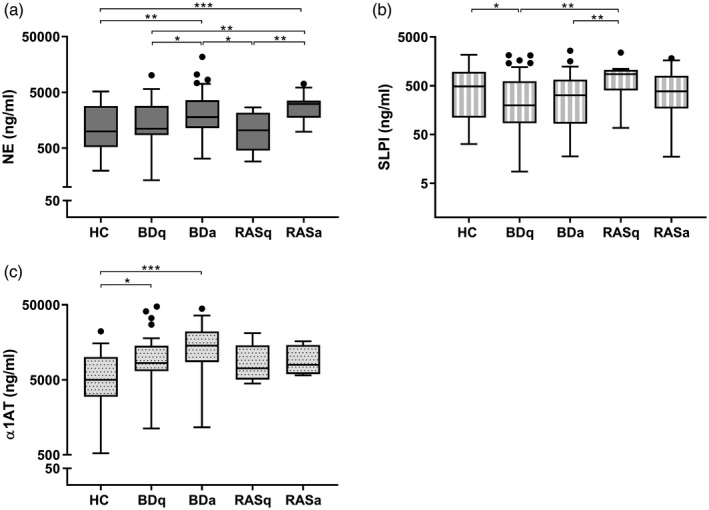
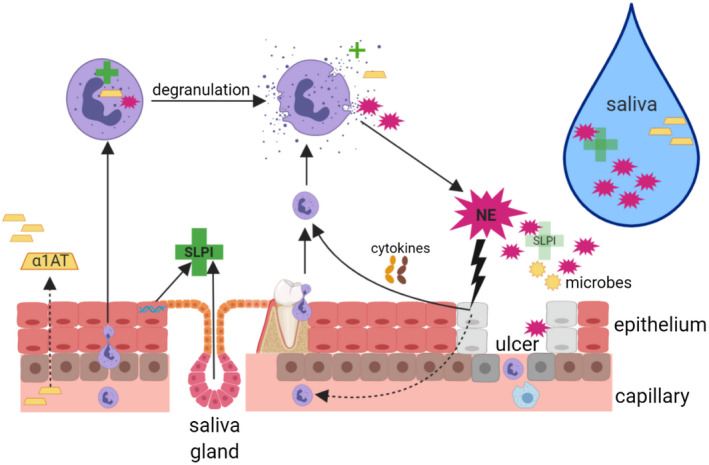
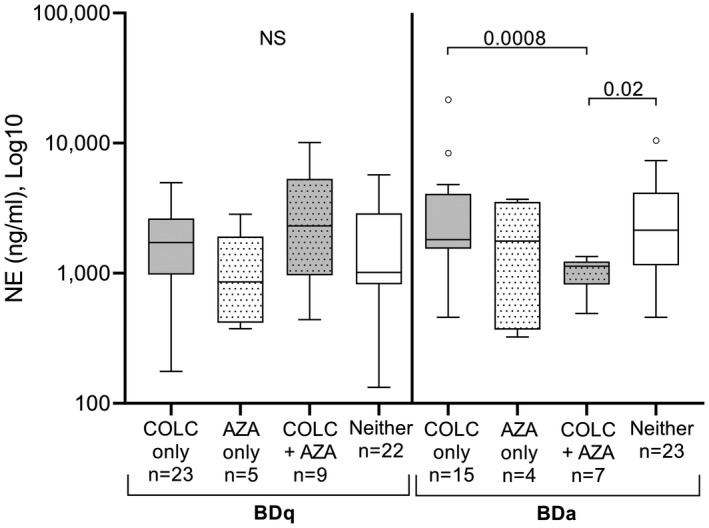
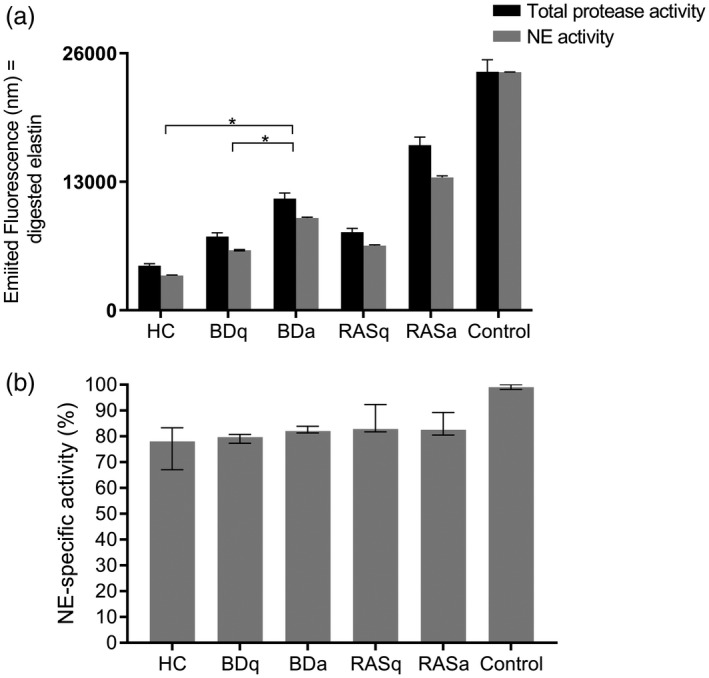
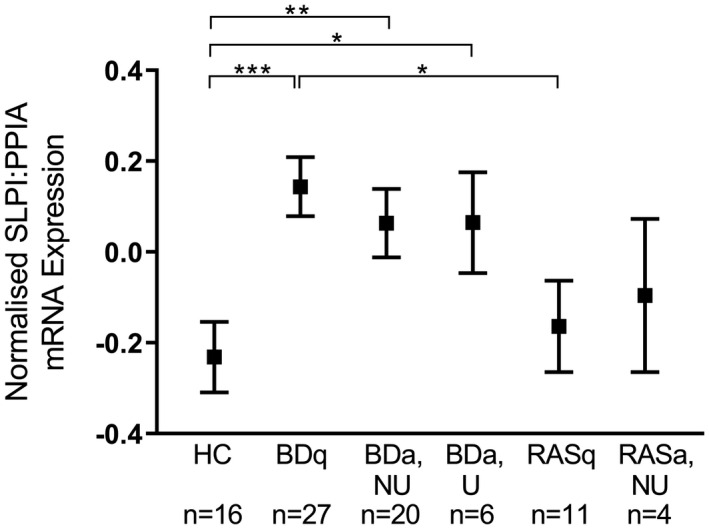
Behçet's disease (BD) is a vasculitis of unknown aetiology typified by chronic recurrent oral ulcers and systemic inflammatory manifestations. Neutrophils, and specifically their protease neutrophil elastase (NE), have been implicated in its pathology. Although NE is an effective anti-microbial, excessive NE can damage host tissue. Recurrent oral ulceration is a primary BD symptom, therefore we hypothesized that excessive neutrophil infiltration evidenced by increased NE and a reduction in specific endogenous inhibitors, secretory leucocyte protease inhibitor (SLPI) and alpha1-anti-trypsin (α1AT) contributes to BD mucosal instability. NE, SLPI and α1AT were quantified in saliva from BD patients with active oral ulcers (BDa) and quiet without ulcers (BDq), recurrent aphthous stomatitis (RASa; RASq) and healthy controls (HC). Although BDq saliva had marginally higher median NE levels (1112 ng/ml) compared to both RASq (1043 ng/ml) and HC (999 ng/ml), SLPI was significantly reduced in BDq (P < 0·01). Despite decreased SLPI protein, mRNA expression was significantly increased in BDq buccal epithelial swabs compared to RASq and HC (P < 0·05, P < 0·001). NE remained enzymatically active, although α1AT levels were at least eight times higher than SLPI in all groups, suggesting that α1AT does not have a primary role in counteracting NE in saliva. Furthermore, NE levels in BDa patients medicated with both azathioprine (AZA) and colchicine (COLC) were significantly lower than those on COLC (P = 0·0008) or neither (P = 0·02), indicating that combining AZA + COLC may help to regulate excessive NE during ulceration. This study showed that enzymatically active NE coupled with reduced SLPI in BD saliva may contribute to recurrent oral ulcerations.
白塞病(BD)是一种病因不明的血管炎,其特征为慢性复发性口腔溃疡和全身炎症表现。中性粒细胞,特别是其蛋白酶中性粒细胞弹性蛋白酶(NE),已被认为与其病理学有关。尽管 NE 是一种有效的抗微生物物质,但过量的 NE 会损害宿主组织。复发性口腔溃疡是 BD 的主要症状之一,因此我们假设,过多的中性粒细胞浸润,表现为 NE 增加和特定内源性抑制剂分泌性白细胞蛋白酶抑制剂(SLPI)和α1-抗胰蛋白酶(α1AT)减少,导致 BD 黏膜不稳定。我们定量分析了来自有活动性口腔溃疡的 BD 患者(BDa)和无症状无溃疡的 BD 患者(BDq)、复发性阿弗他口炎(RASa)和健康对照者(HC)的唾液中的 NE、SLPI 和α1AT。尽管与 RASq(1043ng/ml)和 HC(999ng/ml)相比,BDq 唾液的 NE 水平略高(1112ng/ml),但 SLPI 显著降低(P<0·01)。尽管 SLPI 蛋白减少,但与 RASq 和 HC 相比,BDq 颊上皮拭子的 SLPI mRNA 表达显著增加(P<0·05,P<0·001)。尽管 NE 仍然具有酶活性,但在所有组中,α1AT 的水平都至少是 SLPI 的 8 倍,这表明在唾液中,α1AT 并没有在对抗 NE 中起主要作用。此外,接受 AZA 和 COLC 联合治疗的 BDa 患者的 NE 水平明显低于仅接受 COLC(P=0·0008)或未接受任何治疗(P=0·02)的患者,这表明联合使用 AZA+COLC 可能有助于在溃疡期间调节过量的 NE。本研究表明,BD 唾液中的酶活性 NE 与 SLPI 减少可能导致复发性口腔溃疡。