Traccis Francesco, Frau Roberto, Melis Miriam
Department of Biomedical Sciences, Division of Neuroscience and Clinical Pharmacology, University of Cagliari, Cagliari, Italy.
Front Behav Neurosci. 2020 Jun 5;14:72. doi: 10.3389/fnbeh.2020.00072. eCollection 2020.
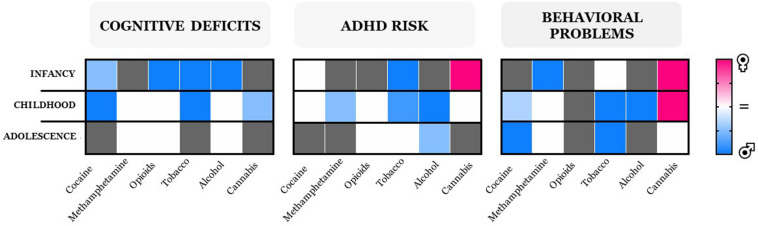
Despite great efforts to warn pregnant women that drugs of abuse impact development of the embryo and the fetus, the use of legal and illegal drugs by childbearing women is still a major public health concern. In parallel with well-established teratogenic effects elicited by some drugs of abuse, epidemiological studies show that certain psychoactive substances do not induce birth defects but lead to subtle neurobehavioral alterations in the offspring that manifest as early as during infancy. Although gender differences in offspring susceptibility have not been fully investigated, a number of longitudinal studies indicate that male and female progeny exposed to drugs of abuse show different vulnerabilities to deleterious effects of these substances in cognitive, executive, and behavioral domains. Here, we briefly review the existing literature focusing on gender differences in the neurobehavioral consequences of maternal exposure to drugs of abuse. Overall, the data strongly indicate that male exposed progeny are more susceptible than female to dysfunctions in cognitive processing and emotional regulation. However, insights into the mechanisms determining this natural phenomenon are not currently available. Our analysis prompts future investigations to implement clinical studies including the influence of gender/sex as a biological variable in the outcome of offspring prenatally exposed to drugs of abuse.
尽管已做出巨大努力警告孕妇滥用药物会影响胚胎和胎儿发育,但育龄妇女使用合法和非法药物仍是一个重大的公共卫生问题。与某些滥用药物引发的已明确的致畸作用同时存在的是,流行病学研究表明,某些精神活性物质不会导致出生缺陷,但会导致后代出现细微的神经行为改变,这种改变早在婴儿期就会显现出来。尽管尚未对后代易感性的性别差异进行充分研究,但多项纵向研究表明,暴露于滥用药物的雄性和雌性后代在认知、执行和行为领域对这些物质的有害影响表现出不同的易损性。在此,我们简要回顾现有文献,重点关注母亲暴露于滥用药物的神经行为后果中的性别差异。总体而言,数据有力地表明,暴露于药物的雄性后代比雌性后代更容易出现认知加工和情绪调节功能障碍。然而,目前尚不清楚决定这一自然现象的机制。我们的分析促使未来的研究开展临床研究,将性别作为一个生物学变量纳入产前暴露于滥用药物的后代结局的研究中。