Division of Mental Health & Addiction Medicine, Institute of Population Health Sciences, National Health Research Institutes, 35 Keyan Road, Zhunan, Miaoli County 35053, Taiwan, ROC.
J Biomed Sci. 2010 Jun 7;17(1):46. doi: 10.1186/1423-0127-17-46.
Abuse of addictive substances is a serious problem that has a significant impact on areas such as health, the economy, and public safety. Heroin use among young women of reproductive age has drawn much attention around the world. However, there is a lack of information on effects of prenatal exposure to opioids on their offspring. In this study, an animal model was established to study effects of prenatal exposure to opioids on offspring.
Female pregnant Sprague-Dawley rats were sub-grouped to receive (1) vehicle, (2) 2-4 mg/kg morphine (1 mg/kg increment per week), (3) 7 mg/kg methadone, and (4) 3 mg/kg buprenorphine, subcutaneously, once or twice a day from E3 to E20. The experiments were conducted on animals 8-12 weeks old and with body weight between 250 and 350 g.
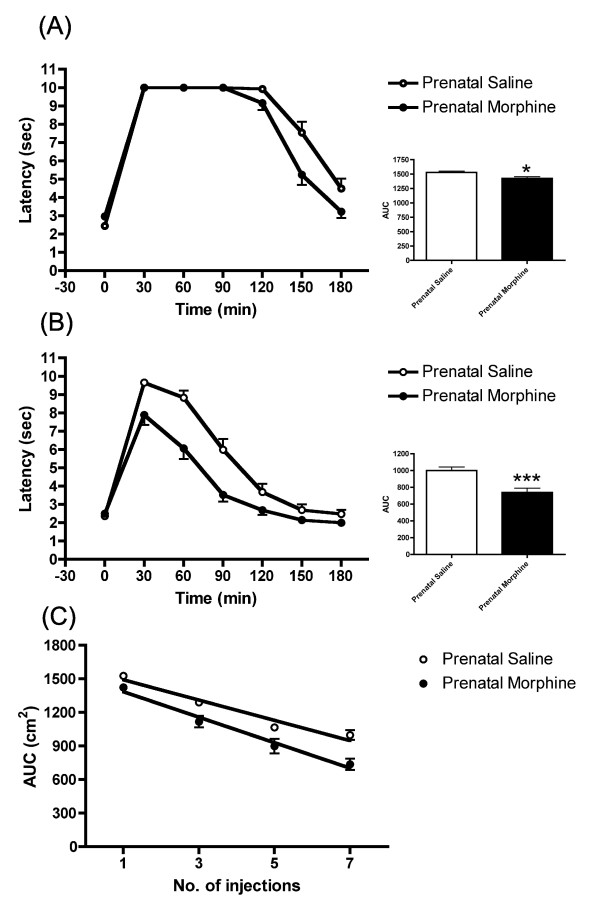
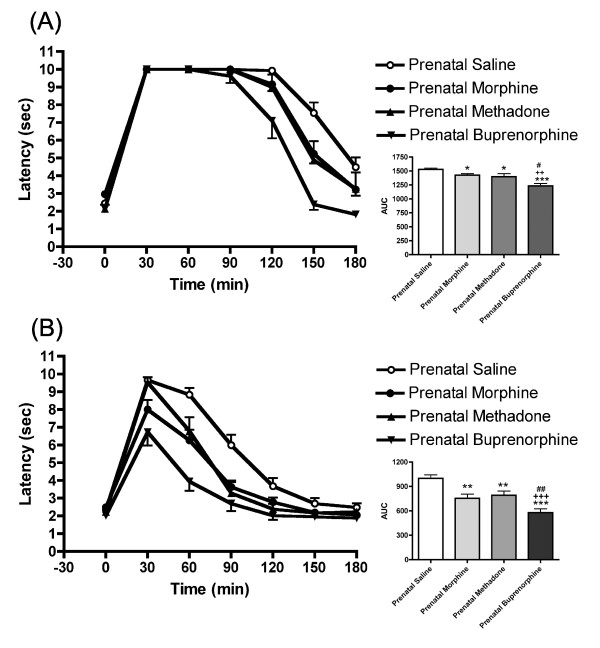
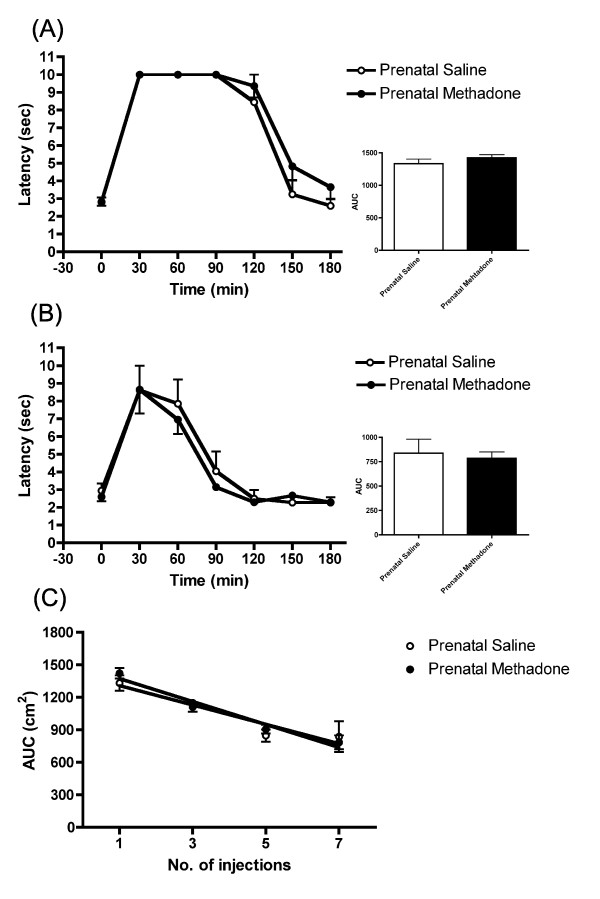
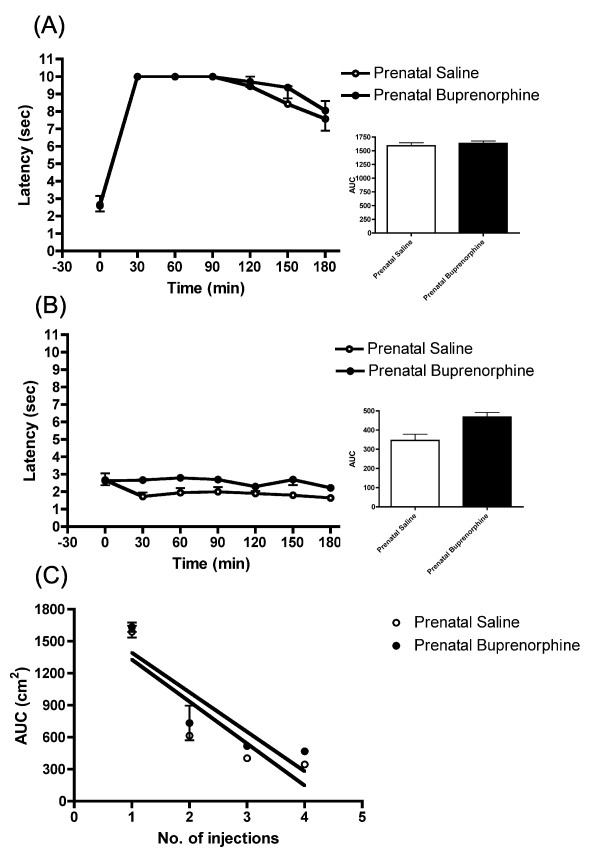
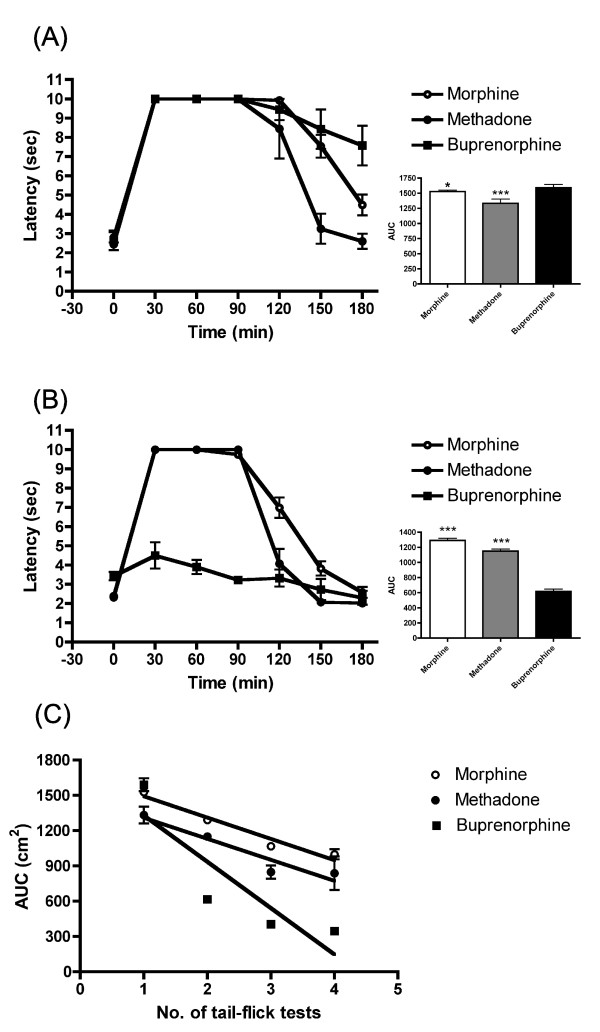
Results showed that prenatal exposure to buprenorphine caused higher mortality than other tested substance groups. Although we observed a significantly lower increase in body weight in all of the opioid-administered dams, the birth weight of the offspring was not altered in all treated groups. Moreover, no obvious behavioral abnormality or body-weight difference was noted during the growing period (8-12 weeks) in all offspring. When the male offspring received morphine injection twice a day for 4 days, the prenatally opioid-exposed rats more quickly developed a tolerance to morphine (as shown by the tail-flick tests), most notably the prenatally buprenorphine-exposed offspring. However, the tolerance development to methadone or buprenorphine was not different in offspring exposed prenatally to methadone or buprenorphine, respectively, when compared with that of the vehicle controlled group. Similar results were also obtained in the female animals.
Animals prenatally exposed to morphine, methadone, or buprenorphine developed tolerance to morphine faster than their controlled mates. In our animal model, prenatal exposure to buprenorphine also resulted in higher mortality and much less sensitivity to morphine-induced antinociception than prenatal exposure to morphine or methadone. This indicates that buprenorphine in higher doses may not be an ideal maintenance drug for treating pregnant women. This study provides a reference in selecting doses for clinical usage in treating pregnant heroin addicts.
滥用成瘾物质是一个严重的问题,对健康、经济和公共安全等领域都有重大影响。生育年龄的年轻女性使用海洛因引起了全世界的关注。然而,关于产前暴露于阿片类药物对其后代的影响的信息却很缺乏。在这项研究中,建立了动物模型来研究产前暴露于阿片类药物对后代的影响。
将雌性怀孕的 Sprague-Dawley 大鼠分为 4 组,分别接受(1)载体、(2)2-4mg/kg 吗啡(每周增加 1mg/kg)、(3)7mg/kg 美沙酮和(4)3mg/kg 丁丙诺啡,每天皮下注射一次或两次,从 E3 到 E20。实验在体重为 250-350g 的 8-12 周龄动物上进行。
结果表明,与其他测试物质组相比,产前暴露于丁丙诺啡导致更高的死亡率。尽管我们观察到所有给予阿片类药物的母体体重增加明显减少,但所有治疗组的后代出生体重均未改变。此外,在所有后代的生长期间(8-12 周),未观察到明显的行为异常或体重差异。当雄性后代每天接受两次吗啡注射 4 天时,产前暴露于阿片类药物的大鼠更快地对吗啡产生了耐受性(如尾部闪烁试验所示),最明显的是产前暴露于丁丙诺啡的后代。然而,与对照组相比,产前暴露于美沙酮或丁丙诺啡的后代对美沙酮或丁丙诺啡的耐受性发展没有差异。在雌性动物中也得到了类似的结果。
产前暴露于吗啡、美沙酮或丁丙诺啡的动物对吗啡的耐受性发展比对照配偶更快。在我们的动物模型中,与产前暴露于吗啡或美沙酮相比,产前暴露于丁丙诺啡也导致更高的死亡率和对吗啡诱导的镇痛作用的敏感性降低。这表明丁丙诺啡的高剂量可能不是治疗孕妇的理想维持药物。本研究为治疗怀孕吸毒者的临床用药剂量选择提供了参考。