Infinity Clinical Research, Sunrise, FL, USA.
King Saud Bin Abdulaziz University for Health Sciences, King Abdulaziz Medical City, Riyadh, Saudi Arabia.
J Neurol. 2020 Nov;267(11):3343-3353. doi: 10.1007/s00415-020-09983-1. Epub 2020 Jun 24.
In the phase 2 CAMMS223 trial (NCT00050778), alemtuzumab significantly improved clinical and MRI outcomes versus subcutaneous interferon beta-1a over 3 years in treatment-naive patients with relapsing-remitting MS. Here, we assess efficacy and safety of alemtuzumab over 12 years in CAMMS223 patients who enrolled in the CAMMS03409 extension (NCT00930553), with available follow-up through the subsequent TOPAZ extension (NCT02255656).
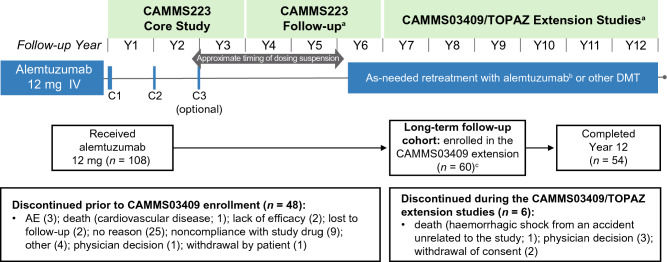
In CAMMS223, patients received 2 alemtuzumab courses (12 mg/day; baseline: 5 days; 12 months later: 3 days); 22% received a third course. In the open-label, nonrandomized extensions, patients could receive as-needed additional alemtuzumab or other disease-modifying therapies.
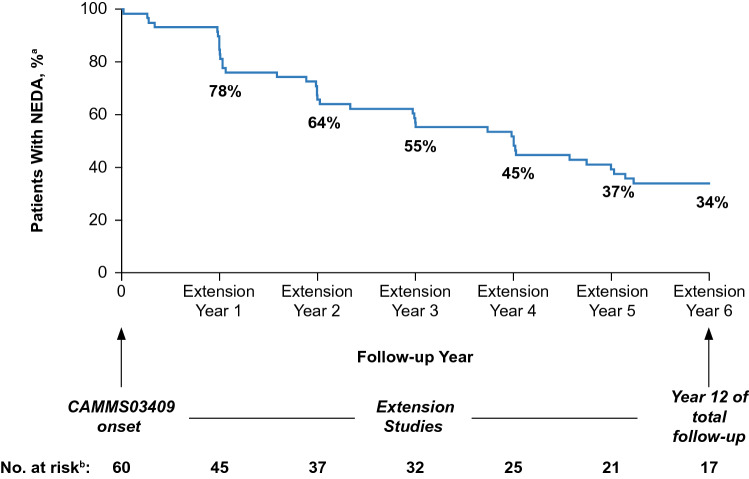
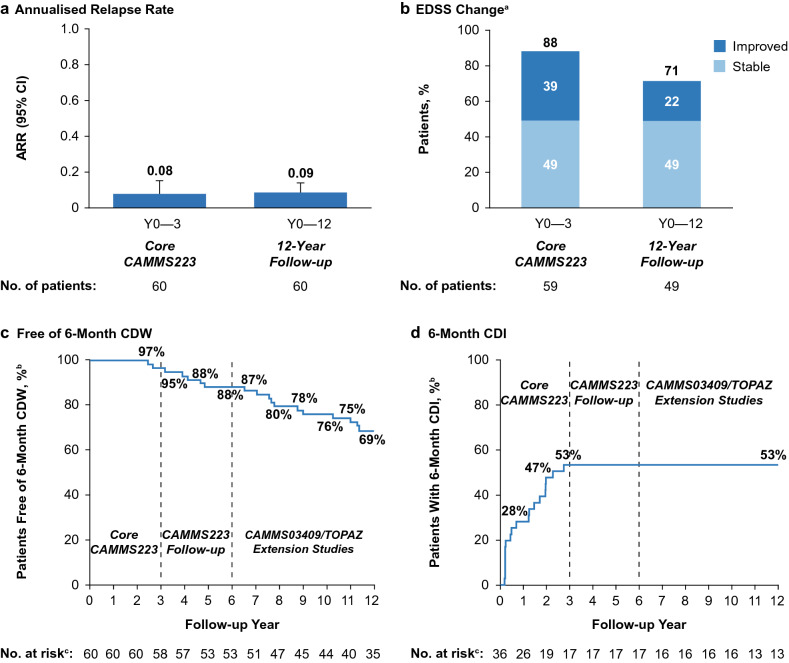
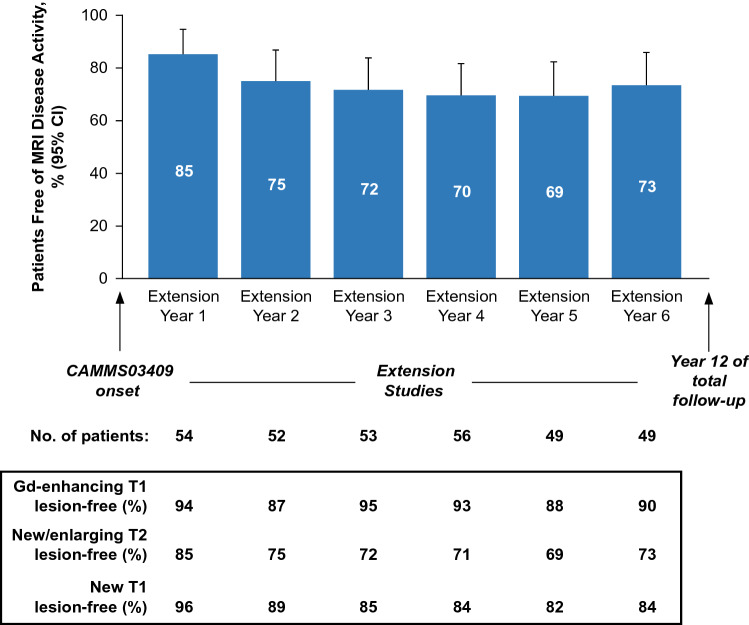
Of 108 alemtuzumab-treated patients in CAMMS223, 60 entered the CAMMS03409 extension; 33% received a total of 2 alemtuzumab courses, and 73% received no more than 3 courses through Year 12. Over 12 years, annualized relapse rate was 0.09, 71% of patients had stable or improved Expanded Disability Status Scale scores, and 69% were free of 6-month confirmed disability worsening. In Year 12, 73% of patients were free of MRI disease activity. Cumulatively throughout the extensions (Years 7-12), 34% of patients had no evidence of disease activity. Adverse event (AE) incidence declined through Year 12. Infusion-associated reactions peaked at first course and declined thereafter. Cumulative thyroid AE incidence was 50%; one immune thrombocytopenia event occurred, and there were no autoimmune nephropathy cases.
Alemtuzumab efficacy was maintained over 12 years in CAMMS223 patients, with 73% receiving no more than three courses. The safety profile in this cohort was consistent with other alemtuzumab clinical trials.
在 2 期 CAMMS223 试验(NCT00050778)中,与皮下注射干扰素β-1a 相比,在未经治疗的复发缓解型多发性硬化症患者中,阿仑单抗在 3 年内显著改善了临床和 MRI 结局。在这里,我们评估了 CAMMS223 患者在 CAMMS03409 扩展(NCT00930553)中使用阿仑单抗的疗效和安全性,这些患者可获得通过后续 TOPAZ 扩展(NCT02255656)的随访。
在 CAMMS223 中,患者接受了 2 个阿仑单抗疗程(12mg/天;基线:5 天;12 个月后:3 天);22%的患者接受了第三个疗程。在开放标签、非随机扩展中,患者可以按需接受额外的阿仑单抗或其他疾病修饰疗法。
在 CAMMS223 中接受阿仑单抗治疗的 108 名患者中,60 名进入了 CAMMS03409 扩展;33%的患者总共接受了 2 个阿仑单抗疗程,73%的患者在第 12 年之前接受了不超过 3 个疗程。在 12 年内,年复发率为 0.09,71%的患者扩展残疾状况量表评分稳定或改善,69%的患者无 6 个月确认残疾恶化。在第 12 年,73%的患者无 MRI 疾病活动。在整个扩展期间(第 7-12 年),34%的患者无疾病活动证据。不良事件(AE)发生率在第 12 年下降。输注相关反应在第一疗程达到高峰,此后逐渐下降。累积甲状腺 AE 发生率为 50%;发生 1 例免疫性血小板减少症事件,无自身免疫性肾病病例。
CAMMS223 患者的阿仑单抗疗效在 12 年内保持不变,73%的患者接受的疗程不超过 3 个。该队列的安全性与其他阿仑单抗临床试验一致。