Research Institute i+12, University Hospital 12 de Octubre, Madrid, Spain.
Thyroid Cancer Unit, Service of Endocrinology, University Hospital 12 de Octubre, Madrid, Spain.
Cancer Med. 2020 Aug;9(16):5746-5755. doi: 10.1002/cam4.3200. Epub 2020 Jun 25.
Conflicting results has been reported regard osteoporosis and fractures in patients with Differentiated Thyroid Cancer (DTC). Our objective was to evaluate the long-term effects of TSH suppression therapy with Levothyroxine (LT4) on trabecular bone score (TBS) and bone mineral density (BMD) in females with DTC after thyroidectomy.
About 145 women with resected DTC and receiving long-term TSH therapy, were stratified according to the degree of TSH suppression. Mean duration of follow-up was 12.3 ± 6.1 years. BMD and TBS, were assessed using dual-energy X-ray absorptiometry (DXA) and TBS iNsight (Med-Imaps), at baseline (1-3 months after surgery) and at the final study visit.
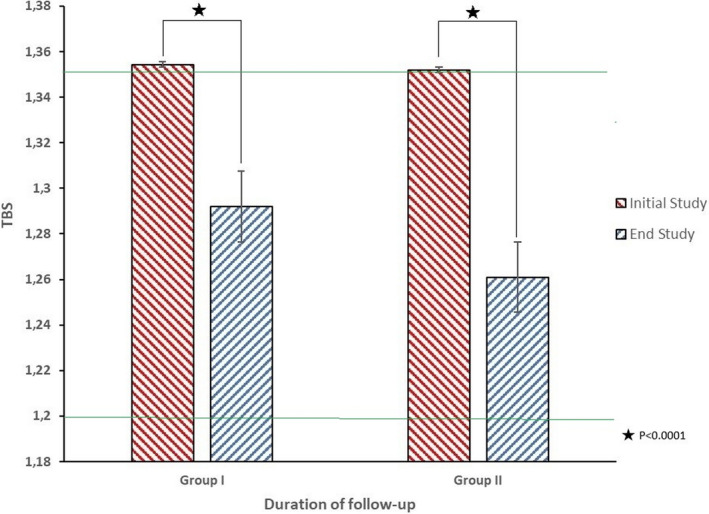
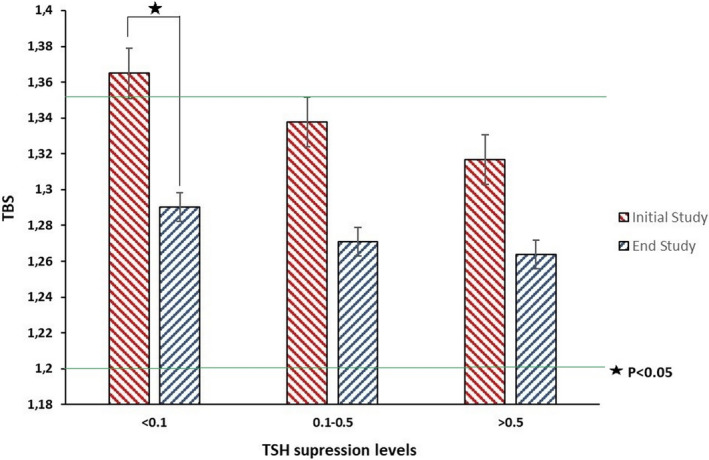
In patients stratified by duration of TSH suppression therapy (Group I, 5-10 years; Group II, >10 years), slight increases from baseline TSH levels were observed. Significant decreases in LS-BMD and FN-BMD were seen in patients after >10 years. TBS values were lower in Groups I (1.289 ± 0.122) and II (1.259 ± 0.129) compared with baseline values (P = .0001, both groups). Regarding the degree of TSH suppression, TBS was significantly reduced in those with TSH < 0.1 µU/mL (P = .0086), and not in patients with TSH suppression of 0.1.-0.5 or >0.5 µU/mL.
We found deterioration of trabecular structure in patients with DTC and TSH suppression therapy below 0.1 µU/mL and after 5-10 years of follow-up. Significant changes in BMD according to TSH levels were not observed. Trabecular Bone Score is a useful technique for identifying thyroid cancer patients with risk of bone deterioration.
分化型甲状腺癌(DTC)患者的骨质疏松症和骨折结果存在矛盾。我们的目的是评估左旋甲状腺素(LT4)抑制促甲状腺激素(TSH)治疗对甲状腺切除术后女性 DTC 患者的小梁骨评分(TBS)和骨密度(BMD)的长期影响。
根据 TSH 抑制程度,对 145 名接受长期 TSH 治疗的 DTC 女性患者进行分层。中位随访时间为 12.3±6.1 年。在基线(术后 1-3 个月)和最终研究访问时,使用双能 X 射线吸收法(DXA)和 TBS iNsight(Med-Imaps)评估 BMD 和 TBS。
在 TSH 抑制治疗时间分层的患者中(组 I,5-10 年;组 II,>10 年),观察到 TSH 水平略有升高。>10 年后,LS-BMD 和 FN-BMD 显著下降。与基线值相比,组 I(1.289±0.122)和组 II(1.259±0.129)的 TBS 值较低(均 P<.0001)。关于 TSH 抑制程度,TSH<0.1µU/mL 的患者 TBS 明显降低(P=.0086),而 TSH 抑制在 0.1-0.5µU/mL 或>0.5µU/mL 的患者中没有降低。
我们发现 DTC 患者和 TSH 抑制治疗低于 0.1µU/mL 以及随访 5-10 年后的小梁结构恶化。未观察到根据 TSH 水平的 BMD 变化。TBS 是一种有用的技术,可用于识别有骨恶化风险的甲状腺癌患者。