Department of Civil and Environmental Engineering, College of Engineering and Computing, University of South Carolina, Columbia, South Carolina, United States of America.
Arnold School of Public Health, University of South Carolina, Columbia, South Carolina, United States of America.
PLoS One. 2020 Jun 25;15(6):e0234541. doi: 10.1371/journal.pone.0234541. eCollection 2020.
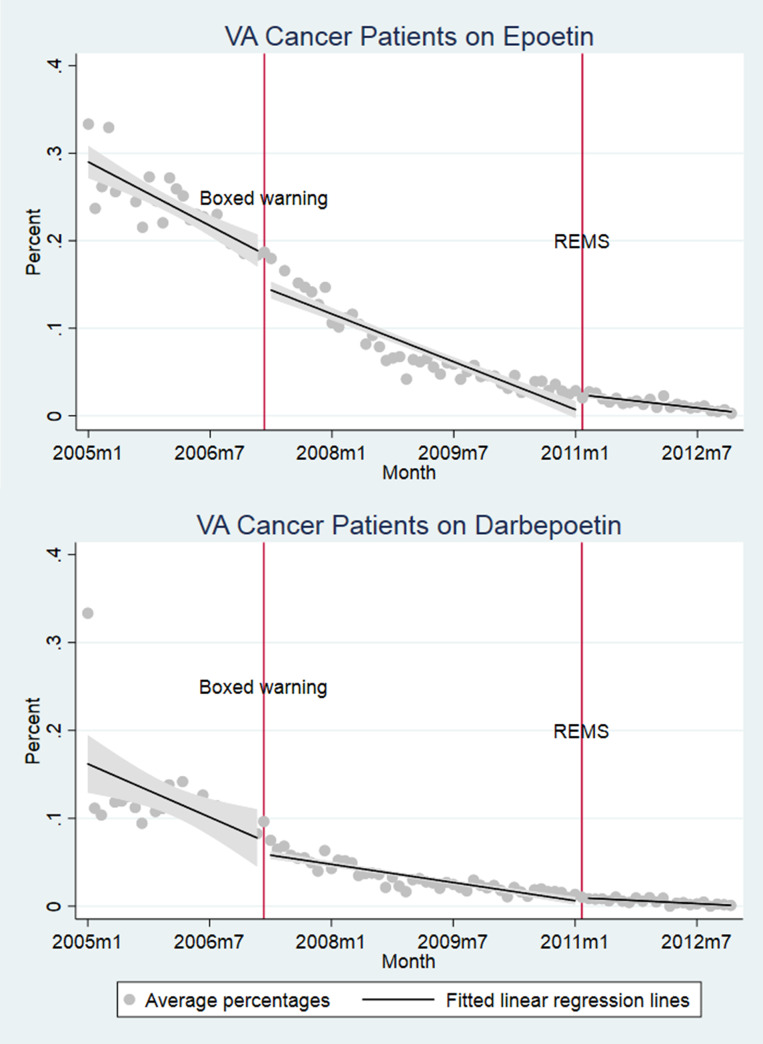
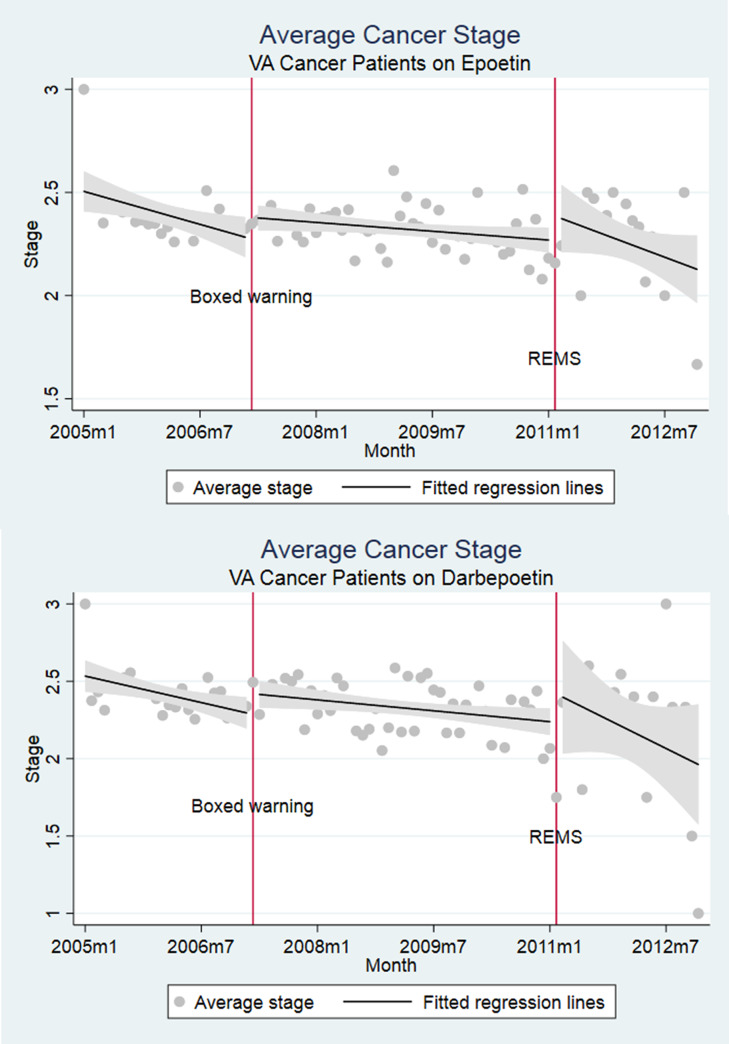
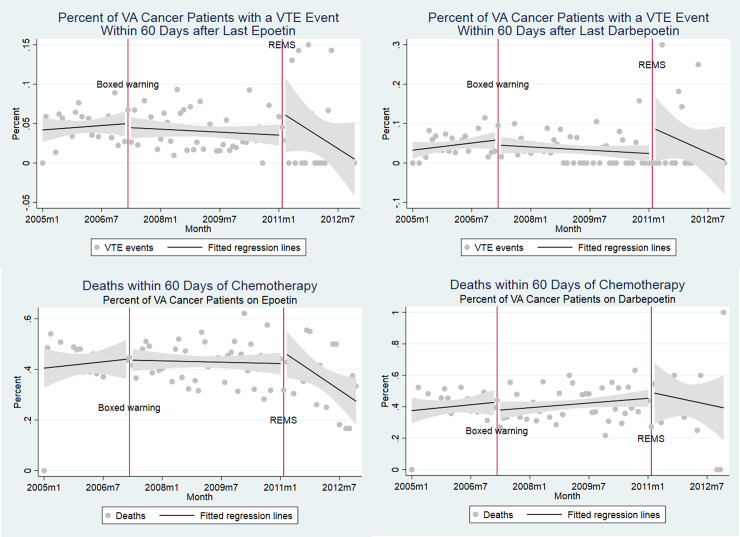
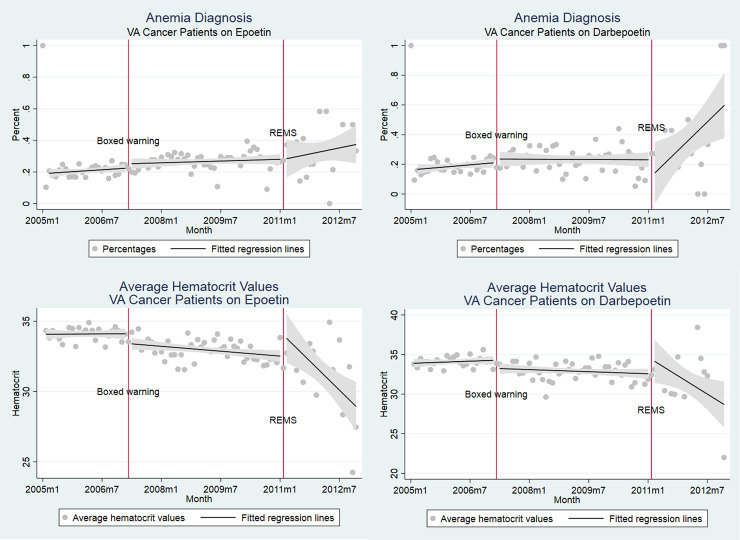
Erythropoisis stimulating agent (ESA) use was addressed in Food and Drug Administration (FDA) Oncology Drug Advisory Committee (ODAC) meetings between 2004 and 2008. FDA safety-focused regulatory actions occurred in 2007 and 2008. In 2007, black box warnings advised of early death and venous thromboembolism (VTE) risks with ESAs in oncology. In 2010, a Risk Evaluation Strategies (REMS) was initiated, with cancer patient consent that mortality and VTE risks were noted with ESAs. We report warnings and REMS impacts on ESA utilization among Veterans Administration (VA) cancer patients with chemotherapy-induced anemia (CIA). Data were from Veterans Affairs database (2003-2012). Epoetin and darbepoetin use were primary outcomes. Segmented linear regression was used to estimate changes in ESA use levels and trends, clinical appropriateness, and adverse events (VTEs) among chemotherapy-treated cancer patients. To estimate changes in level of drug prescription rate after policy actions, model-specific indicator variables as covariates based on specific actions were included. ESA use fell by 95% and 90% from 2005, for epoetin and darbepoetin, from 22% and 11%, respectively, to 1% and 1%, respectively, among cancer patients with CIA, respectively (p<0.01). Following REMS in 2010, mean hematocrit levels at ESA initiation decreased from 30% to 21% (p<0.01). Black box warnings preceded decreased ESA use among VA cancer patients with CIA. REMS was followed by reduced hematocrit levels at ESA initiation. Our findings contrast with privately- insured and Medicaid insured cancer patient data on chemotherapy-induced anemia where ESA use decreased to 3% to 7% by 2010-2012. By 2012, the era of ESA administration to VA to cancer patients had ended but the warnings remain relevant and significant. In 2019, oncology/hematology national guidelines (ASCO/ASH) recommend that cancer patients with chemotherapy-induced anemia should receive ESAs or red blood cell transfusions after risk-benefit evaluation.
2004 年至 2008 年期间,食品和药物管理局(FDA)肿瘤药物咨询委员会(ODAC)会议讨论了红细胞生成刺激剂(ESA)的使用问题。2007 年和 2008 年,FDA 采取了以安全为重点的监管措施。2007 年,黑框警告称,ESA 在肿瘤学中的应用存在早期死亡和静脉血栓栓塞(VTE)风险。2010 年,启动了风险评估策略(REMS),要求癌症患者同意 ESA 会增加死亡率和 VTE 风险。我们报告了黑框警告和 REMS 对退伍军人事务部(VA)癌症患者化疗引起的贫血(CIA)中 ESA 应用的影响。数据来自退伍军人事务部数据库(2003-2012 年)。促红细胞生成素和达贝泊汀的使用是主要结果。使用分段线性回归来估计化疗治疗的癌症患者中 ESA 使用水平和趋势、临床适宜性以及不良事件(VTE)的变化。为了估计政策措施后药物处方率水平的变化,根据具体措施,将特定的药物处方率水平变化模型作为协变量纳入模型。ESA 的使用分别从 2005 年的 22%和 11%下降到分别为 1%和 1%,对于 CIA 的癌症患者,促红细胞生成素和达贝泊汀的使用分别下降了 95%和 90%(p<0.01)。2010 年 REMS 实施后,ESA 起始时的平均血细胞比容水平从 30%降至 21%(p<0.01)。VA 癌症患者 CIA 中的黑框警告导致 ESA 使用减少。REMS 实施后,ESA 起始时的血细胞比容水平降低。我们的研究结果与私营保险和医疗补助保险癌症患者化疗引起的贫血数据形成对比,到 2010-2012 年,ESA 的使用下降到 3%至 7%。到 2012 年,VA 癌症患者接受 ESA 治疗的时代已经结束,但警告仍然相关且重要。2019 年,肿瘤学/血液学国家指南(ASCO/ASH)建议,化疗引起的贫血的癌症患者应在进行风险-效益评估后接受 ESA 或红细胞输血。