Department of Internal Medicine and Liver Research Institute, Seoul National University Hospital, Seoul National University College of Medicine, Seoul, Republic of Korea.
Department of Internal Medicine, Dongguk University Ilsan Hospital, Goyang, Republic of Korea.
JAMA Surg. 2020 Aug 1;155(8):703-711. doi: 10.1001/jamasurg.2020.1501.
The incidence of gallstones has been reported to increase after gastrectomy. However, few studies have been conducted on the prevention of gallstone formation in patients who have undergone gastrectomy.
To evaluate the efficacy and safety of ursodeoxycholic acid (UDCA) in preventing gallstone formation after gastrectomy in patients with gastric cancer.
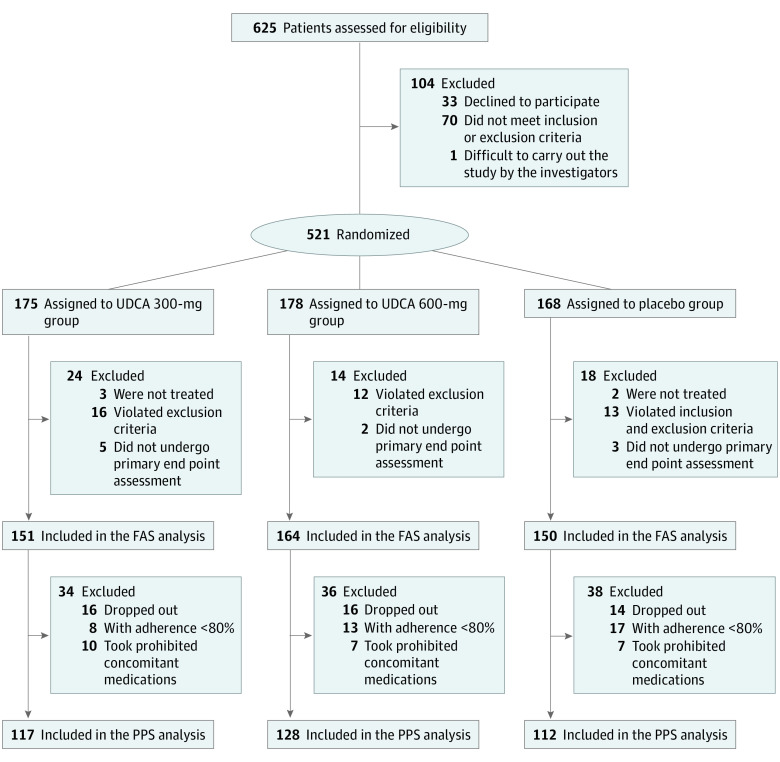
DESIGN, SETTING, AND PARTICIPANTS: The PEGASUS-D study (Efficacy and Safety of DWJ1319 in the Prevention of Gallstone Formation after Gastrectomy in Patient with Gastric Cancer: A Multicenter, Randomized, Double-blind, Placebo-controlled Study) was a randomized, double-blind, placebo-controlled clinical trial conducted at 12 institutions in the Republic of Korea. Adults (aged ≥19 years) with a diagnosis of gastric cancer who underwent total, distal, or proximal gastrectomy were enrolled between May 26, 2015, and January 9, 2017; follow-up ended January 8, 2018. Efficacy was evaluated by both the full analysis set, based on the intention-to-treat principle, and the per-protocol set; full analysis set findings were interpreted as the main results.
Eligible participants were randomly assigned to receive 300 mg of UDCA, 600 mg of UDCA, or placebo at a ratio of 1:1:1. Ursodeoxycholic acid and placebo were administered daily for 52 weeks.
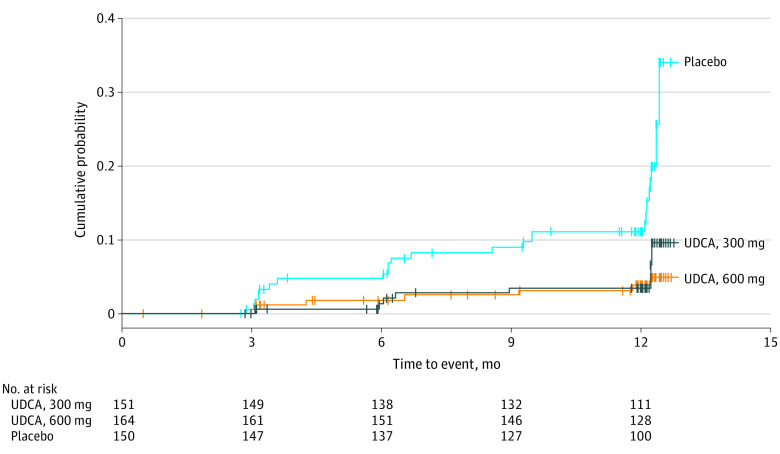
Gallstone formation was assessed with abdominal ultrasonography every 3 months for 12 months. Randomization and allocation to trial groups were carried out by an interactive web-response system. The primary end point was the proportion of patients developing gallstones within 12 months after gastrectomy.
A total of 521 patients (175 received 300 mg of UDCA, 178 received 600 mg of UDCA, and 168 received placebo) were randomized. The full analysis set included 465 patients (311 men; median age, 56.0 years [interquartile range, 48.0-64.0 years]), with 151 patients in the 300-mg group, 164 patients in the 600-mg group, and 150 patients in the placebo group. The proportion of patients developing gallstones within 12 months after gastrectomy was 8 of 151 (5.3%) in the 300-mg group, 7 of 164 (4.3%) in the 600-mg group, and 25 of 150 (16.7%) in the placebo group. Compared with the placebo group, odds ratios for gallstone formation were 0.27 (95% CI, 0.12-0.62; P = .002) in the 300-mg group and 0.20 (95% CI, 0.08-0.50; P < .001) in the 600-mg group. No significant adverse drug reactions were detected among the enrolled patients.
Administration of UDCA for 12 months significantly reduced the incidence of gallstones after gastrectomy for gastric cancer. These findings suggest that UDCA administration prevents gallstone formation after gastrectomy in patients with gastric cancer.
ClinicalTrials.gov Identifier: NCT02490111.
据报道,胃切除术后胆石症的发病率有所增加。然而,对于胃癌患者胃切除术后预防胆石形成的研究较少。
评估熊去氧胆酸(UDCA)预防胃癌患者胃切除术后胆石形成的疗效和安全性。
设计、地点和参与者:PEGASUS-D 研究(DWJ1319 在预防胃癌患者胃切除术后胆石形成中的疗效和安全性:一项多中心、随机、双盲、安慰剂对照研究)是在韩国 12 个机构进行的一项随机、双盲、安慰剂对照临床试验。2015 年 5 月 26 日至 2017 年 1 月 9 日期间,纳入了诊断为胃癌且接受全胃切除术、远端胃切除术或近端胃切除术的成年人(年龄≥19 岁);随访于 2018 年 1 月 8 日结束。根据意向治疗原则,通过全分析集和方案集进行了疗效评估;全分析集结果被解释为主要结果。
符合条件的参与者被随机分配接受 300 mg UDCA、600 mg UDCA 或安慰剂,比例为 1:1:1。UDCA 和安慰剂每天给药一次,持续 52 周。
每 3 个月通过腹部超声检查评估胆石形成情况,持续 12 个月。随机化和分组由交互式网络响应系统进行。主要终点是胃切除术后 12 个月内发生胆石症的患者比例。
共有 521 名患者(175 名接受 300 mg UDCA、178 名接受 600 mg UDCA、168 名接受安慰剂)被随机分组。全分析集包括 465 名患者(311 名男性;中位年龄为 56.0 岁[四分位距,48.0-64.0 岁]),其中 300-mg 组 151 名患者、600-mg 组 164 名患者、安慰剂组 150 名患者。胃切除术后 12 个月内发生胆石症的患者比例为 300-mg 组 8 例(5.3%)、600-mg 组 7 例(4.3%)、安慰剂组 25 例(16.7%)。与安慰剂组相比,300-mg 组胆石形成的优势比为 0.27(95%CI,0.12-0.62;P=0.002),600-mg 组为 0.20(95%CI,0.08-0.50;P<0.001)。未发现纳入患者有明显的药物不良反应。
UDCA 给药 12 个月可显著降低胃癌胃切除术后胆石症的发生率。这些发现表明 UDCA 给药可预防胃癌患者胃切除术后胆石形成。
ClinicalTrials.gov 标识符:NCT02490111。