Institut d'Investigacions Biomèdiques August Pi i Sunyer (IDIBAPS), Barcelona, Spain.
Centro de Investigación Biomédica en Red de Cáncer, Madrid, Spain.
Blood. 2020 Sep 17;136(12):1419-1432. doi: 10.1182/blood.2020005289.
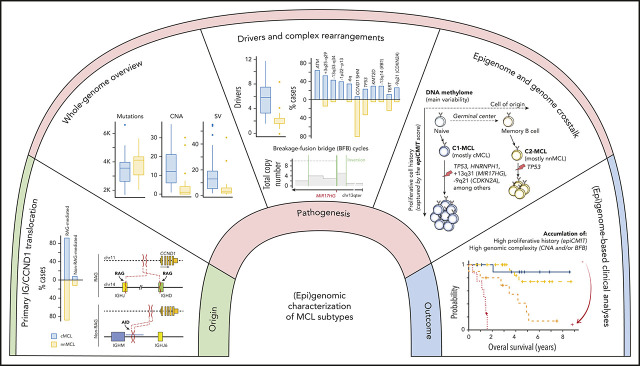
Mantle cell lymphoma (MCL) is a mature B-cell neoplasm initially driven by CCND1 rearrangement with 2 molecular subtypes, conventional MCL (cMCL) and leukemic non-nodal MCL (nnMCL), that differ in their clinicobiological behavior. To identify the genetic and epigenetic alterations determining this diversity, we used whole-genome (n = 61) and exome (n = 21) sequencing (74% cMCL, 26% nnMCL) combined with transcriptome and DNA methylation profiles in the context of 5 MCL reference epigenomes. We identified that open and active chromatin at the major translocation cluster locus might facilitate the t(11;14)(q13;32), which modifies the 3-dimensional structure of the involved regions. This translocation is mainly acquired in precursor B cells mediated by recombination-activating genes in both MCL subtypes, whereas in 8% of cases the translocation occurs in mature B cells mediated by activation-induced cytidine deaminase. We identified novel recurrent MCL drivers, including CDKN1B, SAMHD1, BCOR, SYNE1, HNRNPH1, SMARCB1, and DAZAP1. Complex structural alterations emerge as a relevant early oncogenic mechanism in MCL, targeting key driver genes. Breakage-fusion-bridge cycles and translocations activated oncogenes (BMI1, MIR17HG, TERT, MYC, and MYCN), generating gene amplifications and remodeling regulatory regions. cMCL carried significant higher numbers of structural variants, copy number alterations, and driver changes than nnMCL, with exclusive alterations of ATM in cMCL, whereas TP53 and TERT alterations were slightly enriched in nnMCL. Several drivers had prognostic impact, but only TP53 and MYC aberrations added value independently of genomic complexity. An increasing genomic complexity, together with the presence of breakage-fusion-bridge cycles and high DNA methylation changes related to the proliferative cell history, defines patients with different clinical evolution.
套细胞淋巴瘤(Mantle cell lymphoma,MCL)是一种成熟 B 细胞肿瘤,最初由 CCND1 重排驱动,有 2 种分子亚型,即常规 MCL(conventional MCL,cMCL)和白血病性非结外 MCL(leukemic non-nodal MCL,nnMCL),其临床生物学行为不同。为了确定决定这种多样性的遗传和表观遗传改变,我们使用全基因组(n=61)和外显子组(n=21)测序(74%的 cMCL,26%的 nnMCL),结合 5 个 MCL 参考表观基因组中的转录组和 DNA 甲基化谱。我们发现,主要易位簇基因座的开放和活跃染色质可能有助于 t(11;14)(q13;32)的形成,该易位改变了相关区域的 3 维结构。这种易位主要通过两种 MCL 亚型中的重组激活基因在前体 B 细胞中获得,而在 8%的病例中,易位通过激活诱导的胞嘧啶脱氨酶在成熟 B 细胞中发生。我们鉴定出了新的复发性 MCL 驱动基因,包括 CDKN1B、SAMHD1、BCOR、SYNE1、HNRNPH1、SMARCB1 和 DAZAP1。复杂的结构改变是 MCL 中一个重要的早期致癌机制,靶向关键驱动基因。断裂-融合-桥循环和易位激活了癌基因(BMI1、MIR17HG、TERT、MYC 和 MYCN),导致基因扩增和重塑调控区域。cMCL 比 nnMCL 携带更多的结构变异、拷贝数改变和驱动变化,cMCL 中存在 ATM 的独特改变,而 nnMCL 中则略微富集了 TP53 和 TERT 改变。一些驱动基因具有预后影响,但只有 TP53 和 MYC 异常改变在基因组复杂性之外具有独立的附加价值。基因组复杂性的增加,以及与增殖细胞历史相关的断裂-融合-桥循环和高 DNA 甲基化变化的存在,定义了具有不同临床演变的患者。