School of Population and Public Health, University of British Columbia, Vancouver, BC V6T 1Z3, Canada.
International Labour Organization, Harare, Zimbabwe.
Int J Environ Res Public Health. 2020 Jun 23;17(12):4519. doi: 10.3390/ijerph17124519.
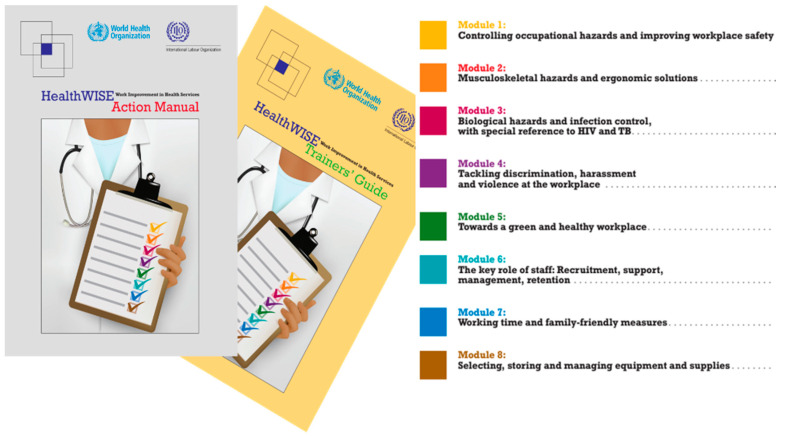
Ways to address the increasing global health workforce shortage include improving the occupational health and safety of health workers, particularly those in high-risk, low-resource settings. The World Health Organization and International Labour Organization designed HealthWISE, a quality improvement tool to help health workers identify workplace hazards to find and apply low-cost solutions. However, its implementation had never been systematically evaluated. We, therefore, studied the implementation of HealthWISE in seven hospitals in three countries: Mozambique, South Africa, and Zimbabwe. Through a multiple-case study and thematic analysis of data collected primarily from focus group discussions and questionnaires, we examined the enabling factors and barriers to the implementation of HealthWISE by applying the integrated Promoting Action on Research Implementation in Health Services (i-PARiHS) framework. Enabling factors included the willingness of workers to engage in the implementation, diverse teams that championed the process, and supportive senior leadership. Barriers included lack of clarity about how to use HealthWISE, insufficient funds, stretched human resources, older buildings, and lack of incident reporting infrastructure. Overall, successful implementation of HealthWISE required dedicated local team members who helped facilitate the process by adapting HealthWISE to the workers' occupational health and safety (OHS) knowledge and skill levels and the cultures and needs of their hospitals, cutting across all constructs of the i-PARiHS framework.
解决全球卫生人力短缺问题的方法包括改善卫生工作者的职业健康和安全,特别是在高风险、资源匮乏的环境中工作的卫生工作者。世界卫生组织和国际劳工组织设计了 HealthWISE,这是一种质量改进工具,可帮助卫生工作者识别工作场所的危害,找到并应用低成本的解决方案。然而,其实施从未得到系统评估。因此,我们在三个国家的七家医院中研究了 HealthWISE 的实施情况:莫桑比克、南非和津巴布韦。我们通过对主要来自焦点小组讨论和问卷调查的数据进行多案例研究和主题分析,应用综合促进卫生服务研究实施行动(i-PARiHS)框架,考察了 HealthWISE 实施的促成因素和障碍。促成因素包括工作人员参与实施的意愿、支持该过程的多样化团队以及有支持力的高层领导。障碍包括如何使用 HealthWISE 不够清晰、资金不足、人力资源紧张、旧建筑以及缺乏事件报告基础设施。总的来说,HealthWISE 的成功实施需要有专门的本地团队成员,他们通过将 HealthWISE 适当地调整到工人的职业健康和安全(OHS)知识和技能水平以及医院的文化和需求,帮助推动这一过程,跨越了 i-PARiHS 框架的所有结构。