Porsbjerg Celeste M, Sverrild Asger, Lloyd Clare M, Menzies-Gow Andrew N, Bel Elisabeth H
Dept of Respiratory Medicine, Bispebjerg Hospital, Copenhagen, Denmark
Dept of Respiratory Medicine, Bispebjerg Hospital, Copenhagen, Denmark.
Eur Respir J. 2020 Nov 12;56(5). doi: 10.1183/13993003.00260-2020. Print 2020 Nov.
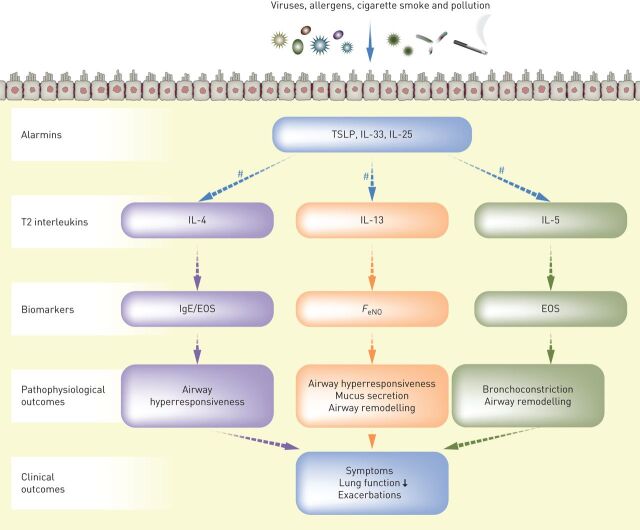
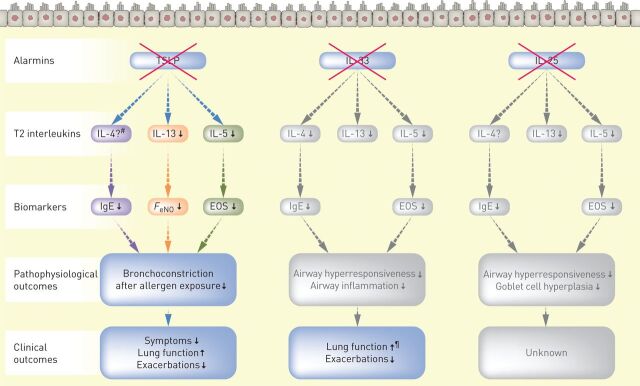
Monoclonal antibody therapies have significantly improved treatment outcomes for patients with severe asthma; however, a significant disease burden remains. Available biologic treatments, including anti-immunoglobulin (Ig)E, anti-interleukin (IL)-5, anti-IL-5Rα and anti-IL-4Rα, reduce exacerbation rates in study populations by approximately 50% only. Furthermore, there are currently no effective treatments for patients with severe, type 2-low asthma. Existing biologics target immunological pathways that are downstream in the type 2 inflammatory cascade, which may explain why exacerbations are only partly abrogated. For example, type 2 airway inflammation results from several inflammatory signals in addition to IL-5. Clinically, this can be observed in how fractional exhaled nitric oxide ( ), which is driven by IL-13, may remain unchanged during anti-IL-5 treatment despite reduction in eosinophils, and how eosinophils may remain unchanged during anti-IL-4Rα treatment despite reduction in The broad inflammatory response involving cytokines including IL-4, IL-5 and IL-13 that ultimately results in the classic features of exacerbations (eosinophilic inflammation, mucus production and bronchospasm) is initiated by release of "alarmins" thymic stromal lymphopoietin (TSLP), IL-33 and IL-25 from the airway epithelium in response to triggers. The central, upstream role of these epithelial cytokines has identified them as strong potential therapeutic targets to prevent exacerbations and improve lung function in patients with type 2-high and type 2-low asthma. This article describes the effects of alarmins and discusses the potential role of anti-alarmins in the context of existing biologics. Clinical phenotypes of patients who may benefit from these treatments are also discussed, including how biomarkers may help identify potential responders.
单克隆抗体疗法显著改善了重度哮喘患者的治疗效果;然而,疾病负担依然很重。现有的生物治疗方法,包括抗免疫球蛋白(Ig)E、抗白细胞介素(IL)-5、抗IL-5Rα和抗IL-4Rα,仅能使研究人群中的病情加重率降低约50%。此外,目前对于重度2型低哮喘患者尚无有效治疗方法。现有的生物制剂靶向2型炎症级联反应下游的免疫途径,这可能解释了为何病情加重只是部分得到缓解。例如,2型气道炎症除了由IL-5引起外,还源于多种炎症信号。临床上,这可以从以下情况中观察到:由IL-13驱动的呼出气一氧化氮分数()在抗IL-5治疗期间尽管嗜酸性粒细胞减少但可能保持不变,以及在抗IL-4Rα治疗期间尽管降低但嗜酸性粒细胞可能保持不变。由气道上皮细胞释放“警报素”胸腺基质淋巴细胞生成素(TSLP)、IL-33和IL-25以响应触发因素,引发了涉及IL-4、IL-5和IL-13等细胞因子的广泛炎症反应,最终导致病情加重的典型特征(嗜酸性粒细胞炎症、黏液分泌和支气管痉挛)。这些上皮细胞因子的核心上游作用已使其成为预防2型高哮喘和2型低哮喘患者病情加重及改善肺功能的强大潜在治疗靶点。本文描述了警报素的作用,并在现有生物制剂的背景下讨论了抗警报素的潜在作用。还讨论了可能从这些治疗中获益的患者的临床表型,包括生物标志物如何有助于识别潜在的反应者。