Department of Cardiology, Affiliated Hospital of Jiangsu University, Zhenjiang, Jiangsu Province 212000, China.
Department of Cardiology, Ren Ji Hospital Affiliated to Shanghai Jiao Tong University School of Medicine, Shanghai 200135, China.
Mediators Inflamm. 2020 Jun 6;2020:4321912. doi: 10.1155/2020/4321912. eCollection 2020.
Endothelial dysfunction and apoptosis resulting from oxidative stress can lead to the development of atherosclerosis. Our group has previously showed that CD137 signaling contributes to the progression of atherosclerosis and the vulnerability of plaques. The aim of this study is to investigate the effects of CD137 signaling in atherosclerosis on endothelial cells (ECs) apoptosis and to explore the underlying mechanisms.
Serum samples were collected from 11 patients with acute myocardial infarction and 4 controls. Peritoneal injection of agonist-CD137 recombinant protein in ApoE mice was used to determine whether CD137 signaling can promote apoptosis in vivo, and human umbilical vein endothelial cells treated with agonist-CD137 recombinant protein, M5580 (a Nrf2 pathway agonist) and CAPE (a NF-B pathway inhibitor) were used to explore the effect of Nrf2 and NF-B pathway in CD137 signaling-induced ECs apoptosis in vitro.
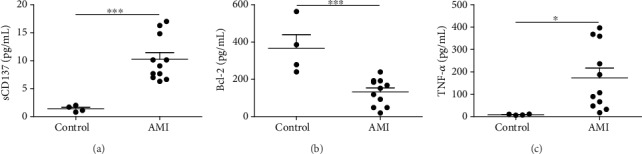
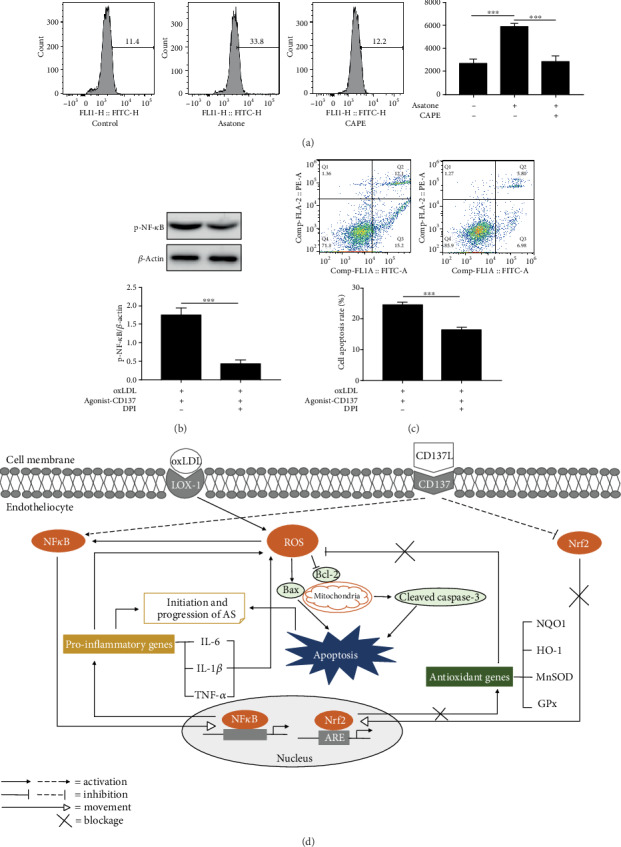
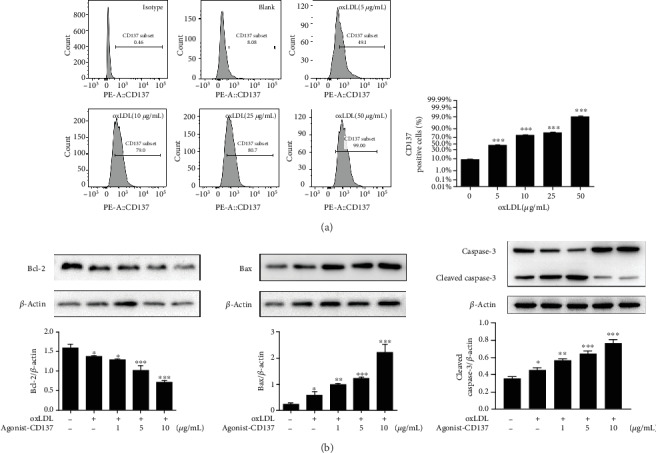
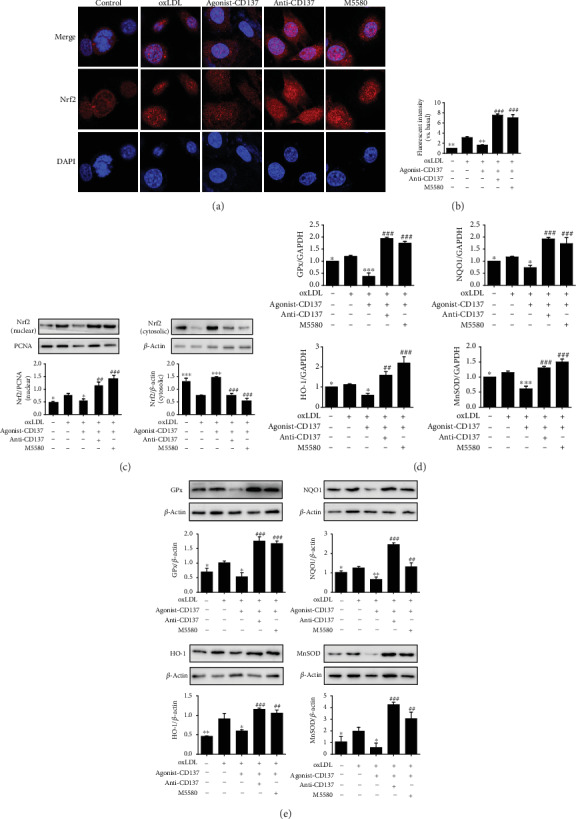
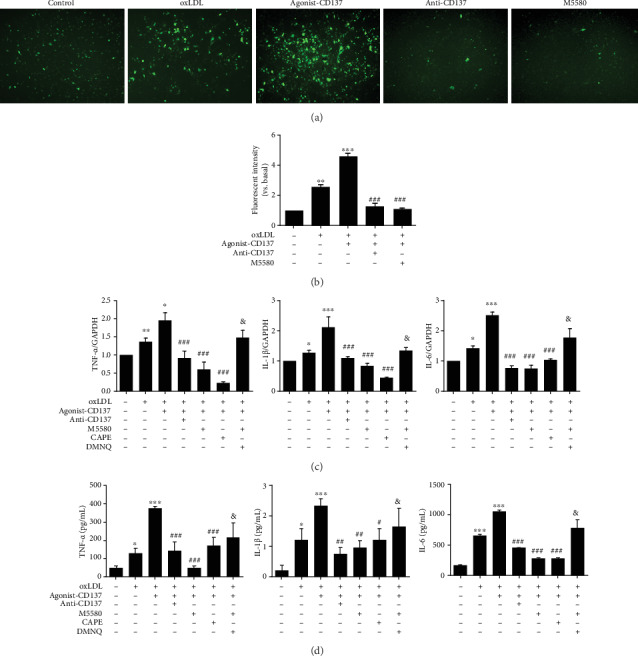
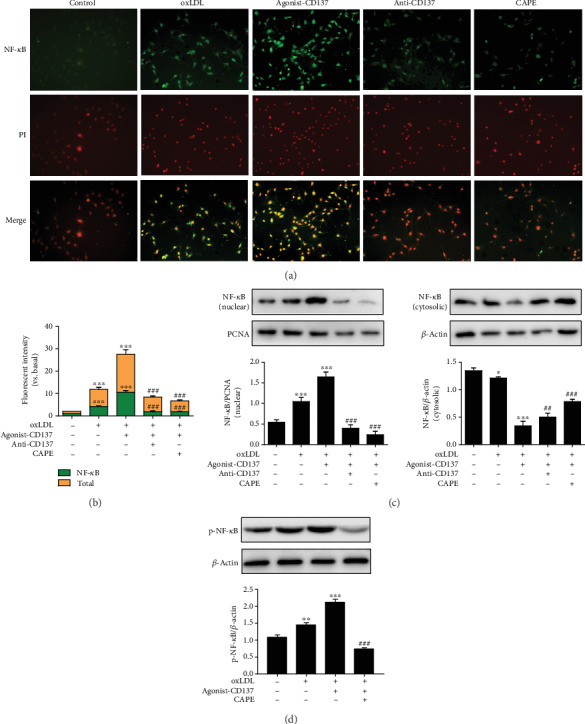
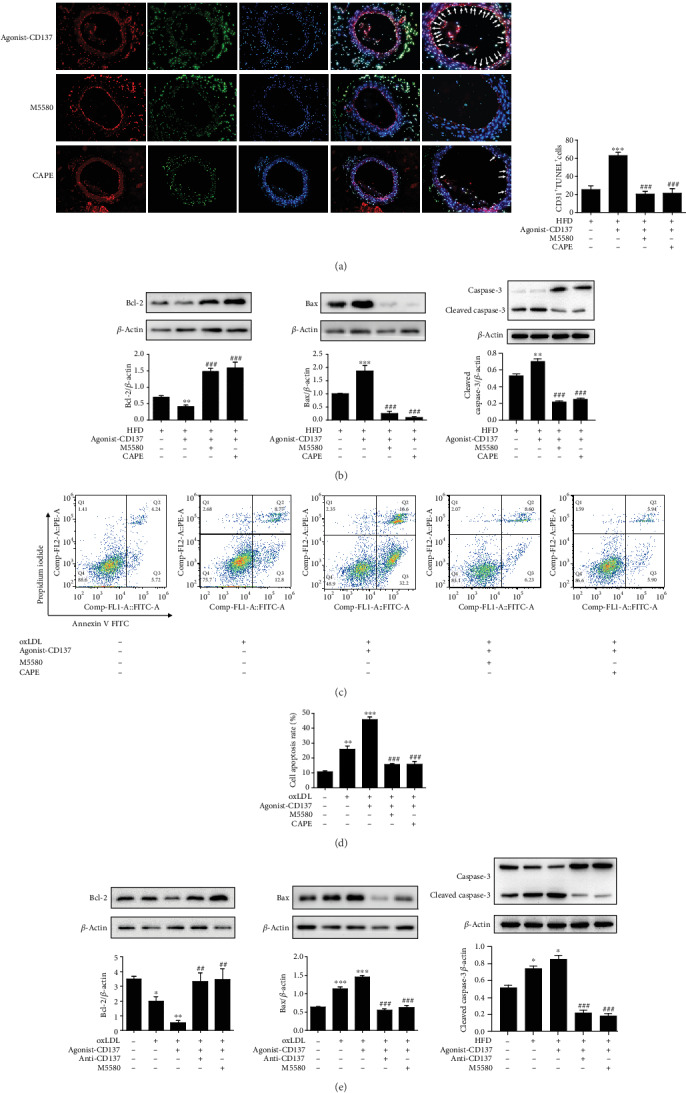
ELISA showed that Bcl-2 in the serum of AMI patients was lower than that of the control group, while TNF- and sCD137 were higher than that of the control group. Confocal microscopy and Western blot analysis showed that the nuclear translocation of Nrf2 in the agonist-CD137 group was significantly inhibited, and the expression of its downstream antioxidant enzymes was also decreased when compared with control. Immunofluorescence and Western blot results showed that the nuclear translocation of NF-B in the agonist-CD137 group was enhanced, and ELISA results showed that the secretion of proinflammatory cytokines in the agonist-CD137 group was increased. Immunofluorescence results revealed that ROS production in the agonist-CD137 group was higher than that in control, M5580 (a Nrf2 pathway agonist) and CAPE (a NF-B pathway inhibitor) groups. In vitro studies using HUVECs and in vivo studies using high-fat-fed ApoE mice showed that the number of apoptotic endothelial cells was the highest in the agonist-CD137 group. By contrast, both M5580 and CAPE treatments were able to reduce CD137 induced ECs apoptosis.
Our results showed that CD137 signaling promotes ECs apoptosis through prooxidative and proinflammatory mechanisms, mediated by Nrf2 and NF-B pathways, respectively.
氧化应激导致的内皮功能障碍和细胞凋亡可导致动脉粥样硬化的发生。我们的研究小组先前已经表明,CD137 信号转导有助于动脉粥样硬化的进展和斑块的不稳定性。本研究旨在探讨 CD137 信号转导在动脉粥样硬化中的作用对内皮细胞(EC)凋亡的影响,并探讨其潜在机制。
收集 11 例急性心肌梗死患者和 4 例对照者的血清样本。通过腹腔注射激动剂-CD137 重组蛋白,在 ApoE 小鼠中确定 CD137 信号转导是否能促进体内的细胞凋亡,并用激动剂-CD137 重组蛋白、M5580(Nrf2 途径激动剂)和 CAPE(NF-B 途径抑制剂)处理人脐静脉内皮细胞,探讨体外 CD137 信号转导诱导 EC 凋亡中 Nrf2 和 NF-B 途径的作用。
ELISA 结果显示,AMI 患者血清中的 Bcl-2 低于对照组,而 TNF-和 sCD137 则高于对照组。共聚焦显微镜和 Western blot 分析显示,激动剂-CD137 组的 Nrf2 核转位明显受到抑制,其下游抗氧化酶的表达也低于对照组。免疫荧光和 Western blot 结果显示,激动剂-CD137 组 NF-B 的核转位增强,ELISA 结果显示,激动剂-CD137 组促炎细胞因子的分泌增加。免疫荧光结果显示,激动剂-CD137 组的 ROS 产生高于对照组、M5580(Nrf2 途径激动剂)和 CAPE(NF-B 途径抑制剂)组。体外研究使用 HUVECs,体内研究使用高脂喂养的 ApoE 小鼠,结果显示,激动剂-CD137 组的内皮细胞凋亡数量最多。相比之下,M5580 和 CAPE 处理均可减少 CD137 诱导的 ECs 凋亡。
我们的研究结果表明,CD137 信号转导通过 Nrf2 和 NF-B 途径介导的促氧化和促炎机制促进 ECs 凋亡。