Mahamane Salif, Wan Nick, Porter Alexis, Hancock Allison S, Campbell Justin, Lyon Thomas E, Jordan Kerry E
Department of Behavioral & Social Sciences, Western Colorado University, Gunnison, CO, United States.
Department of Psychology, Utah State University, Logan, UT, United States.
Front Psychol. 2020 Jun 10;11:990. doi: 10.3389/fpsyg.2020.00990. eCollection 2020.
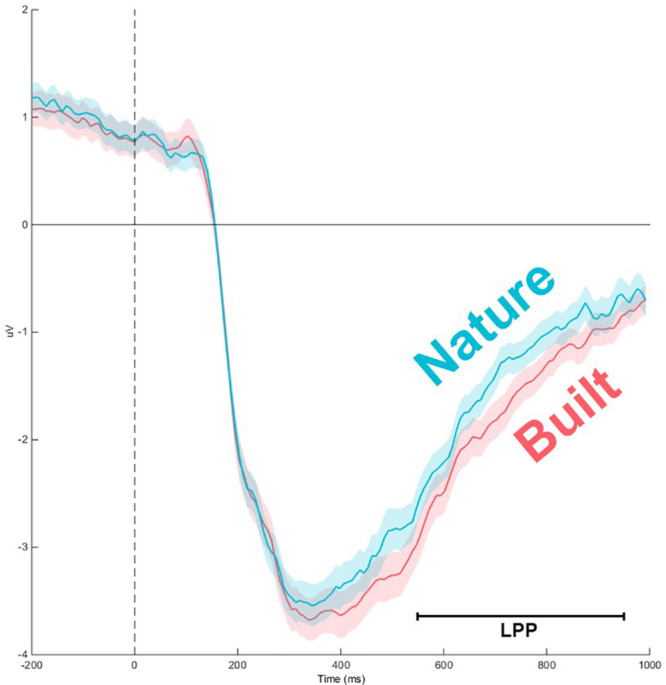
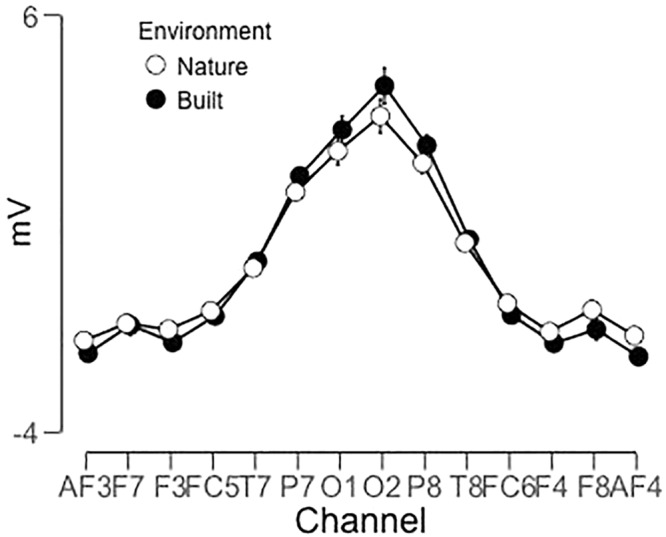
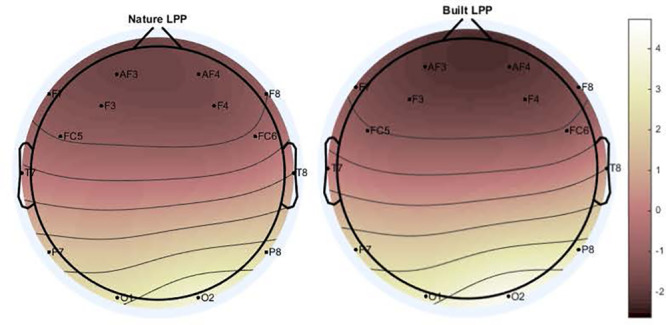
Environments are unique in terms of structural composition and evoked human experience. Previous studies suggest that natural compared to built environments may increase positive emotions. Humans in natural environments also demonstrate greater performance on attention-based tasks. Few studies have investigated cortical mechanisms underlying these phenomena or probed these differences from a neural perspective. Using a temporally sensitive electrophysiological approach, we employ an event-related, implicit passive viewing task to demonstrate that in humans, a greater late positive potential (LPP) occurs with exposure to built than natural environments, resulting in a faster return of activation to pre-stimulus baseline levels when viewing natural environments. Our research thus provides new evidence suggesting natural environments are perceived differently from built environments, converging with previous behavioral findings and theoretical assumptions from environmental psychology.
环境在结构组成和引发的人类体验方面是独特的。先前的研究表明,与人造环境相比,自然环境可能会增加积极情绪。处于自然环境中的人在基于注意力的任务上也表现出更好的成绩。很少有研究从神经角度探究这些现象背后的皮层机制或探讨这些差异。我们采用一种对时间敏感的电生理方法,运用与事件相关的隐式被动观看任务来证明,在人类中,与自然环境相比,接触人造环境时会出现更大的晚期正电位(LPP),这导致在观看自然环境时激活更快恢复到刺激前的基线水平。因此,我们的研究提供了新的证据,表明自然环境与人造环境的感知不同,这与先前环境心理学的行为研究结果和理论假设相一致。